





A new report from the Financial Stability Board (FSB) highlights several key factors hindering cross-border cooperation between countries on cryptocurrencies. The G20 risk watchdog has identified the difference in privacy rules as one of these major obstacles.
Privacy rules hinder cross-border crypto regulation
It’s been 16 years since the launch of Bitcoin (BTC), and financial watchdogs around the world continue to encounter problems when trying to access crypto data. According to a recent FSB report, privacy laws complicate efforts to access this data.
In a detailed 107-page peer-reviewed report, the G20 risk regulator highlighted that data privacy remains a crucial bottleneck hindering cross-border cooperation in the regulation of digital assets such as Bitcoin (BTC), Ethereum (ETH) and stablecoins.
It should be noted that the FSB is funded by the Bank for International Settlements (BIS) and functions as a global financial authority that monitors and reports recommendations on the evolution of the global financial system.
The FSB has discovered several major gaps in the way governments in different countries around the world regulate the digital asset market. The authority said these gaps lead to second-order challenges, including regulatory arbitrage, data gaps and market fragmentation. He added:
Comprehensive coverage of potentially riskier activities, such as borrowing, lending and margin trading, is often lacking. Furthermore, gaps or lack of comprehensive reporting frameworks for crypto-asset service providers (CASPs) hamper the authorities’ ability to effectively monitor and address potential risks to financial stability.
The FSB noted that crypto oversight and enforcement efforts tend to lag behind regulatory development, with many jurisdictions yet to implement the necessary tools to ensure compliance and oversight.
According to the FSB, the issue of data privacy remains a major concern in identifying potential systemic risks and, therefore, supervising cross-border crypto asset activities. Specifically, secrecy or data confidentiality laws are likely to pose significant obstacles to cooperation.
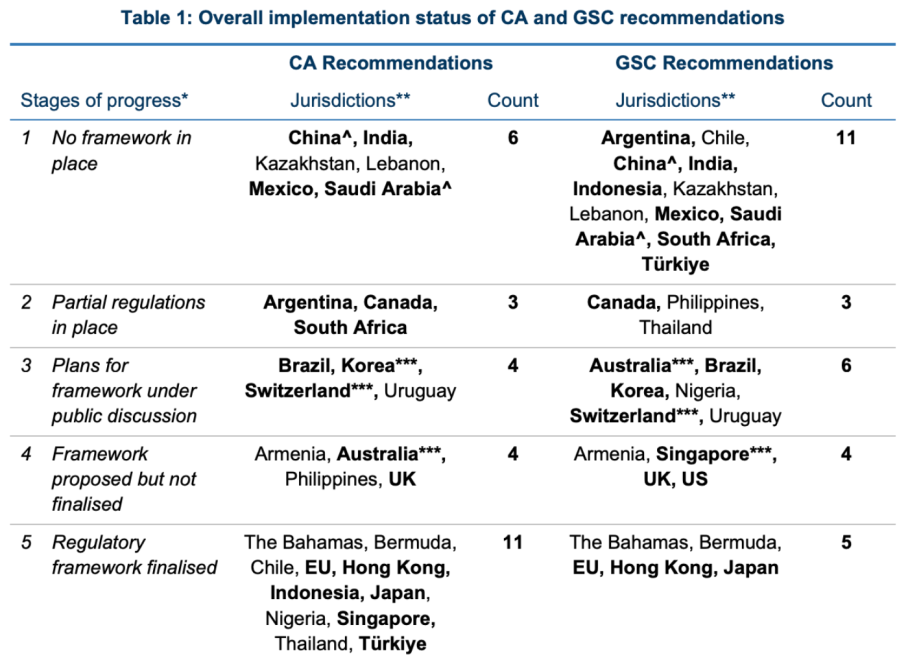
Furthermore, the FSB noted that a good portion of users are reluctant to share confidential information due to the risks of data breaches and the lack of guaranteed reciprocity. The report shares the following table highlighting the status of implementation of the FSB policy recommendations.
Little progress made by the G20
In 2023, the G20 – a group of countries comprising the world’s 20 largest economies – promised to establish a unified regulatory framework for cryptography. At the time, the body asked its member countries to share information to better regulate the emerging asset class.
However, little progress has been made since then. The challenges remain the same, if not more complicated, due to the rapid pace of progress in the crypto industry. A G20 member country, India, recently delayed release its crypto framework due to systemic risk concerns.
Meanwhile, the FSB recently declared that it will take measures to address the risks associated with the stablecoin. At press time, BTC is trading at $106,727, down 1.2% over the past 24 hours.

Featured image from Unsplash.com, charts from FSB and TradingView.com
Editorial process as Bitcoinist focuses on providing thoroughly researched, accurate and unbiased content. We follow strict sourcing standards and every page undergoes careful review by our team of top technology experts and seasoned editors. This process ensures the integrity, relevance and value of our content to our readers.


