



Most blockchain networks do not offer revenue opportunities for standard transport nodes, but Graphite Network’s recently launched proof-of-authority (PoA) Polymer 2.0 blockchain does. In a recently published press release, the company stated that in the Graphite ecosystem, even regular entry node operators can now earn rewards.
Since entry point nodes are simple to integrate, this innovation allows anyone, not just validators, to start generating revenue by supporting network operability. With Graphite, users hosting entry point nodes receive 50% of each transaction fee processed through their nodes, while the remaining 50% goes to an authorized node that validates the transaction.
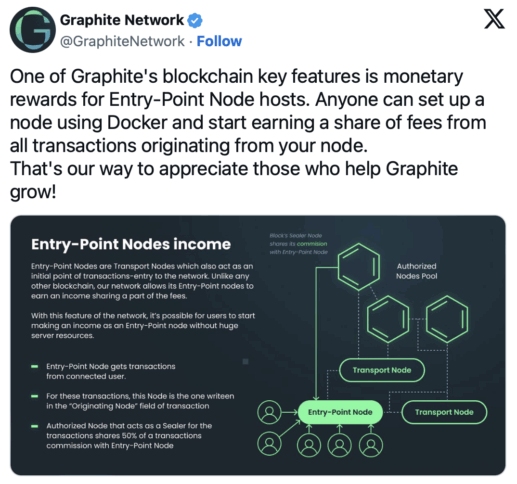
Unlike entry point nodes, authorized nodes must meet Graphite’s highest KYC standards and meet technical requirements. The Graphite Foundation also supports network stability through 15 foundation nodes, which are always active to ensure reliable network availability.
In addition to generating passive income for all types of node operators, Graphite stands out with a reputation-based approach to blockchain interactions, bringing best practices from traditional finance (TradFi) to Web3. In this way, Graphite aims to create trust without sacrificing privacy, making the user experience both transparent and secure.
Four Pillars of Graphite’s Reputation-Based System
Graphite Network’s reputation-centric features include account activation, multi-level KYC verification, KYC transaction filters to allow users to choose their counterparties, and a trust score that gives a quick read of the creditworthiness of the user.
Many blockchains currently allow users to create as many wallet addresses as they want, leading to an overload of inactive or single-use wallets, some created for illegal transactions.
a16zcrypto’s State of Crypto 2024 report reveals that 220 million unique addresses have interacted with blockchains at least once since the start of the year. However, a significant portion of these addresses have only been used once and cannot be classified as truly active. Additionally, while we await updated statistics from the 2024 Crypto Crime Report, 2023 data already indicates concerning trends, with $24.2 billion in cryptocurrency linked to illicit activities.

To address these issues, one potential solution is to require each new account to pay a small activation fee. Graphite implements this exact approach, around the “one user, one account” policy, which not only deters spam accounts, but also helps ensure that wallet addresses are more likely to be used legitimately.
Even though Graphite emphasizes reputation, it always respects user anonymity and never compromises data privacy. Building on this commitment, Graphite includes a tiered KYC process, each increasing the user’s credibility score, with social media verification available in the initial release.
Graphite ensures that all KYC procedures are completely off-chain and users’ personal data is never stored on the blockchain. On top of that, it applies a Zero Knowledge Proof (ZKP) method to verify the validity of data without revealing the data itself, thus keeping KYC checks entirely private.
Naturally, many users prefer not to interact with questionable parties, and to further strengthen user control and trust in every transaction, Graphite is introducing KYC-based filtering options for added security. Using these filters, Graphite users can define criteria that incoming transactions must meet.
For example, users can choose to only accept transactions from accounts with a specific KYC level or higher, or from accounts that have been activated. If an incoming transaction does not meet filtering requirements, it is automatically rejected at the network level, keeping suspicious or disreputable transactions at bay.
Added to this is Graphite’s Trust Score, which reflects a user’s overall credibility. It gives an indication of how safe it is to engage with a person, which is useful for things like loans, helping lenders assess risks and decide on terms.
Graphite’s solution to high fees and slow transaction confirmations
Millions of users are already tired of the inefficiencies that typically accompany blockchain transactions. For too long, they have had to deal with high transaction fees (sometimes up to 25% of the total transaction amount) and long wait times for confirmations, often over 10 minutes.
With transaction times under 10 seconds and a network capable of handling up to 1,400 transactions per second, Graphite ensures users can transfer smoothly even during peak periods. Additionally, the network’s pricing structure is simple, making costs much more predictable.
Helping developers build with EVM compatibility
Graphite also offers a solution for developers wanting to run smart contracts compatible with Ethereum. By integrating an industry-standard EVM, Graphite allows Web3 builders to run Solidity contracts on its network without any additional development required, saving time and money. Finally, with Graphite’s Proof of Authority (PoA) Polymer 2.0 consensus, smart contracts execute faster and more efficiently.


