




In a world where cryptocurrencies are attracting increasing attention, Hong Kong has become a key player in shaping global regulation of digital assets.
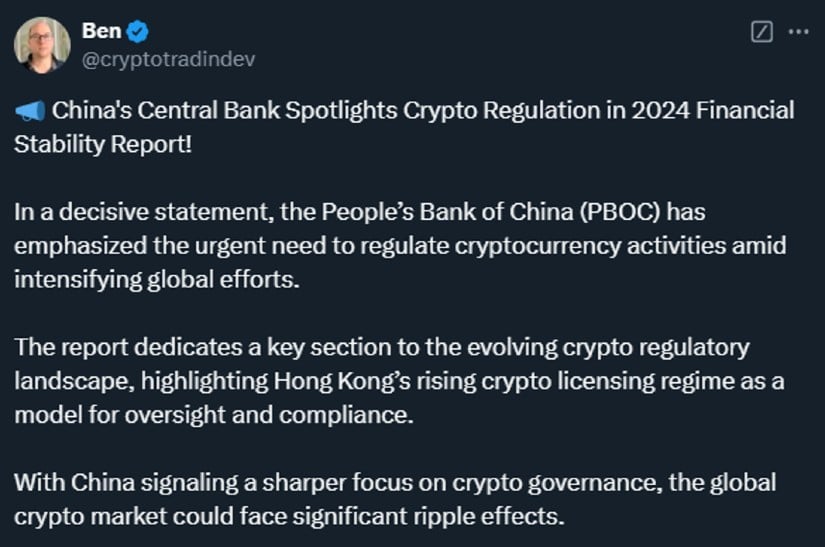
As highlighted in the People’s Bank of China’s (PBOC) Financial Stability Report 2024, Hong Kong’s proactive approach to crypto licensing stands in stark contrast to mainland China’s strict restrictions on digital currencies. This change is part of a broader global trend where governments are adapting their regulatory frameworks to adapt to the evolving crypto market.
Hong Kong’s dual licensing system
Hong Kong introduced the so-called “dual licensing” system, which provides a structured regulatory environment for digital assets. It separates cryptocurrencies into two classes: security tokens and non-security tokens. Security tokens fall under the SFC regulatory regime, while non-security tokens fall under the AML Ordinance. This helps mitigate the risks involved in crypto trading while providing clarity to exchanges and investors with a clear path to follow.
Source: X
In the report, the People’s Bank of China praised Hong Kong’s efforts to balance such a regulatory model with the aim of ensuring investor protection while encouraging innovation. This system requires financial institutions, including HSBC and Standard Chartered Bank, to treat crypto asset trading like any other business in their daily operations and ensure that these businesses are held to the same rigorous standards as traditional finance.
Global Crypto Trends and Regulatory Oversight
The report also addresses the growing global focus on cryptocurrency regulation, particularly in response to market volatility and concerns over investor protection. The PBOC highlighted that 51 countries have banned or heavily restricted crypto activities. In contrast, several key markets, including the United States, Japan, and the European Union, are moving in the opposite direction and moving toward more structured regulatory approaches that ensure the rights of crypto traders are protected.
Source: X
China has been rather cautious about cryptocurrencies, citing capital flight, market manipulation and lack of investor protection in unregulated markets. With this in mind, the PBOC realizes that cryptocurrencies can no longer be ignored in a global financial system and calls for international cooperation to establish uniform regulations.
Hong Kong’s role in positioning Asia as a crypto hub
Hong Kong’s crypto licenses are part of a larger plan to become a regional hub for digital assets. Such clarity and favorable conditions set by regulators make Hong Kong a modern destination of choice in the world for several crypto companies. Major exchanges like OKX and Bybit are reconsidering plans to stay away from the island due to regulatory uncertainty.
However, it is not all smooth sailing for the licensing process in Hong Kong. Although the city has granted licenses to seven platforms, delays and hurdles have affected the issuance of approvals, especially compared to neighboring Singapore, which has been more aggressive in issuing licenses to crypto companies . Some exchanges even withdrew their license applications without explanation, fueling speculation about mainland China’s influence on Hong Kong’s crypto policies.
The impact of China’s ban on crypto activities
While Hong Kong continues its pro-cryptocurrency policies, mainland China remains firm in its stance against cryptocurrencies. Since banning the trading and mining of digital currencies in 2021, China has continued to tightly control the nascent sector, including banning cryptocurrency trading outright. This has created a contradictory situation in which many mainland Chinese traders use VPNs to access exchanges from abroad to circumvent restrictions imposed by Beijing.
Despite these difficulties, Hong Kong occupies a privileged position as an administrative region that protects it through a distinct legal framework. Unlike the case in mainland China, the city’s willingness to experiment with cryptocurrency regulations also sets it apart and likely serves as an example to other jurisdictions in this region.
Looking Ahead: Hong Kong’s Crypto Asset Reporting Framework
In addition to its licensing efforts, Hong Kong is set to implement the Crypto Asset Reporting Framework (CARF) by 2026, which aims to improve tax transparency and combat cross-border tax evasion in the crypto space. The CARF introduced by the OECD will create an automatic exchange of information between jurisdictions, creating a more transparent global crypto market.
The move is seen as a further step towards the inclusion of cryptocurrencies in the global financial system, which would make it easier for tax authorities to supervise crypto transactions and ensure compliance with international tax standards.
Hong Kong’s unique regulatory approach to digital currencies sets the stage for broader adoption in Asia and beyond. Despite remaining challenges, such as delays in licensing or competitive pressure from other cryptocurrency-friendly hubs like Singapore, the clear regulatory framework and commitment to innovation make the city a leader in the global cryptocurrency landscape.


