



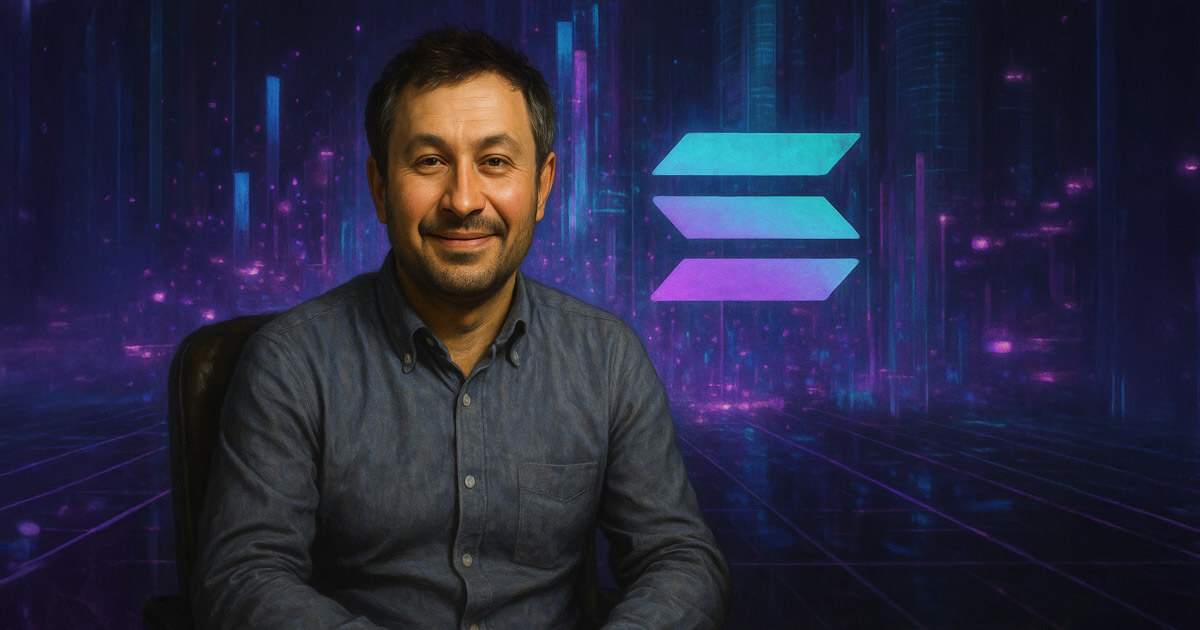
The co-founder of Solana, Anatoly Yakovenko, proposed to create a “meta-blockchain” designed to reduce data availability costs (DA) while increasing interoperability on several blockchain networks.
In a position on May 12 on X, Yakovenko explained that the proposed meta-blockchain would not serve as an autonomous but aggregator. It would collect and organize data from various channels as part of a unified transaction control system.
The key idea is to reference the latest block headers from each participating chain, allowing a shared and deterministic method to align transactions.
He said:
“There should be a meta-blockchain. Post data everywhere, Ethereum, Celestia, Solana, and use a specific rule to merge data from all chains into a single order.
Meta-blockchain
Yakovenko suggested that a meta-transaction on Solana could include recent blocks from Ethereum and Celestia. This approach would reduce the uncertainty of transaction sequencing and would allow users to benefit from the cheapest data availability solution.
The co-founder of Solana also stressed that a fixed rule for the merger of transactions would ensure consistency in the system. This model could reduce dependence on centralized sequencers, which are often considered as unique failures in many roller ecosystems.
In its opinion, an ideal system would use a protocol that automatically merges data from all connected channels without the need for an external coordinator.
He said:
“A lame version of it is based on an external sequencer. I think that the cooler version is only a melting rule that reads all the channels. Thus, users can send TX anywhere.”
Feasibility challenge
Although the concept has aroused interest, not everyone is convinced of its practicality.
Celestia Coo, Nick White, has rejected the idea, noting that similar proposals, called multiplexers DA, have long existed in theory but are rarely implemented.
According to White, these models increase operational complexity because the rollers must execute nodes for each DA layer. In addition, the management of the rules for choosing fork on several channels would considerably increase the general costs, offering limited advantages in return.
However, Yakovenko remains convinced that the availability of affordable and accessible data will reduce the cost of other chain activities. He said:
“Getting the availability of cheap data makes it possible to make everything else cheap. The bandwidth is the irreducible bottleneck. ”


