



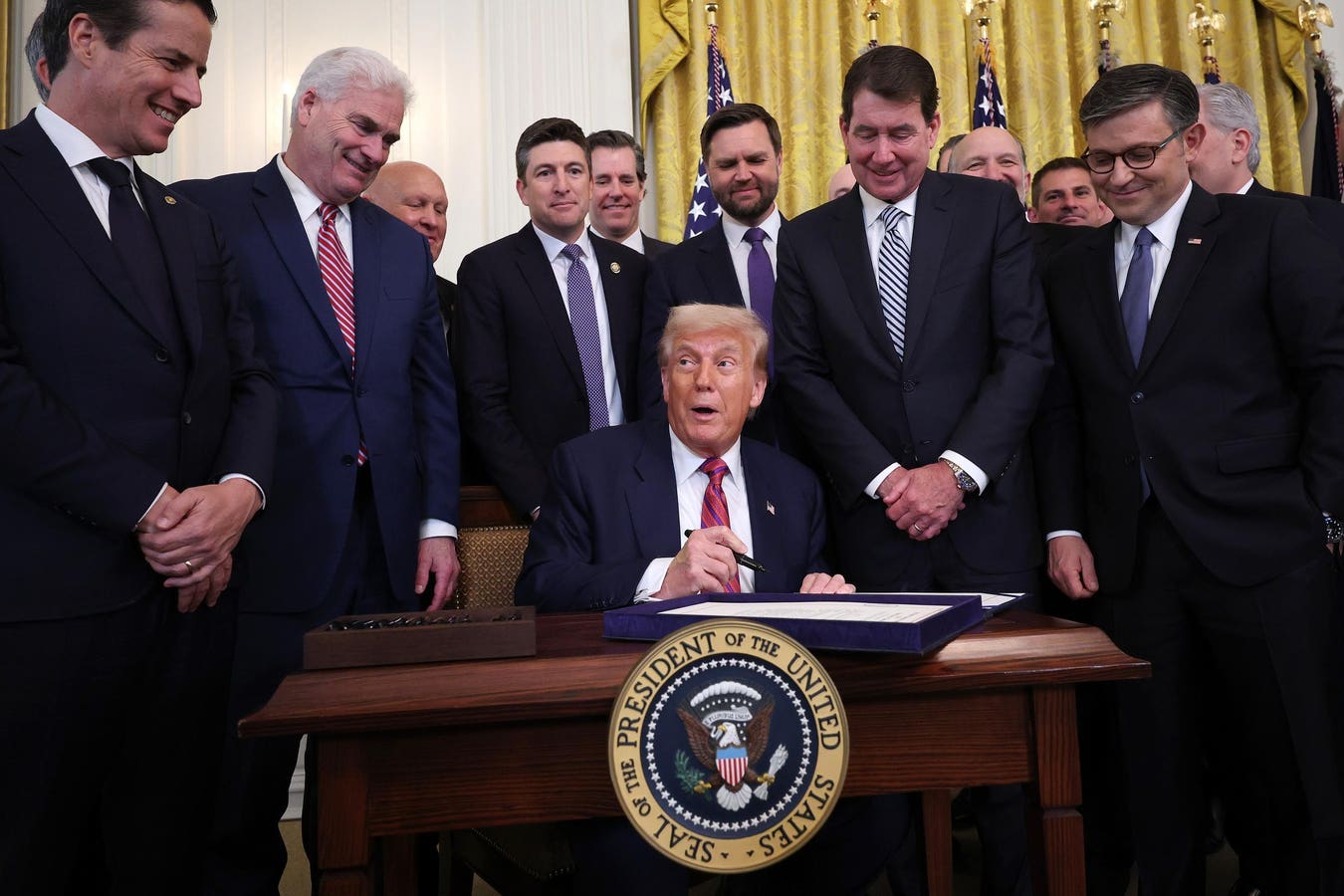
Washington, DC – July 18: US President Donald Trump, surrounded by legislators, signs the “genius … More
The cryptocurrency industry has won its most important victory to the congress to date, winning the passage of the Geniuswhich would regulate stablecoins, earlier this month. Now, legislators and lobbyists seek to capitalize on the momentum to adopt other bills. However, the objectives for doing so, with the most notable measure being a bill to formalize the rules of structure of the digital asset market, are likely to prove more difficult to send to the office of President Donald Trump. The support of the Senate Democrats for cryptocurrency means that there is a chance to do so, but the process is likely to take several months and could extend in 2026.
The legislation on stablescoin has always been perceived as the low fruit for the Congress on the crypto, making its adoption a key adhesive for the quantity of bipartisan support for the legislation on digital assets. The legislation on the structure of the market, on the other hand, is considered a much more complex company. This is partly due to the fact that some of the divisions between legislators concern the definitions of blocking proposals, such as tokens considered as basic products and which are titles. The answer to this question will determine whether the Securities and Exchange Commission or the Commodity Futures Trading Commission will be responsible for the supervision of a given token.
In addition to the debates on the text, there are possible political problems which could slow down the progress of the legislation on the structure of the market. One of these obstacles was exposed during the House crypto week in July, when conservative republicans organized a procedure to defend the anti-CBDC surveillance state ActA measure that divides legislators along the party party, to have a path to the law. THE concessionas indicated by Punchbowl Newswas that the Chamber included the proposal in its annual bill on defense policy. However, it could still be removed by the Senate and rekindle this debate when the future cryptographic legislation is envisaged. Another challenge will be Trump’s cryptographic companies, with some first Democratic supporters of stable legislation in the Senate, such as Senator Adam Schiff (D-Calif.), Expressing reserves on the market on the market structure in a recent audience Due to the president’s participation in the cryptocurrency sector.
However, there are reasons for optimism that the current congress will be able to adopt legislation on the structure of the cryptographic market, even if the process is longer than certain legislators. In particular, the version of the house, The act of clarityAttracted the support of nearly 80 democrats, a sign of bipartite interest in resolving the question. Additionally, some of the Newer Senate Democrats, Including Senators Angela Alsobrooks (D-MD.), Ruben Gallego (D-Ariz.), Andy Kim (Dn.j.), and Lisa Blunt Rochester (D-Del.), Appear to be potential supporters, with Some having supported Last year, financial innovation and technology for the law of the 21st century. These members are joined by Senator Kirsten Gillibrand (DN.Y.), who made democratic support in the upper room this year. At least seven Democrats will have to support the measure to adopt the Senate, this group of legislators likely to be among these republicans who seek to support.
The chamber having adopted its version of the legislation on the structure of the market, the fate of the bill is now in the hands of the Senate. However, the upper bedroom does not seem to be planning to simply take the version adopted by the Chamber, that senator Amy Klobuchar (d-minn.), The best democrat of the Senate Committee for Agriculture, Nutrition and Forestry, expressed its concerns in a recent audience. Instead, the main Republicans of the Senate released a discussionaccompanied by a Request for industry commentsEarlier this week. The text includes some differences in relation to the proposal of the house, such as the creation of a new category of digital tokens called “auxiliary active ingredients”.
The chairman of the Senate banks, housing and urban affairs committee, Tim Scott (Rs.C.) said He hopes to pass the measure in the upper room at the end of September. However, the decline in democrats could delay this process, even if the bill can be adopted by the committee before that. Scott had done pressure for an equally ambitious calendar for the Stable bill, aimed at adopting it in the first 100 days of Trump’s presidency, and probably will miss this goal again. A more realistic objective could be the adoption of market structure legislation in the Senate by the end of the year, but the realization of this will depend on the ability to collect the support of Democrats, because none currently sponsors the measure.
What will ultimately be sent to the Trump office is more likely to resemble everything that the Senate ends up going, which makes it a process that is worth being followed closely. When the legislators return in September after the recess of August, the action of the committee of the Senate of Banks, Housing and Urban Affairs and the Senate Committee for Agriculture, Nutrition and Forestry will offer a critical overview of the probability that democratic support is likely and what it can take to obtain the necessary votes for the structure of the market to reach the office of Trump.


