



Sun 07 Sept. 2025 ▪
5
Min read ▪ by
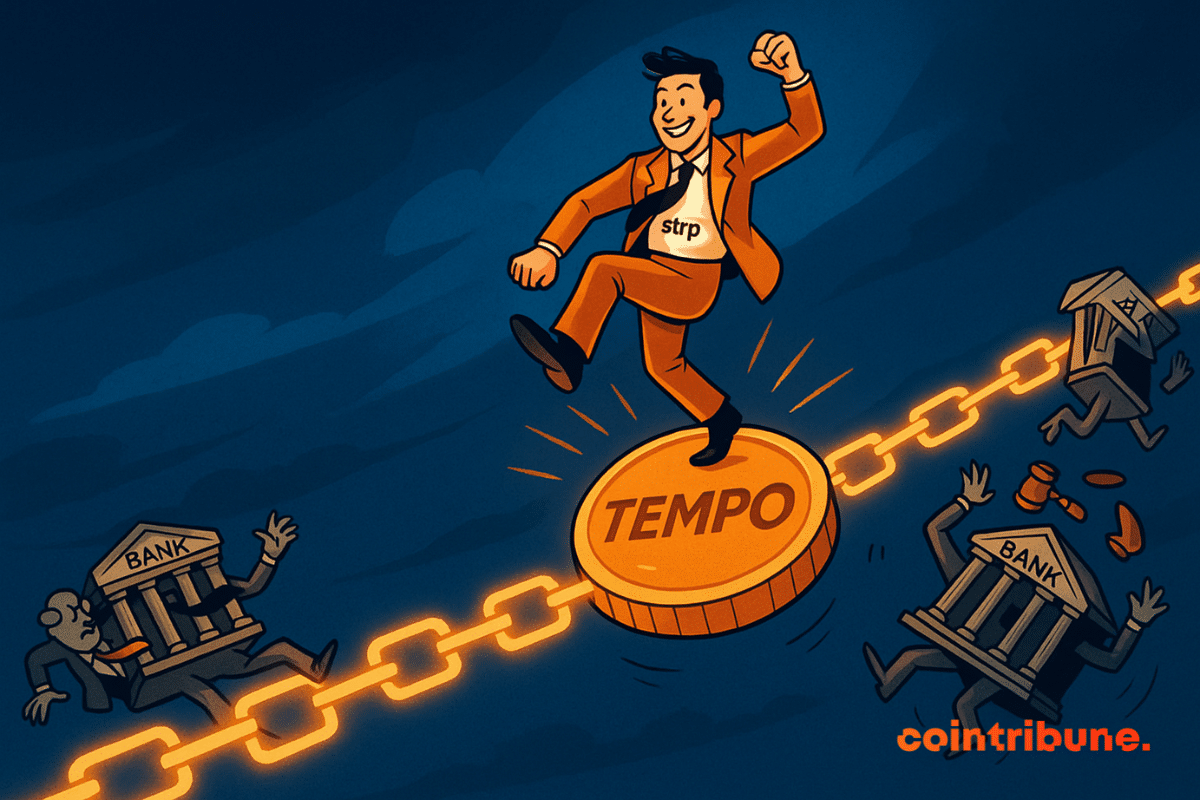
The cryptography industry is full of flamboyant players who monopolize attention. But some are built in the shadows of the spotlight, patiently, before bursting on the stage. Stripe belongs to this category. For a long time in the world of digital payments, the company is not unrelated to betting on disturbances. With Tempo, a blockchain designed for stablecoins, Stripe and its partner paradigm reshape the future of world transactions.
Brief
- Stripe launches tempo with paradigm, a blockchain designed to optimize stablecoin payments.
- Patrick Collison states that Stablecoins finally meet the real needs of global companies.
- The partners include Visa, Revolut, Deutsche Bank, Nubank, Shopify, Openai and Anthropic.
- The cryptographic community criticizes the tempo, arguing that an ethereum layer 2 would have served better.
From distrust to conversion: when Stripe embraces stablecoins
When Solana went after electronic commerce, Stripe joined the cryptographic adventure. A surprise considering that Patrick Collison had long expressed his skepticism. On Hacker News, the CEO of Stripe explained: ” There are many cryptographic skeptics on HN (and we have been disappointed with the usefulness of cryptographic payments for a large part of the last decade). It could therefore be interesting to share what has made us change our mind in recent years: we have started to notice that many real companies have found a utility in Stablecoins“.
This change is not theoretical. Stripe acquired a bridge in 2024, and since then, the main customers have launched projects. SpaceX uses it to manage flows in difficult to access areas. The Latin American Dolarapp Fintech counts on it to offer banking services. And an importer of Argentinian bicycle pays its suppliers via the Stripe dashboard.
Collison insists:
It is important to emphasize that none of these companies use the crypto because it is cryptographic or for no speculative advantage. They lead real financial affairs and have found that crypto (via Stablecoins) is simpler, faster and better than the status quo.
Tempo, the new swift on chain sought by Stripe
Stripe and paradigm do not want to participate: they want to build the infrastructure. Tempo is a blockchain designed to work behind the scenes, like Swift or Ach. Collison even described it as a ” Decentralized Swift on an internet scale“. The analogy is not perfect, but it illustrates the ambition.
The technical features are impressive: 100,000 transactions per second, the purpose in less than a second, the EVM compatibility via Reth. The costs are payable directly in the stablescoins, without a native token. Tempo also offers optional confidentiality, a “payment route” dedicated with memos and access lists.
Stripe has gathered a range of partners who give credibility to the project: Visa, Standard Chartred, Deutsche Bank, Nubank, Revolut, Shopify, Openai and Anthropic.
The vision is clear: allow payments, funds, token deposits and microtransactions to go to the head, without imposing the complexity of the blockchain on end users. For many, it is a serious attempt to transform stablecoins into global payment rails.
Was the crypto divided: was a new layer 1 really necessary?
The launch of tempo was not unanimous. Some praise him as an ambitious project, others denounce him as a blockchain too much. Joe Petrich, engineer in Courtyard, reacted frankly:
No one wants another blockchain. The problems you mention are already resolved for those determined to use blockchains, so there is no need for a new channel that claims to “solve” these problems.
Technical criticisms have also emerged. Helius Labs said that Collison was mistaken about Solana’s capacities, describing his analysis of “evil on several dimensions”.
Others, like Devansh Mehta from the Ethereum Foundation, wonder why Tempo was not built as a layer 2. According to him, an L2 would have made it possible to benefit from the safety and interoperability of Ethereum.
Key facts on the tempo
- Launched in September 2025 by Stripe and Paradigme;
- Debt announced: more than 100,000 transactions per second;
- Finality: in less than a second, no native token, costs in the stablescoins;
- Initial partners: Visa, Revolut, Deutsche Bank, Nubank, Shopify, Openai, Anthropic.
Stripe defends his choice: his volumes already exceed 10,000 transactions per second to a advanced activity. For Collison, no current blockchain is calibrated for this scale. The tempo would therefore be the tool necessary for the world of crypto payments to turn into a new dimension.
Last May, Patrick Collison said that banks were very interested in Stablecoins. Four months later, Stripe appears to be one of the most committed players in their adoption. With tempo, the company does not only follow the trend: it tries to shape it, by placing stablecoins at the heart of a future global payment system.
Maximize your Consribune experience with our “Read to garn” program! For each article you read, earn points and access exclusive rewards. Register now and start gaining advantages.

The Blockchain and Crypto revolution is underway! And the day when the impacts will be felt on the most vulnerable economy of this world, countertopury, I would say that I was there for YL
Non-liability clause
The points of view, the thoughts and opinions expressed in this article belong only to the author and must not be considered as investment advice. Do your own research before making investment decisions.


