





Ethereum”s current strength is largely linked to the performance and activity of its network, which is showing robust growth. While the leading blockchain has seen strong growth in several key areas, one area currently stands out: economic activity on the network.
A divergence between real activity and Ethereum price
With the broader cryptocurrency landscape evolving, market expert and trader Milk Road has revealed that the Ethereum network is showing signs of strength. Compared to his recent price performancethe leading network subtly conveys a different narrative.
Despite the fact that the market value of ETH has at times fluctuated or even lagged behind riskier assets, the amount of economic activity settled on the blockchain has continued to increase. The disparity highlights a crucial aspect of the current ETH cycle, namely that its fundamentals are strengthening beneath the surface, while market sentiment does not accurately reflect it.
At the same time, the Ethereum network is chosen for real deployment by increasing institutional capital. This grows a chain that becomes less of a speculative asset and more of a financial infrastructure.
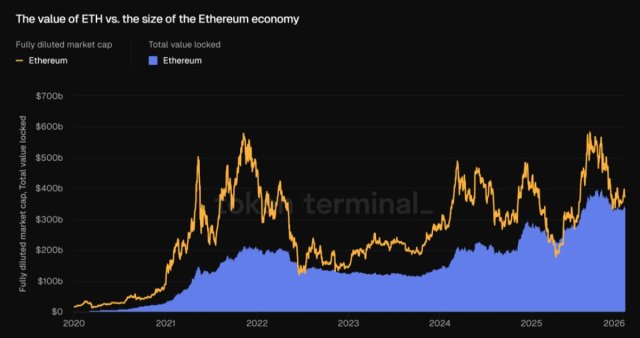
According to Milk Road, these participants are focusing more on availability, liquidity, settlement certainty and compliance, which is quickly narrowing the set of viable networks. Meanwhile, the economic weight placed on Ethereum’s base layer becomes significant as on-chain activity increases, thereby increasing transaction volume and fee revenue.
As seen in the past, ETH has struggled to remain stable for extended periods when demand is high. However, the analyst expects the price of ETH to increase as adoption increases.
Real assets invade the network
According to According to a report from Leon Waidmann, Head of Research at the On-Chain Foundation, tokenized real-world assets (RWA) are quickly emerging as one of Ethereum’s key growth engines. With the transfer of real-world assets to ETH, the development is bringing traditional financial activity on-chain at a rapid pace.
This change is more than just buzz, as institutional infrastructure, token issuance, and settlement volumes are all increasing at once, transforming the status of ETH. Data shows that the market capitalization of stablecoins found on the network is around $190 billion, indicating The growing choice of ETH as a major crypto-finance chain.
At the same time, the total amount of tokenized funds has reached between $6-7 billion and continues to grow rapidly. Its token proceeds have reached over $4 billion, which appears to continue to reach new highs. Additionally, tokenized shares of ETH are valued at $400-500 million, but that’s just the beginning. Such a scenario suggests that the tokenization of real-world assets could provide the foundation for the next phase of significant adoption of Ethereum.
Given the strong growth in these areas, Waidmann said that “ETH is become the default settlement layer for real assets.” Waidmann’s claims are not based on simple narratives, but on the fact that the network already operates on a large scale.
Featured image from Freepik, graphic from Tradingview.com
Editorial process as Bitcoinist focuses on providing thoroughly researched, accurate and unbiased content. We follow strict sourcing standards and every page undergoes careful review by our team of top technology experts and seasoned editors. This process ensures the integrity, relevance and value of our content to our readers.


