





Vietnam has launched a pilot licensing program for cryptocurrency exchanges, aiming to bring the fast-growing market into a formal legal framework after years of regulatory uncertainty.
Crypto licensing pilot begins in Vietnam
On Tuesday, Vietnam for the first time launched its pilot licensing regime to officially regulate crypto trading platforms in the country, with the aim of gradually moving the sector from the shadows to a framework properly supervised by local financial authorities.
According to local reports, the Ministry of Finance issued Decision No. 96/QD-BTC on January 20, introducing the necessary procedures for the implementation of Government Resolution No. 05/2025/NQ-CP.
The three new administrative procedures cover the issuance, modification and revocation of licenses for entities operating crypto asset trading platforms. The ministry announced that it has started accepting applications from companies looking to offer crypto asset trading services.
As a reminder, the country’s cryptocurrency market lacked a clear legal framework and existed in an unsupervised “gray zone”. Last year, the National Assembly adopted the “Digital Technology Industry Law”, which came into force on January 1, 2026, to create a basis for authorities to develop appropriate management policies.
In September, Vietnamese Deputy Prime Minister Ho Duc Phoc signed Government Resolution No. 05/2025/NQ-CP, authorizing a five-year pilot program for the issuance and trading of crypto assets.
As reported by Bitcoinist, under Resolution No. 05, organizations seeking to provide services for cryptocurrency trading markets must be registered with financial authorities and fully comply with a strict set of rules, including a minimum paid-in share capital of VND10 trillion, worth approximately $380.66 million.
Notably, at least 65% of the registered capital must be held by institutional investors, with more than 35% contributed by at least two institutions such as commercial banks, securities companies, fund management companies, insurance companies or technology companies.
The general manager must have at least two years of experience in finance, while the CTO must have at least five years of experience in information technology. Additionally, companies must hire at least 10 technology employees with cybersecurity certificates and at least 10 employees with securities practice certificates working in other departments.
Financial institutions are moving into digital assets
Following the publication of Resolution No. 05, major financial players, including securities companies and banking institutions, announced their intention to participate in the pilot project and enter the sector, the report noted.
In June, two SSI subsidiaries, SSI Digital Technology JSC and SSI Asset Management Company Limited, signed memoranda of understanding with Tether, U2U Network and Amazon Web Services to develop a digital financial ecosystem in Vietnam based on blockchain and cloud computing platforms.
Additionally, VIX Securities provided capital to create the VIX Crypto Asset Exchange and partnered with tech giant FPT Corp. to prepare its technological infrastructure.
Meanwhile, in the banking sector, MBBank entered into a technical cooperation agreement with Dunamu, the operator of Korean exchange Upbit, to establish a cryptocurrency exchange in Vietnam while jointly developing the legal framework and investor protection mechanisms.
Techcombank also established the Techcom Crypto Asset Exchange with a registered capital of several hundred billion VND. Similarly, VPBank said it is fully prepared to begin operations as soon as it receives regulatory approval.
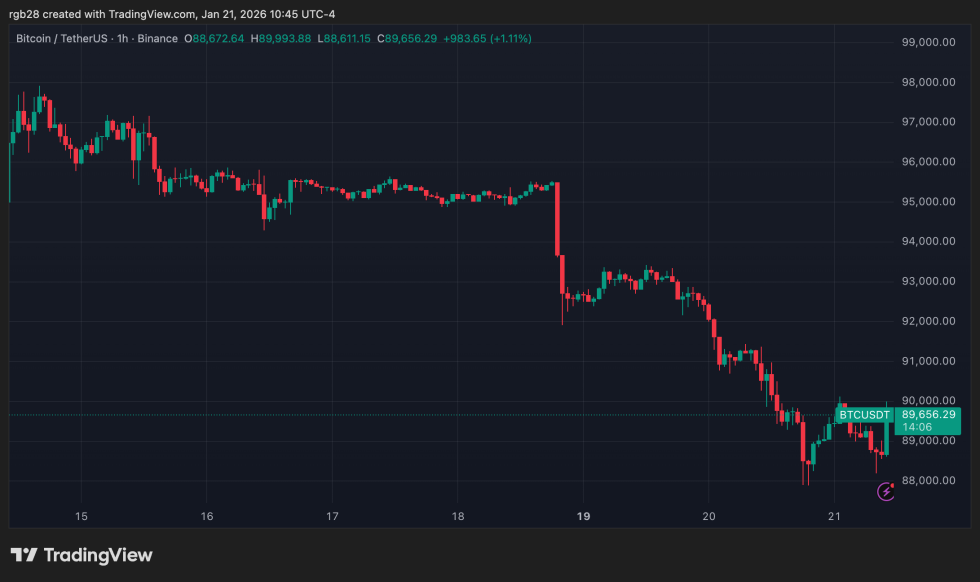
Bitcoin (BTC) trades at $89,656 in the one-week chart. Source: BTCCUSDT on TradingView
Featured image from Unsplash.com, chart from TradingView.com
Editorial process as Bitcoinist focuses on providing thoroughly researched, accurate and unbiased content. We follow strict sourcing standards and every page undergoes careful review by our team of top technology experts and seasoned editors. This process ensures the integrity, relevance and value of our content to our readers.


