





Ethereum Foundation protocol maintainers released a new “Protocol Priorities Update for 2026” on February 18, outlining how core R&D will be organized this year and what the next upgrade cycle should focus on.
Ethereum’s priorities in 2026
The update considers 2025 a high-speed year for core network changes, anchored by two network upgrades. Pectra shipped in May, Fusaka followed in December with PeerDAS on mainnet. Along with these upgrades, the community increased the mainnet gas limit from 30 million to 60 million, which is the first significant increase since 2021.
The main change is organizational. “Now that these steps are behind us, we have the opportunity to think about how we organize our work at a slightly higher level,” the authors write. For 2026, the protocol’s work is grouped into three streams: scale, improve UX, and strengthen L1, each with named tracks.
The Scale program, led by Ansgar Dietrichs, Marius van der Wijden and Raúl Kripalani, merges last year’s “Scale L1” and “Scale Blobs” initiatives into a single effort. The foundation views this as pragmatic consolidation, because execution capacity, networking, and consensus changes tend to land in the same client code and influence each other.
On the roadmap, the update highlights the continued increase in gas limits “towards and beyond 100 million”, supported by block-level access lists via EIP-7928 and ongoing customer benchmarking. It also reports “Glamsterdam scaling components”, including dedicated PBS via EIP-7732, repricing, and additional blob parameter increases.
Beyond that, the Scale track includes moving a zkEVM attestation client from prototype to production readiness, as well as longer-term state scaling work that extends from short-term repricing and history expiration to binary trees and statelessness.
The Improve UX track, led by Barnabé Monnot and Matt Garnett, focuses on two areas that the foundation sees as most effective for usability in 2026: native account abstraction and interoperability.
Regarding account abstraction, the update positions EIP-7702 as a step toward an endpoint where smart contract wallets become the default without bundles, relays, or additional gas fees. He points to proposals such as EIP-7701 and EIP-8141, described as “framework transactions,” as work that deepens the smart account logic within the protocol itself.
This UX roadmap is also linked to the security direction. The foundation says native account abstraction provides a cleaner migration path away from ECDSA-based authentication, and says parallel proposals aim to make quantum-resistant signature verification much cheaper within the EVM.
Interoperability work builds on the Open Intents framework with the stated goal of “seamless, trust-minimizing inter-L2 interactions,” supported by faster L1 confirmations and faster L2 settlement times.
The new Harden the L1 program, led by Fredrik Svantes, Parithosh Jayanthi, and Thomas Thiery, is designed as insurance policy work that preserves the fundamental properties of Ethereum while scaling continues.
The update ties security efforts into Svantes’ billion-dollar security initiative, including post-quantum readiness and execution layer protections such as post-execution transaction assertions and “trustless RPC.”
Regarding censorship resistance, Thiéry’s scope includes FOCIL through EIP-7805 and extensions that touch on censorship resistance for blobs, work on statelessness called VOPS, and the development of measurable measures of censorship resistance. Jayanthi’s mandate covers devnet, testnet, and client interoperability testing, which the foundation says becomes more critical if Ethereum moves to a faster fork cadence.
Looking ahead, the foundation is targeting Glamsterdam for the first half of 2026, with Hegotá planned for later in the year. The stated ambition brings together parallel execution, significantly higher gas limits, dedicated PBS, continued blob scaling, and advancements in censorship resistance, native account abstraction, and post-quantum security, with more track-level updates promised as the year progresses.
At press time, Ethereum was trading at $1,968.
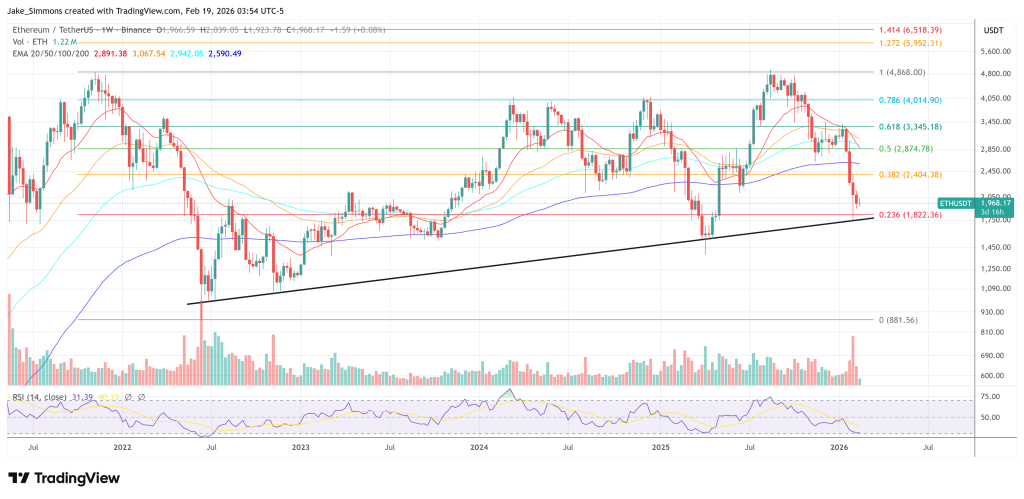
Featured image created with DALL.E, chart from TradingView.com
Editorial process as Bitcoinist focuses on providing thoroughly researched, accurate and unbiased content. We follow strict sourcing standards and every page undergoes careful review by our team of top technology experts and seasoned editors. This process ensures the integrity, relevance and value of our content to our readers.


