



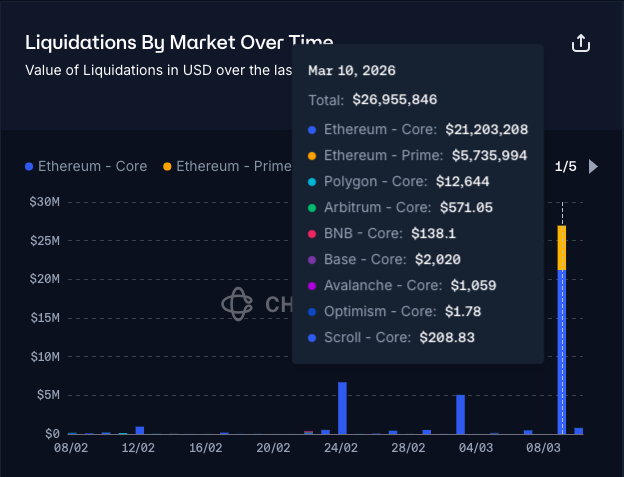
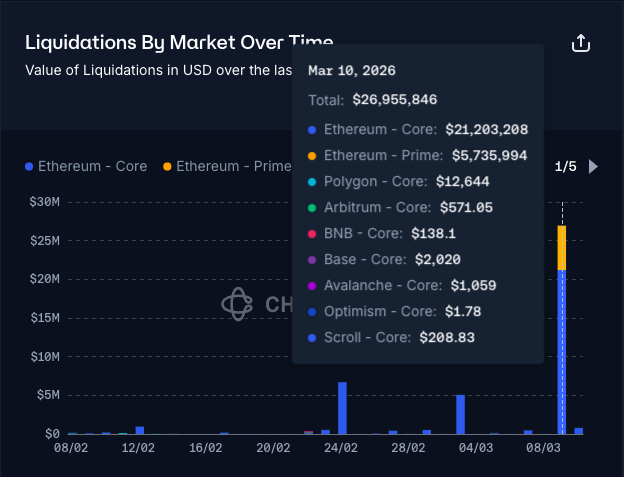
A misconfigured Oracle system at Aave triggered $27 million in forced liquidations on March 10, undervaluing staked Ether by 2.85% compared to its actual market rate.
According to Chaos Labs’ post-mortem, the CAPO oracle error caused the Aave V3 Ethereum Core and Prime instances to apply an exchange rate of approximately 1.1939 wstETH-per-ETH when the live on-chain rate was approximately 1.228, a gap sufficient to automatically push 34 highly leveraged E-Mode positions below their liquidation thresholds.
This resulted in the liquidation of 10,938 wstETH. The protocol states that it has not incurred any bad debt and is preparing to compensate all affected users.
The damage: 34 users, $27 million in liquidations and 499 ETH in bot profits
The Oracle issue liquidated 34 users, with the total volume reaching $27 million in wstETH positions.
Liquidation bots responded quickly, capturing 499 ETH in bonuses, or approximately $1.2 million, by executing positions that should not have been eligible for liquidation at that time.
Aave founder and CEO Stani Kulechov confirmed in a post on Wednesday that the protocol did not generate any bad debt as a result of the incident.
Of the 499 ETH awarded to liquidators, Aave recovered 141 ETH ($285,000) through BuilderNet refunds and an additional 13 ETH in liquidation fees.
These recovered funds will be paid directly to affected users as compensation, with the DAO treasury funds covering any remaining shortfall up to the full 345 ETH identified as the excess liquidation windfall.
Lido contributors confirmed that the event had no connection to wstETH or the Lido staking protocol itself; The problem was entirely with Aave’s Oracle configuration layer.
While Ethereum price defended the $2,000 support zone at the time of the incident, liquidation values were amplified by the broader market backdrop for ETH-denominated collateral.
Discover: The best crypto sales before launch
Chaos Labs Confirms Aave CAPO Oracle Misconfiguration: Here’s What They Found
Chaos Labs, Aave’s external risk management partner, confirmed that the incident stemmed from what it described as a misalignment of on-chain configuration under different on-chain update constraints, and not a design flaw in the CAPO system or Aave’s core Oracle infrastructure.
The team highlighted that Chaos Risk Oracles processed over 1,200 payloads and over 3,000 parameters in Aave Markets without incident before March 10.
Chaos Labs quickly brought the situation under control: borrowing caps on wstETH were immediately reduced and snapshot settings were manually realigned to restore Oracle accuracy. Kulechov noted in his public statement that the configuration issue had already been resolved at the time of the post-mortem release, and praised the team’s speed of response to limit broader DeFi risk contagion.
The Aave governance post-mortem marks this as the first operational failure in the history of CAPO deployment on Aave V3, despite over a year of live operation in multiple markets.
What Aave Traders and Users Watch Next
The immediate focus is on the full repayment schedule. Aave DAO service providers are finalizing compensation for the 34 affected users following the initial refund of 141 ETH via BuilderNet, with a formal governance announcement expected shortly.
Beyond compensation, governance teams are conducting a broader review of CAPO metrics across Aave’s markets, updating outdated snapshots and implementing enhanced monitoring to flag rate discrepancies before they reach the liquidation threshold.
Whether this review produces binding standards for updating metrics or remains advisory is the governance issue to watch.
If the DAO formalizes automated CAPO sync requirements and publishes updated risk oracle documentation, the incident could ultimately strengthen Aave’s operational credibility. If the review fails at the discussion stage, the reputational cost will compound the financial cost.
Discover: The best new cryptocurrencies
The post Aave Oracle Glitch Causes $27M Liquidations: CAPO Misconfiguration Confirmed appeared first on Cryptonews.


