





Ethereum co-founder Vitalik Buterin says the network’s clearest value proposition may not be smart contracts or payments, but something more fundamental: acting as a censorship-resistant public data layer. In a post reflecting on Real World Crypto conversations and related events, Buterin argued that moving outside of the “blockchain baggage” makes the core utility of ETH easier to see.
“I was recently at Real World Crypto (that’s crypto as in cryptography) and related side events, and one thing that struck me was that it was a clarifying experience in terms of understanding what blockchains are for,” Buterin wrote. “We blockchain people (myself included) often tend to start from the perspective that we are Ethereum, and so we have to go around and find use cases for Ethereum.”
Ethereum’s Fundamental Value Starts with a “Public Bulletin Board”
His goal was less to defend Ethereum as a brand and more to reevaluate it as an infrastructure. “For a moment, let’s forget that we are ‘the Ethereum community’. Rather, we are the maintainers of the Ethereum tool,” he wrote, asking where the network adds value when viewed with “zero attachment to Ethereum in particular.”
The first answer, he says, is “not what you think.” These are “not smart contracts, or even payments,” but what cryptographers call a “public bulletin board,” a publicly readable and writable place to post blobs of data. This is important because a range of cryptographic systems, including secure online voting, software and website version control, and certificate revocation, depend on precisely this type of shared infrastructure.
“This does not require any computational functionality,” Buterin wrote. “Actually, it doesn’t directly require money, although it does require money indirectly, because if you want permissionless anti-spam, it has to be economical. The only thing it basically needs is data availability.”
This framing leads directly to Ethereum’s recent scaling work. Buterin highlighted PeerDAS, which he said has increased Ethereum’s data availability capacity by 2.3 times, with a roadmap to push it another 10 to 100 times higher. This, he says, makes Ethereum increasingly relevant not only to on-chain finance, but also to a broader class of open, privacy-preserving internet infrastructure.
Payouts still count, but as a secondary level in the stack. Buterin argued that many systems need value transfer not primarily for commerce, but for anti-spam, sybil resistance, and machine-to-machine coordination. He highlighted Ethereum plus ZK payment channels as a solid design for permissionless APIs, and said ETH can serve as a “natural safety net” for applications that want to resist abuse from fake accounts without relying on phone numbers or other centralized identity rails.
Smart contracts come next. Here, Buterin described them as useful for security deposits, for implementing structures such as ZK payment channels, and for managing pointers to “digital objects” linked to socially recognized external entities. Technically, he said, most non-ETH use cases could be addressed by treating the chain like a bulletin board and using ZK-SNARK for off-chain computing. In practice, however, it is difficult to standardize this model and shared execution remains the most interoperable route.
The broader claim is that Ethereum works best when understood as a “global shared memory” within a decentralized software stack. Buterin suggested that adoption may still lag behind reality because many builders are operating with outdated assumptions from 2020 to 2022, when fees were much higher and scaling seemed less mature. Today, he argued, fees are “extremely low,” the roadmap is stronger, and the tools to protect users from fee volatility have improved.
At press time, ETH was trading at 2,110.
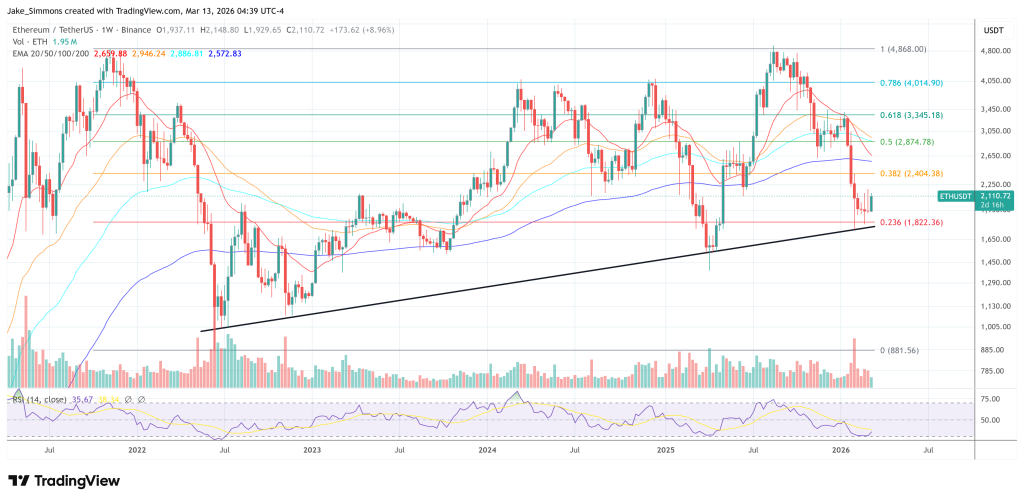
Featured image created with DALL.E, chart from TradingView.com
Editorial process as Bitcoinist focuses on providing thoroughly researched, accurate and unbiased content. We follow strict sourcing standards and every page undergoes careful review by our team of top technology experts and seasoned editors. This process ensures the integrity, relevance and value of our content to our readers.


