




The long-awaited Aster Chain launch finally arrived yesterday, but for ASTER crypto holders, the ongoing retracement this morning is far from happy, as ASTER price is currently trading at $0.71, trapped in a corrective move following a brief spike in speculative momentum following the mainnet launch. As the broader market stabilizes, the asset faces a binary risk environment, and analysts wonder whether the rollout of privacy-centric features will catalyze a breakout toward $3.4, or whether the “sell the news” phenomenon will dominate price action amid the ongoing retracement.
Crypto Mainnet Launch events are historically volatile, and ASTER approaches this milestone with high expectations focused on its transition from a decentralized exchange (DEX) foundation to a full layer 1 blockchain. Traders are closely monitoring validation of specific roadmap deliverables, particularly formalized mandates for privacy and scalability. As the critical resistance level of $0.81 holds and rejects initial enthusiasm, the market decides whether the network’s technical promises can withstand a valuation shift.
ASTER Price Analysis: Resistance Levels and Momentum Setup
Technically, ASTER is oscillating within a narrow channel, bounded by immediate support at $0.70 and overhead resistance at $0.81. Price action has formed a base over the past four weeks, characteristic of an accumulation phase often seen before major protocol upgrades.
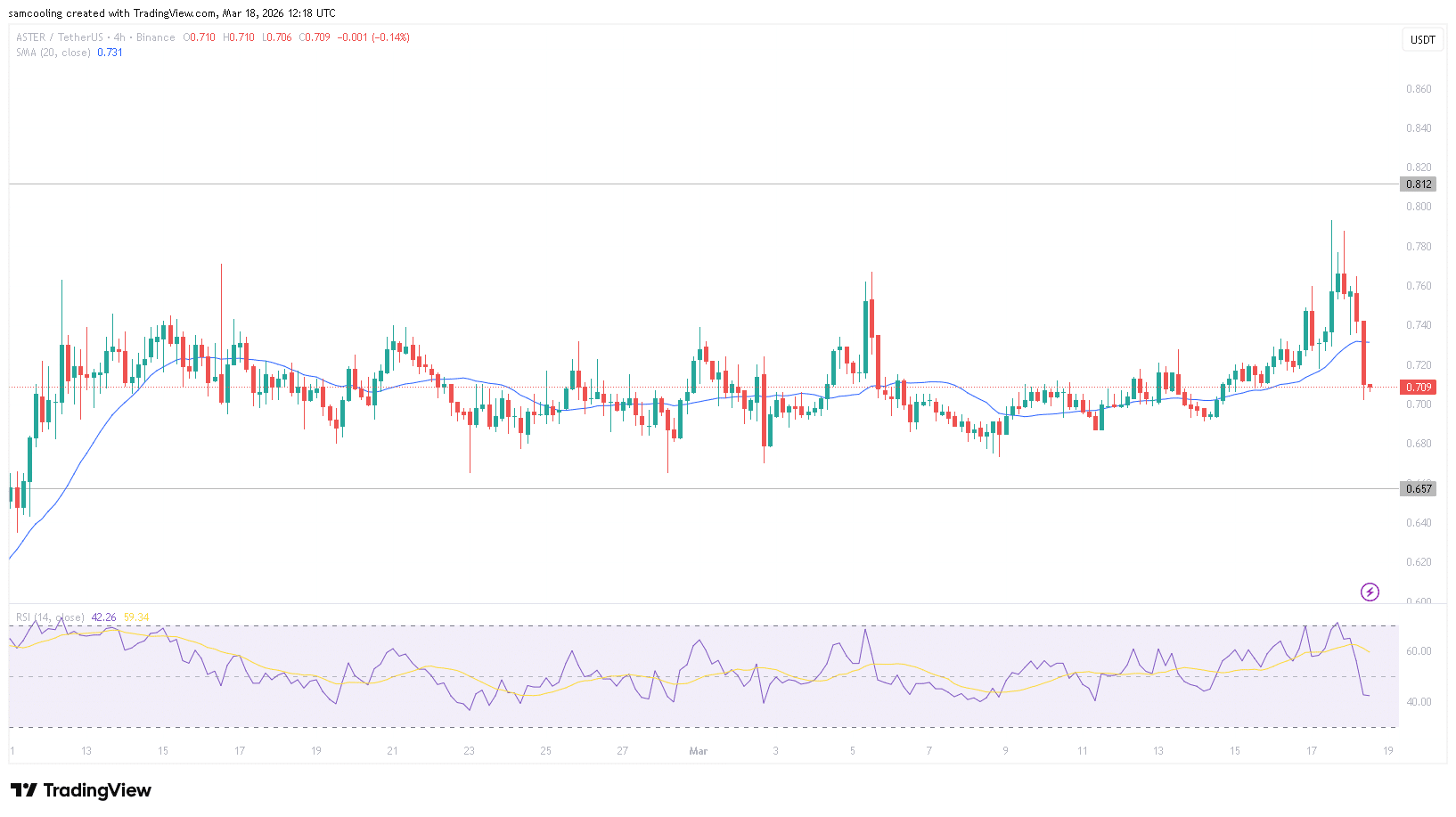
(Source – ASTERUSDT, TradingView)
Momentum indicators present a mixed but slightly bullish orientation. The Relative Strength Index (RSI) on the daily chart is currently at 39.4, placing the asset in neutral-bullish territory with enough room to move before entering overbought territory.
The chart structure indicates that a decisive break above $0.81 is required to confirm a trend reversal. Until this level is reclaimed with significant volume, ASTER remains in a consolidation pattern, susceptible to broader market volatility.
DISCOVER: Hyperliquide opens a policy advocacy center in the United States
Stealth Addresses and DeFi Zero-Gas: What the Mainnet Upgrade Offers
The core investment thesis of the ASTER rally relies on two specific features: stealth addresses and gasless DeFi. Unlike standard Layer 1 upgrades that focus primarily on throughput, this transition prioritizes privacy and reducing friction. Stealth addresses allow users to generate unique, unique public keys for each transaction, effectively decoupling the recipient’s identity from their on-chain history. This feature responds to a growing demand for on-chain privacy following recent security concerns in the broader technology sector, where vulnerabilities often expose user data.
To explain why privacy features are becoming mainstream talk, recent industry reports have highlighted how easily standard protections can be circumvented. For example, Google recently warned of exploits targeting mobile interfaces, highlighting the urgent market need for protocol-level privacy solutions like those offered by Astar. If implemented successfully, these features could position the network as a preferred location for high-value participants requiring anonymity.
Simultaneously, the introduction of Zero-gas DeFi aims to remove the unpredictability of transaction costs. By subsidizing specific types of interaction, the network intends to onboard users who are typically excluded from high-frequency trading strategies on other chains. Analysts suggest that if these barriers are effectively lowered, the velocity of capital within the ecosystem could increase significantly post-launch.
Network Metrics: Is Ecosystem Activity Supporting a Rally?
On-chain data from the testnet phase offers a conflicting signal regarding readiness. Bullish metrics show the public testnet attracted more than 50,000 participants in early February, generating more than $8 million in weekly platform fees. This revenue generation is crucial, as the protocol’s roadmap includes a mechanism to channel 80% of these daily fees into on-chain ASTER redemptions, theoretically creating constant pressure on demand.
However, distinct caveats remain in the data. Despite the high number of participants, the monthly number of active addresses (MAAs) maintaining activity stood at just 340 at the end of February. This gap suggests that while many users have claimed airdrop eligibility or tested features, lasting engagement has not yet solidified.
Additionally, developer activity, a major indicator of the future value of the ecosystem, needs to intensify. The success of the transition to Aster Network depends not only on users, but also on manufacturers who deploy applications that exploit the new privacy architecture. Without an increase in unique dApp deployments in Q2, the fee reduction mechanism may not have the volume required to impact the token’s price.
DISCOVER: The Ethereum Foundation partners with Seal to fight against wallet drainers
Can ASTER break $3.4? Two Scenarios Traders Are Watching
As the mainnet launch approaches, market participants are modeling two distinct outcomes for the ASTER Price Prediction.
The bullish scenario: If ASTER manages to close above the $0.81 resistance level on high volume, it confirms a breakout of the multi-week accumulation zone. In this scenario, improving liquidity and activating the fee buyback mechanism could promote price discovery. Analysts identify $3.4 as the main medium-term target, derived from Fibonacci extension levels and the anticipated market capitalization needed to support the platform’s projected revenues. A roadmap including “Shield Mode” for private commerce further strengthens this case, assuming mainnet deployment proceeds without technical issues.
The bearish scenario: Conversely, failing to exceed $0.81 suggests that the mainnet launch is a “news sell” event. If the price falls below the critical support at $0.70, the bullish structure is invalidated. In this case, traders could expect a retest of lower liquidity zones around $0.65. The lack of immediate adoption of zero-gas features could exacerbate this sell-off, as hot money shifts to more established assets. Watch for downward spikes in volume as a confirmation signal.
following
Disclaimer: Coinspeaker is committed to providing unbiased and transparent reporting. This article is intended to provide accurate and current information, but should not be considered financial or investment advice. Because market conditions can change quickly, we encourage you to verify the information for yourself and consult a professional before making any decisions based on this content.

Daniel Frances is a technical writer and Web3 educator specializing in macroeconomics and DeFi mechanics. Hailing from crypto since 2017, Daniel leverages his experience in on-chain analytics to write evidence-based reports and in-depth guides. He holds certifications from the Blockchain Council and is dedicated to providing “insight gain” that overcomes market hype to find real utility for blockchain.


