



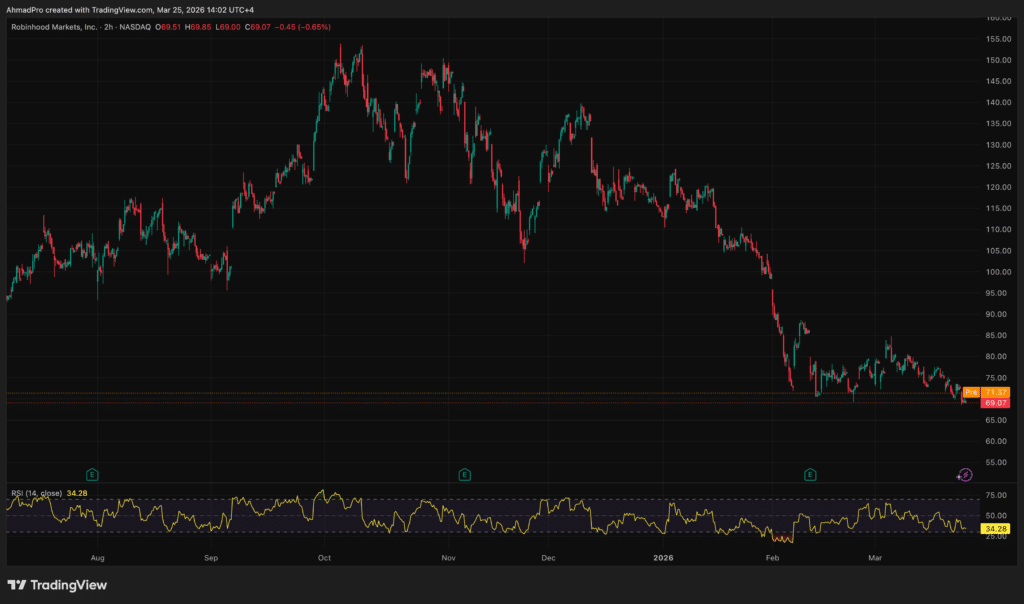
Robinhood is betting $1.5 billion on itself. The popular trading platform announced a massive share buyback program on Tuesday, allowing the company to repurchase its own shares over the next three years. The move comes at a time of stark contrast: while management signals confidence, the stock itself (HOOD) is trading near its 2026 lows.
It’s a bold defensive move. Robinhood shares are down about 39% so far this year and sit about 54% below their October all-time high of $152.46.
As broader geopolitical headwinds hit the tech and crypto sectors, Robinhood is using its cash reserve to inform the market that its shares are currently on sale.
(Source: TradingView)
Market reaction was initially lukewarm. Shares ended Tuesday down 4.7% at around $69.08, although they recovered slightly after hours. The question for investors is simple. Is this a judicious use of capital that will reward shareholders, or a way to support a stock price that is struggling to find a bottom?
The contradiction: trust versus market reality
Robinhood spends $1.5 billion to buy its own shares.
The program combines $1.1 billion in new capacity with funds carried over from a previous authorization. The mechanics are simple. Fewer shares outstanding means earnings per share increase even if earnings remain flat. Financial engineering that makes the numbers look better without the company actually growing.
The $3.25 billion revolving credit facility provided to JPMorgan Chase is the backstop behind the move. A business credit card ensures that cash flow remains intact while billions flow out. The balance sheet is healthy enough to do both.
Chief Financial Officer Shiv Verma called Robinhood a generational company and presented the buyout as an opportunity to capture long-term value at a price that doesn’t reflect the company’s true potential. The stock is trading around $69. Management thinks it’s cheap.
$ HOOD Robinhood just released two major updates that show serious confidence:
• Authorized a new $1.5 billion action
buyback program
• Increased their revolving credit facility
at $3.25 billion (with capacity of up to
$4.875 billion) $ HOOD actively fight against dilution during loading… pic.twitter.com/u3ZJhAuNq5– Karol Kozicki (@k2__investment) March 24, 2026
The bear’s case is harder to ignore. Companies buy back shares when they believe they are undervalued. They also buy back stock when they run out of better ideas. Investing $1.5 billion in financial engineering rather than product development, marketing or acquisitions carries a real opportunity cost in a market where competitors are constantly evolving and institutional products are reshaping the landscape.
The broader context makes this decision stand out. The Algorand Foundation just downsized to preserve the track during the same recession. Robinhood projects strength while the rest of the sector demands caution.
This is either a sign of sincere belief or a very expensive way to cover up a lack of growth strategy. The next quarters will answer this.
DISCOVER: The best Meme Coin ICOs to invest in 2026
The post Robinhood Announces $1.5 Billion Stock Buyback Amid 2026 Stock Struggles appeared first on 99Bitcoins.


