





Ethereum is trying to hold $2,000. The market is preparing for a significant evolution. And the organization that has been selling this asset for months has just changed what it does with its ETH.
Data from Arkham Intelligence confirmed a change in behavior within the Ethereum Foundation that the market was waiting for without knowing it was waiting for it: the Foundation stopped selling ETH and started staking it. This sentence requires context to take its full weight.
For much of the past few months, the Ethereum Foundation’s periodic ETH sales have represented one of the most psychologically damaging overhangs in the market. Every confirmed sales transaction from Foundation wallets arrived as a signal from within: the organization that created Ethereum, which understands its technology more deeply than any outside participant, choosing to convert its holdings to cash. The market interpreted these sales as institutional doubt expressed in the most credible way possible. The price suffered as a result.
This chapter seems to be closing. Staking is the opposite of selling in every sense of the word. It’s about locking, committing, withdrawing from circulation, and earning yield based on the belief that the future of Ethereum warrants this commitment. The Foundation no longer exists. It embeds itself deeper.
It’s no longer a one-off decision
Arkham’s on-chain data documents the specific transaction that brings the behavioral change to fruition: The Ethereum Foundation staked an additional $46.64 million in ETH, bringing its total position to $96.59 million. This cumulative figure is the number that matters most – not because of its size relative to the Foundation’s total treasury, but because of what it represents as a repeated, deliberate and growing commitment.

A single staking transaction can be considered cash flow optimization. Two deals totaling almost $100 million can’t. The Foundation has now made the same decision twice, in the same direction, at a price level that the broader market saw as fragile support. Every transaction is a vote. The second vote confirms that the first was not an anomaly.
The supply consequence is direct and permanent for the entire duration of the bet. $96.59 million worth of ETH is now in staking contracts – unavailable for sale, removed from the liquid float, contributing nothing to the selling pressure that has been weighing on the $2,000 level for weeks. Past Foundation sales have added to this pressure. His current betting position is actively reducing it.
The organization that built Ethereum has now committed nearly $100 million to its own protocol at the exact moment the market is deciding whether $2,000 will be retained. This timing is not accidental. It’s a statement.
Related Reading: $410 Million in Bitcoin Losses Realized in One Week. Two Key Indicators Indicate Stress Is Not Over Yet
Ethereum’s weekly structure shows a market at an inflection point, not in a confirmed breakdown. The price currently sits near $2,060, just above the 200-week moving average – a level that has historically acted as a long-term trend boundary. This positioning is important. Unlike shorter time frames, this is where the bullish and bearish structural regimes are defined.
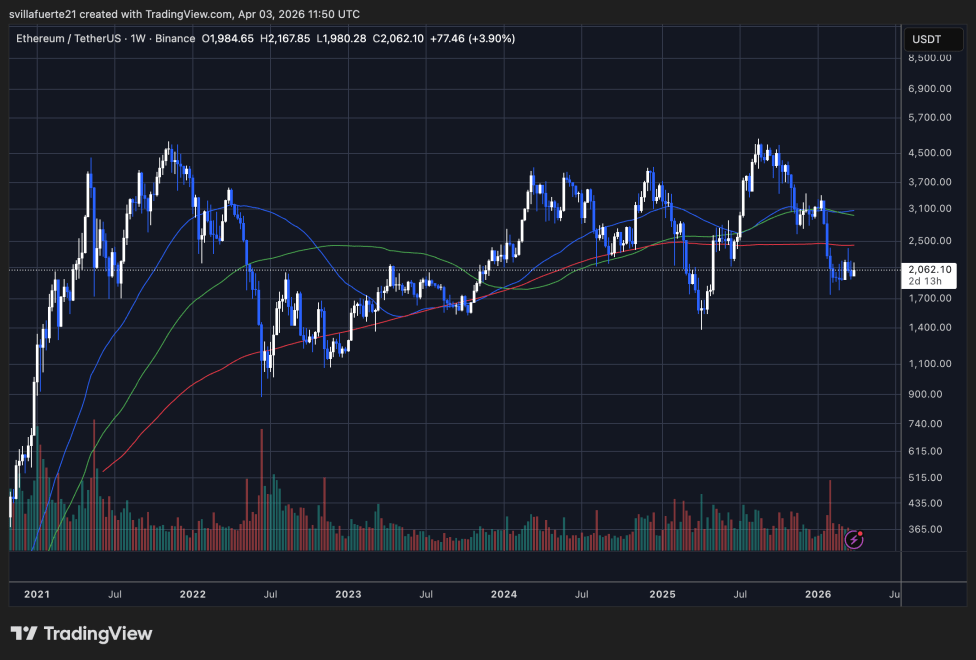
The rejection from the $4,000-$4,500 region established a clear lower high, breaking the streak of higher highs that defined the previous expansion phase. Since then, Ethereum has retraced sharply, losing the 50- and 100-week moving averages, which are now flattening and starting to reverse. This change signals weakening momentum, but not yet a complete trend reversal.
The key issue is follow-up. The recent rebound from levels below $2,000 was not strong enough to decisively recover the 100-week average. Without this, the price remains vulnerable to another test of the 200-week level.
Volume is not showing aggressive accumulation at current levels. This absence raises a question: is this a structural defense or a temporary pause?
If $2,000 fails on a weekly basis, the next significant support lies significantly lower. If this holds, Ethereum remains in a contested but still recoverable long-term structure.
Featured image from ChatGPT, chart from TradingView.com
Editorial process as Bitcoinist focuses on providing thoroughly researched, accurate and unbiased content. We follow strict sourcing standards and every page undergoes careful review by our team of top technology experts and seasoned editors. This process ensures the integrity, relevance and value of our content to our readers.


