



Aave crypto TVL, worth $50 billion, now operates without a dedicated risk manager – a direct result of Chaos Labs’ exit, which removes the company’s protocol responsible for pricing every loan on the platform since 2022 and managing liquidation thresholds, collateral factors and interest rate settings across all V2 and V3 markets.
This departure follows previous releases from BGD Labs and the Aave Chan Initiative, leaving Aave with no remaining technical contributors from its V3 build team at precisely the time when V4 requires dual-stack oversight.
The mechanism is a governance dispute over compensation structure and risk philosophy – but the structural exposure is an empty landing of protocol risk on a migrating $50 billion balance sheet.
- What happened: Chaos Labs, Aave’s primary risk manager since November 2022, announced its exit citing unprofitability, contributor attrition, and a fundamental disagreement with Aave Labs over risk methodology for the V4 migration.
- Protocol risk: Chaos managed collateral factors, liquidation thresholds, and interest rate models across all Aave V2 and V3 markets – functions that now have no designated owner on a platform holding over $50 billion in TVL and processing nearly $1 trillion in cumulative loans.
- Compensation dispute: Aave Labs proposed increasing Chaos Labs’ budget to $5 million per year – about 3.5% of Aave’s $142 million revenue in 2025 – but Chaos deemed it insufficient given three years of operating losses and the increased workload of V4. Banks typically allocate 6-10% of revenue to risk and compliance functions.
- Complexity V4: Aave V4, which launched a week before the release announcement, introduces a hub-and-spoke liquidity architecture requiring entirely new infrastructure, tools and simulation models – while V3 simultaneously requires active support until full migration, a process that Chaos Labs founder Omer Goldberg says historically takes years, not months.
- Contributor attrition: Chaos Labs is the third major Aave contributor to leave in 2025, following BGD Labs and the Aave Chan Initiative – a sequence that compresses the remaining institutional knowledge base within the DAO at a critical transition point.
- What to watch: The DAO Governance Forum votes on interim appointments of risk mandates – particularly if an accredited replacement is appointed before the first adjustment of Aave’s V4 settings is required. Any V4 liquidation event without a designated risk manager would represent a measurable failure of the transition framework.
Check out: Best Crypto Exchanges for Active DeFi Traders in 2025
What Chaos Labs Really Did at Aave Crypto – and Why Its Exit Creates a Structural Gap
The real story is not the end of a relationship with a supplier. That’s because Aave’s core risk infrastructure, the system that determines which assets can be used as collateral, at what ratios, and with what liquidation buffers, was built and maintained by a single external company that pulled out during the most complex protocol upgrade in Aave’s history.
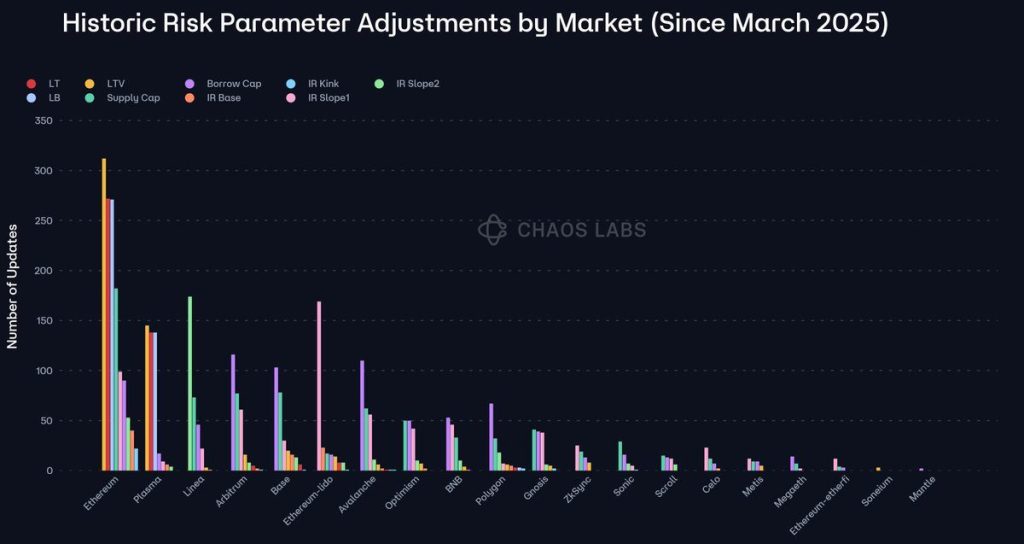
Chaos Labs has priced every loan initiated on Aave from November 2022 to present, managing risk parameters across V2 and V3 deployments spanning over a dozen networks.
This scope includes liquidation threshold calibration, interest rate curve configuration, and collateral factor adjustments – the parameters that determine whether a $50 billion lending platform absorbs volatility or generates cascading bad debt.
Goldberg said on
The governance conflict crystallized around three cumulative pressures. First, Aave Labs’ proposed $5 million annual budget – about 3.5% of Aave’s protocol’s $142 million revenue in 2025 – fell short of what Chaos had calculated as cost recovery after three years of operational losses.
The risk and compliance functions of traditional financial institutions absorb 6-10% of revenue; Chaos was required to operate at approximately half of this floor while taking on materially greater complexity.
Second, V4’s hub-and-spoke architecture requires building from the ground up: new infrastructure, new liquidation simulations, and new Oracle integrations for asset classes that Aave had not yet managed. Goldberg described it clearly: “going from zero to one again on a code base that has not yet been battle tested.”
Third, and this is structurally most important: the question of the legal liability of DeFi risk managers remains completely unresolved.
An Oracle misconfiguration in March 2026 – a Chaos Labs CAPO risk agent feeding an inaccurate price report for staked Ether – triggered $26.9 million in erroneous liquidations. There is no regulatory safe harbor for DeFi risk managers operating at this scale.
As DeFi governance conflicts increasingly surface over questions of legal and ethical liability, the indefinite exposure of managing $50 billion in lending metrics is no longer theoretical – it factors into the decision to exit.
Aave Labs CEO Stani Kulechov pushed back against the emergency framework, stating that V4 is additive and migrating to V3 does not result in any forced deadline. This may be true at the protocol level. It does not determine who manages the V3 risk parameters during the search for a replacement – nor who sets the initial V4 guarantee factors when the first major markets come online.
The article Chaos Labs Leaves as Aave Crypto Risk Manager Amid Governance Conflict appeared first on Cryptonews.


