





Ethereum recovered above $2,300, with bulls now targeting the $2,400 level that capped the recovery throughout the consolidation phase. Price action is improving, but a CryptoQuant analysis has identified a development in network data that suggests the current price level could tell an incomplete story about where Ethereum really stands.
The analysis looks at Ethereum’s active addresses, that is, the number of unique wallets that interact with the network on a daily basis. The 100-day moving average of this metric just reached an all-time high of around 587,000 active addresses. This is not a multi-year high. Not a high cycle. An all-time high – a level of sustained daily engagement on the network that Ethereum has never seen before in its history.
The timing creates a divergence that the data calls unprecedented. Ethereum price is more than 50% below its October peak. Its network usage, as measured by the most sustained and smooth version of the active address metric, is at a record. The two have never been this far apart in the same direction at the same time.
Historically, this gap has not persisted. According to CryptoQuant, there has always been a strong positive correlation between active address growth and the price of Ethereum – and the current deviation from this correlation is the largest the data has ever recorded.
The network is growing. The price has not yet caught up
The CryptoQuant report draws a distinction that separates the current environment from the standard narrative of a bear market. In typical recessions, price weakness and network weakness move together: fewer users, less activity, reduced engagement. What the active address data for Ethereum shows is the opposite. The continued rise of the 100-day moving average to a new all-time high reflects growing fundamental demand, increasing adoption, and an ecosystem that becomes more active precisely when sentiment is most negative.

This pattern of behavior – real users continuing to use blockchain even as prices fall – is the on-chain equivalent of a company expanding its customer base during a recession. The market may price Ethereum as if underlying demand is weakening. Network data indicates underlying demand is at an all-time high.
The implication of undervaluation follows directly from the historical relationship identified by the report. Asset prices tend to follow the fundamental utility of the network over the long term. When they diverge – when price falls while utility increases – the gap has historically narrowed in favor of the utility signal rather than the price signal. Ethereum’s price has moved away from the fundamentals of its network, not the other way around.
The report describes this as a hidden bullish signal, as it is only visible to participants looking below the price chart. The bearish sentiment around Ethereum reflects the price action. The active address record reflects what the network is actually doing. Over time, these two things have always converged. The question the current setup raises is not whether this will be the case, but how long the gap can persist before the price catches up to the current usage level.
Ethereum Reclaims Support But Faces Resistance to Overhead Trend
Ethereum is stabilizing near $2,320 after recovering from February’s sharp decline, but the broader structure remains mixed. The rebound from levels below $1,800 formed a clearly higher low, but price is now stuck directly in a resistance group defined by the 50- and 100-week moving averages. Both indicators are flattening but still act as dynamic ceilings, limiting upward momentum.
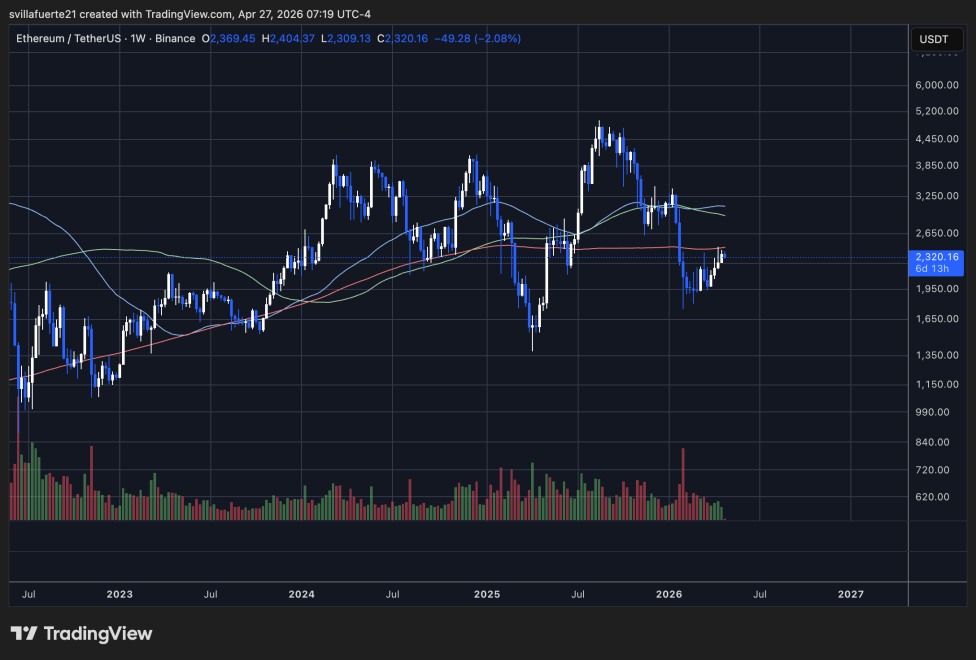
The 200-week moving average, currently trending higher below prices, continues to serve as long-term structural support. ETH’s ability to hold above this level during the correction reinforces that the macro trend has not completely broken, even if medium-term weakness persists.
Price action since March shows a transition from impulse selling to range-limited consolidation. The recovery phase was orderly, with higher lows and controlled advances rather than aggressive expansion. However, the failure to reclaim the $2,600-$2,800 area – where an acceleration of the previous breakout occurred – suggests that supply remains active during rallies.
The volume confirms this interpretation. The rise in capitulations was marked by forced liquidations, while the recovery phase was marked by declining participation, reflecting cautious accumulation rather than strong conviction.
For the structure to become decidedly bullish, Ethereum must recover and hold above the 100-week moving average. Until then, the market remains in a transitional phase between recovery risk and continuation risk.
Featured image from ChatGPT, chart from TradingView.com
Editorial process as Bitcoinist focuses on providing thoroughly researched, accurate and unbiased content. We follow strict sourcing standards and every page undergoes careful review by our team of top technology experts and seasoned editors. This process ensures the integrity, relevance and value of our content to our readers.


