




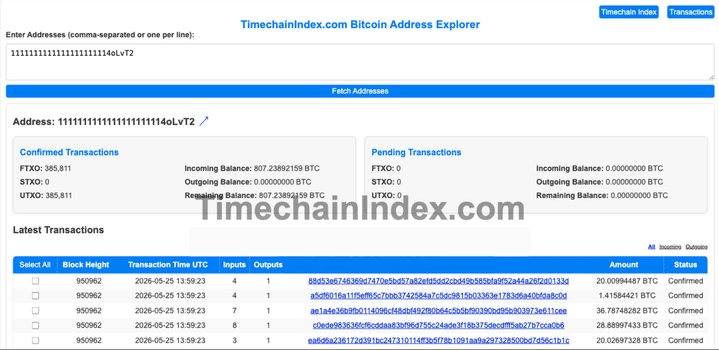
Bitcoin News Today: Five Bitcoin addresses, all created on April 10, 2014, simultaneously transferred a total of 107 BTC, worth approximately $8.2 million at prevailing market prices, to the well-known burn address. 1111111111111111111114oLvT2 Monday, permanently removing funds from Bitcoin’s circulating supply, a move that on-chain analyst Sani (SaniExp) was among the first to publicly report.
The synchronized timing, construction of identical transactions, and deliberate locking settings ruled out coincidence almost immediately, sending observers across X into a cascade of competing theories about motive, identity, and intent.
We believe this is less of a mysterious and dramatic burn story and more of a structural signal about the increasing sophistication with which long-dormant Bitcoin holders – whether individuals, collectives, or automated systems – are staging irreversible exits from the network. The mechanics matter more than the pattern here, and the chain recording is exceptionally readable.
Source: CD
DISCOVER: Best crypto to buy in 2026
Bitcoin News Today: The Burn Mechanism and What On-Chain Recording Establishes
The mechanism works as follows: a Bitcoin burn address, such as 1111111111111111111114oLvT2 – sometimes referred to in community shorthand as a 1BitcoinEater-style destination, is a validly formatted address for which no corresponding private key exists or can be derived, meaning that any BTC sent to it is provably and permanently unusable under current Bitcoin cryptographic rules.
The five sending addresses – 16g5hMoREWqMcaQGvnCHCWPheotD99bVQt, 1PkWqW1P7KsxYXsAnWMPru6NNTfBeiRT6V, 1LieqLD1qNadbQrSGjYAUT3tVL2w4cxXQu, 14UNkCVPDQFCZAvq3j4vUQ6h6pHwBtegMaAnd 1JtpAuksysZdwzkCjwQpTG5mzE8BRq7qmh, Everyone sent their entire balance in a single outing, leaving all five addresses at exactly zero.
The total fees paid for the five transactions were just $5.56 at a rate of 1.81 sat/vByte, although on-chain analysts noted that this was roughly double the prevailing fee level for that block range, suggesting that the sender prioritized rapid inclusion once the lockout deadline expired.
🚨107 BITCOIN WORTH $8.3 MILLION JUST DISAPPEARED FOREVER
Yesterday, five long-dormant wallets suddenly transferred 107 BTC to a burn address, permanently removing approximately $8.3 million worth of Bitcoin from circulation after remaining untouched for over 11 years.
Destroy so much… pic.twitter.com/gcNdGW6xJR
– Coinbureau (@coinbureau) May 27, 2026
Each transaction shared a lock block 950 958the same fee replacement setting and multi-UTXO consolidation into a single output, consistent fingerprinting with pre-signing, and automated delivery by a single operator rather than five independent parties acting in coordination.
Execution was synchronized down to the second across all five wallets, according to the Protos report, citing on-chain data. The MEXC on-chain review indicated that the original cluster had been accumulating since 2014, with its overall BTC position peaking at around $2.5 million in late 2025 before being entirely destroyed in this event.
It is necessary to point out here the epistemic status of several details. Blockchain analytics firm AMLBot claimed that some of the entries carried historical associations with the address infrastructure of the defunct Mt. Gox exchange, but did not explicitly identify the actual sender or link the transfer to the Mt. Gox domain or its trustee. As of this writing, no court filings, official communications from the trustee, or notices to creditors have confirmed any connection to Mt. Gox.
The motive, identity of the operator and the precise trigger of the automated distribution remain unverified. What the on-chain records unambiguously confirm is the destruction itself: 107 BTC removed from the BTC supply, with the burn address now containing 807 Bitcoins worth a total of approximately $61 million that are, under current network rules, permanently inaccessible to any party.
DISCOVER: Best Meme Coins to Buy in 2026
following
Disclaimer: Coinspeaker is committed to providing unbiased and transparent reporting. This article is intended to provide accurate and current information, but should not be considered financial or investment advice. Because market conditions can change quickly, we encourage you to verify the information for yourself and consult a professional before making any decisions based on this content.

Daniel Frances is a technical writer and Web3 educator specializing in macroeconomics and DeFi mechanics. Hailing from crypto since 2017, Daniel leverages his experience in on-chain analytics to write evidence-based reports and in-depth guides. He holds certifications from the Blockchain Council and is dedicated to providing “insight gain” that overcomes market hype to find real utility for blockchain.


