




Thomas Lee’s BitMine is turning to the preferred stock market to raise new capital for its Ethereum strategy, offering investors an annual payout of 9.5%.
On June 3, the company revealed plans to sell 3 million shares of 9.50% Series A perpetual preferred stock for a reported $100, creating a potential raise of $300 million.
The shares are expected to trade on the New York Stock Exchange under the symbol BMNP if the listing is approved. Moelis & Company and Cantor act as joint lead bookrunners.
If sold in full, the offering would add approximately $28.5 million in annual dividend obligations, paid weekly as BitMine’s board declares.
The sale comes as treasury firm Ethereum faces a tougher test of the enterprise crypto model. Due to current market conditions, BitMine’s unrealized losses on ETH exceeded $8 billion after ETH’s decline pushed the asset well below the company’s average purchase price.
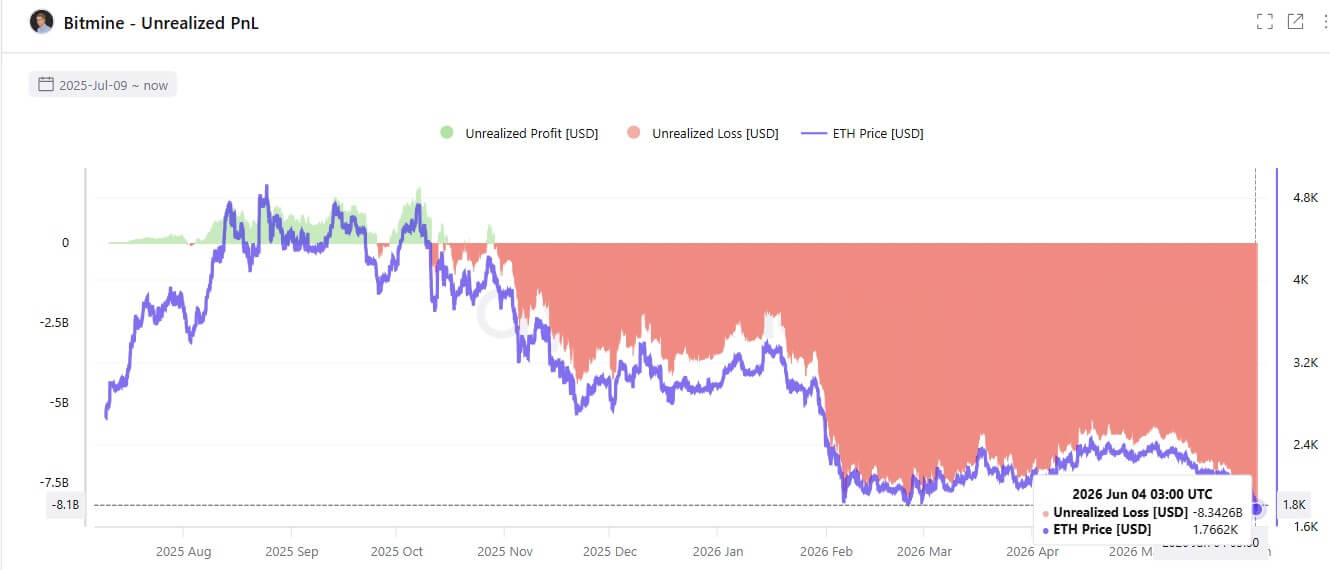
Nonetheless, the move will strengthen the connection between the company’s balance sheet, its staking operation, and the public market investors invited to fund its next stage of accumulation.
A payment built around Ethereum yield
BitMine said the proceeds from the offering may be used for general corporate purposes, including additional purchases of ETH and other digital assets, expansion of its staking and validation infrastructure, working capital, strategic investments related to Ethereum, and repurchase of its common stock.
This wide use of the products makes the offer more than a balance sheet repair. This could allow BitMine to continue accumulating ETH while market prices remain weak, strengthening the company’s role as the largest public Ethereum treasury company.
Over the past year, the company has strengthened its position in its ETH portfolio through aggressive purchases and currently holds over 5.3 million tokens. This represents approximately 4.5% of the circulating supply of ETH.
Notably, a large portion of this stack is staked, allowing BitMine to earn protocol rewards while it holds the tokens.
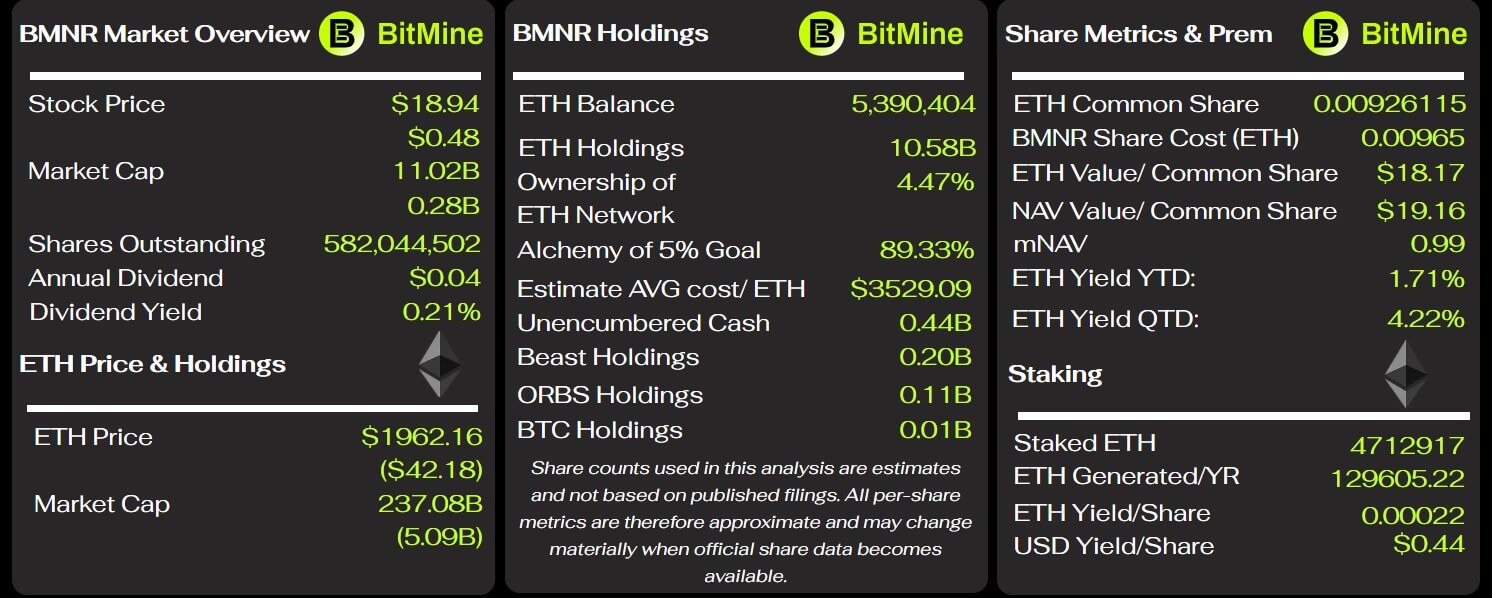
Chairman Thomas Lee argued that these staking rewards give Ethereum cash companies an advantage over Bitcoin-focused vehicles. Unlike Bitcoin, ETH can produce a return through staking, allowing a company to earn returns without selling the underlying asset.
This distinction is at the heart of BitMine’s new preferred shares. With a 9.5% coupon, the total offering of $300 million would cost about $548,000 per week in dividends.
BitMine said its annualized staking revenue is in the hundreds of millions of dollars, suggesting that the preferred payout is small compared to the revenue its staked ETH could generate under ordinary market conditions.
Additionally, the broader Ethereum treasury industry is already moving in this direction. Staking accounted for 60% of disclosed revenue at publicly traded ETH treasury companies in 2025, according to a study by staking provider Everstake.
The report states that this figure comes from companies that broke out staking-related revenue separately, showing how active deployment has become a more important part of ETH’s public treasury model.
This revenue split helps explain why BitMine relies on Ethereum’s yield profile while asking investors to accept a flat 9.5% payout.
The company does not simply hold ETH as a cash reserve. It attempts to convert this reserve into a recurring revenue base that can support financing in capital markets.
However, the company’s filing also shows why the structure is not without risk.
BitMine does not promise a dedicated pool of staking revenue to preferred shares. Instead, the filing states that dividends may be funded by cash on hand, ETH yield activity, security sales, future funding, or other sources.
At the same time, the company also warns that staking revenue may not be sufficient and staked ETH may not be immediately available for withdrawal or sale during periods of stress.
This caveat is at the heart of the transaction, as the preferred shares turn part of BitMine’s Ethereum bet into a recurring cash obligation.
Strategy STRC Comparison Has Limitations
BitMine’s move closely resembles the financing model used by Strategy, Michael Saylor’s Bitcoin treasury company, which has repeatedly leveraged preferred stock and other securities to fund crypto accumulation and manage its capital structure.
Both companies use public market instruments to transform investors’ demand for yield into balance sheet capacity for purchasing digital assets. Both have sought to create securities that are attractive to investors who want exposure to crypto treasure without directly owning the underlying token.
Both also operate in a market where the value of their principal asset can change significantly before the maturity of the cash obligation attached to the security.
However, this comparison has limits.
Strategy’s preferred STRC is a floating rate product designed to help keep stocks close to their stated amount of $100. Its dividend rate can be adjusted monthly, giving Strategy a tool to react if market prices move away from par.
BitMine’s preferred A-series is simpler in one respect and stricter in another. It features a fixed coupon of 9.5%, paid weekly in arrears once declared, rather than a variable rate which can be reset to influence the trading price.
However, if dividends are not paid, they accrue and compound each week. The rate of unpaid dividends can increase over time, capped at 15% per year.
| Functionality | STRC | BitMine Series A |
|---|---|---|
| Issuer | Strategy, Bitcoin treasury | BitMine, Ethereum treasure |
| Security type | Perpetual preference | Perpetual preference |
| Dividend | Variable, currently 11.50% | Fixed 9.50% |
| Payment cadence | Monthly cash flow | Weekly cash, if declared |
| Aim | General corporate purposes, including Bitcoin purchases | General company goals including ETH/digital assets and staking infrastructure |
| Nominal/indicated amount | $100 | $100 |
| Market stabilization function | Dividend adjusted to keep price near $100 | Liquidation preference adjusts using a market price formula, but not a variable dividend targeting par value. |
| Redemption | STRC redeemable at $101 or more, plus unpaid dividends | BitMine callable at 110% for the first 18 months, 105% from 18 months to three years, then 100%, plus unpaid dividends |
Preferred shares also include a liquidation preference that starts at $100 and adjusts according to a market price formula, never falling below $100.
BitMine can repurchase the shares at 110% of the stated amount during the first 18 months, 105% from 18 months to three years, and 100% after three years, plus accrued and unpaid dividends. Holders would also have redemption rights if certain fundamental changes occurred.
These terms give BitMine flexibility, but they also show the price of raising capital in a weaker crypto market. A 9.5% payout is high enough to attract the attention of income investors, but it also reflects the premium required of a company whose primary asset base is tied to ETH.


