



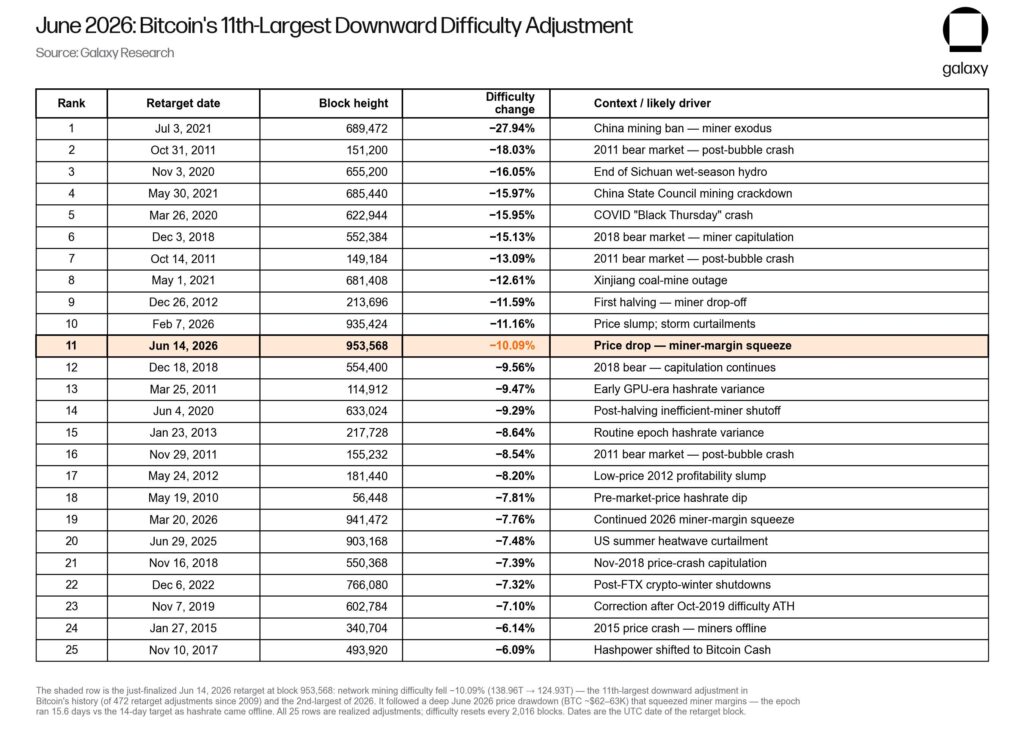
Bitcoin mining difficulties fell 10.09% on Sunday, June 15, from 138.96 trillion to 124.93 trillion at block 953,568, the 11th largest downward adjustment in the protocol’s history and the second largest of 2026.
The trigger was a deadly June for BTC miners: Bitcoin’s price fell about 15% that month, crushing the margins of high-cost operations until rigs began to shut down on the network.
Here’s the central tension this article uncovers: The adjustment provides immediate, measurable relief to surviving miners, but whether that relief will turn into a lasting recovery of margins depends entirely on how Bitcoin’s price moves from there.
DISCOVER: The Next 1000x Crypto Gem Ahead of Its Listing on Binance
Mining Difficulty Drop: What the 124.93 Trillion Number Really Tells You
Think of Bitcoin mining difficulty as a volume dial that the network automatically increases or decreases so that a block arrives every ten minutes on average. When more computing power joins the network, the dial opens, puzzles become more difficult, competition intensifies, and block times stay close to the target. When machines go offline, the dial goes down so that the remaining miners can still find blocks at roughly the right rate.
This dial rotates every 2,016 blocks, a period called an epoch. If the previous epoch took more than 14 days, the difficulty decreases; if he runs faster, the difficulty increases. The just-ended epoch lasted 15.6 days, well above the 14-day target, as hashrate, the total computing power pointed at the network, had fallen sharply as unprofitable platforms were shut down.
Practical result of Sunday’s adjustment: BTC miners who got their machines working now face a less competitive headache. Crypto trader Merlijn Enkelaar calculated that the remaining miners earn around 9% more BTC per machine per day.
Hashprice, the metric tracked by Hashrate Index, which quantifies expected daily revenue per unit of hashrate, jumped 13% and now sits at $33 per Petahash per second (PH/s) per day, back above the critical $30/PH/s gross breakeven point that The Energy Mag identified as the dividing line between survival and shutting down marginal operations. To place the severity of historical precedents: the only declines comparable to a single adjustment occurred in July 2021, when China’s mining ban triggered a mass hashrate exodus, and in February 2026, when storm cuts combined with a 25% BTC price collapse produced an 11% decline.
DISCOVER: The best Meme Coin ICOs to invest in 2026
Why it happened: A 15% price drop did what price cuts always do
The drop in the price of Bitcoin by around 15% in June 2026 is the direct cause. Galaxy Research explicitly reported that slippage “squeezed miner margins” to the breaking point, a causal chain of its own: a lower BTC price means each block reward is worth less in dollar terms, which means miners with higher electricity costs can no longer cover their operating expenses, meaning these rigs are out of business.
The scale of offline migration is evident in the hashrate data. The network’s total hashrate currently stands at 886 exahashes per second (EH/s), according to Blockchain.com, down 12% so far in June and 23% from its October peak.
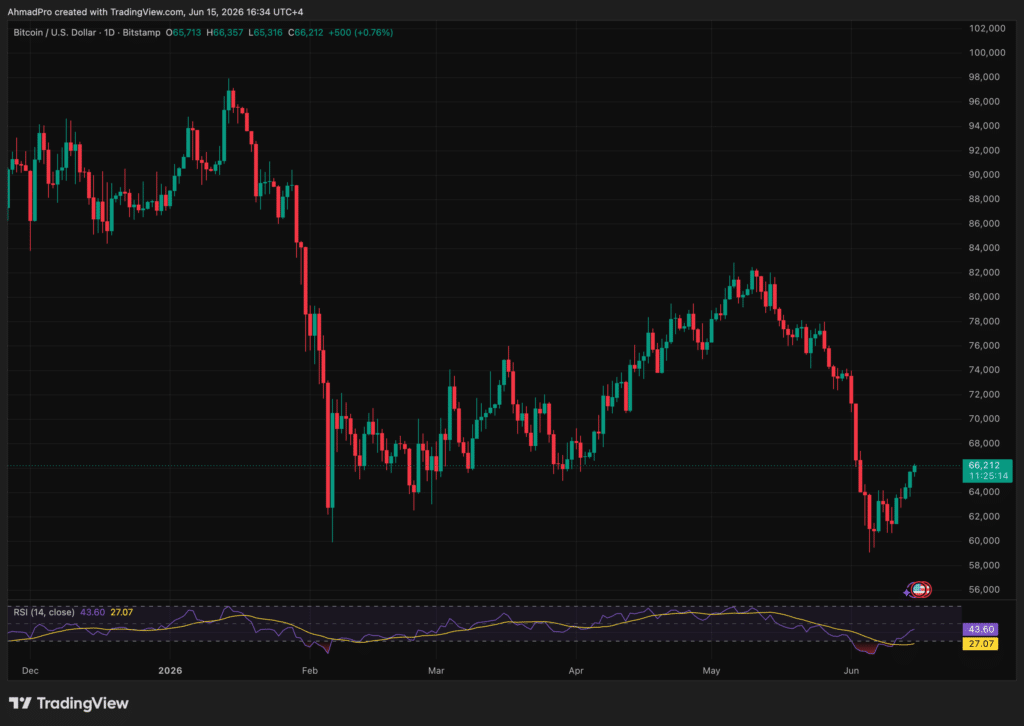
The difficulty itself is now 20% lower than its peak in November. This is not a minor fix; this reflects a real wave of miner capitulation, a term used when operators are forced to shut down hardware rather than choosing to do so strategically.
The efficiency fault line extends roughly to the hash price level of $30/PH/s. Below this threshold, older generation application-specific integrated circuit (ASIC) miners – specialized hardware platforms used in Bitcoin mining, consuming power at above-market rates cannot generate a positive gross margin.
Galaxy Research analysts noted that only operators running newer ASICs with energy costs below $0.05 per kilowatt hour can generate attractive returns at current hash price levels. Everyone absorbs losses or, as hashrate data confirms, leaves.
This dynamic is also fueling broader pressure on Bitcoin prices via corporate and miner treasury strategies.. When margins collapse, miners sell their BTC reserves to cover fixed costs, adding selling pressure at exactly the wrong time in the cycle.
EXCLUSIVE: Earn $10 USDC via Binance Signup
Follow 99Bitcoins on X For the latest market updates and subscribe on YouTube for daily market analysis from experts.
Bitcoin Mining Difficulty Drops 10%: What This Means for Miners and BTC Price appeared first on 99Bitcoins.


