




Venice Token (VVV) fell 11.32% to $13.41 over the past 24 hours at press time, even as trading volume soared 21.02% to $28.68 million. This highlights increasing activity during the token’s price decline.
The increase in participation, however, failed to stabilize price action, as sellers maintained control throughout the session. Recent candles pushed VVV closer to an important support zone that has already attracted buyers on several occasions. Although volume has increased significantly, the market has not translated this activity into sustained demand.
Instead, traders appeared to use the increased liquidity to exit their positions. As a result, VVV has entered a critical phase where preservation of support has become more essential than short-term trading activity.
Has the overheated phase of the VVV finally cooled down?
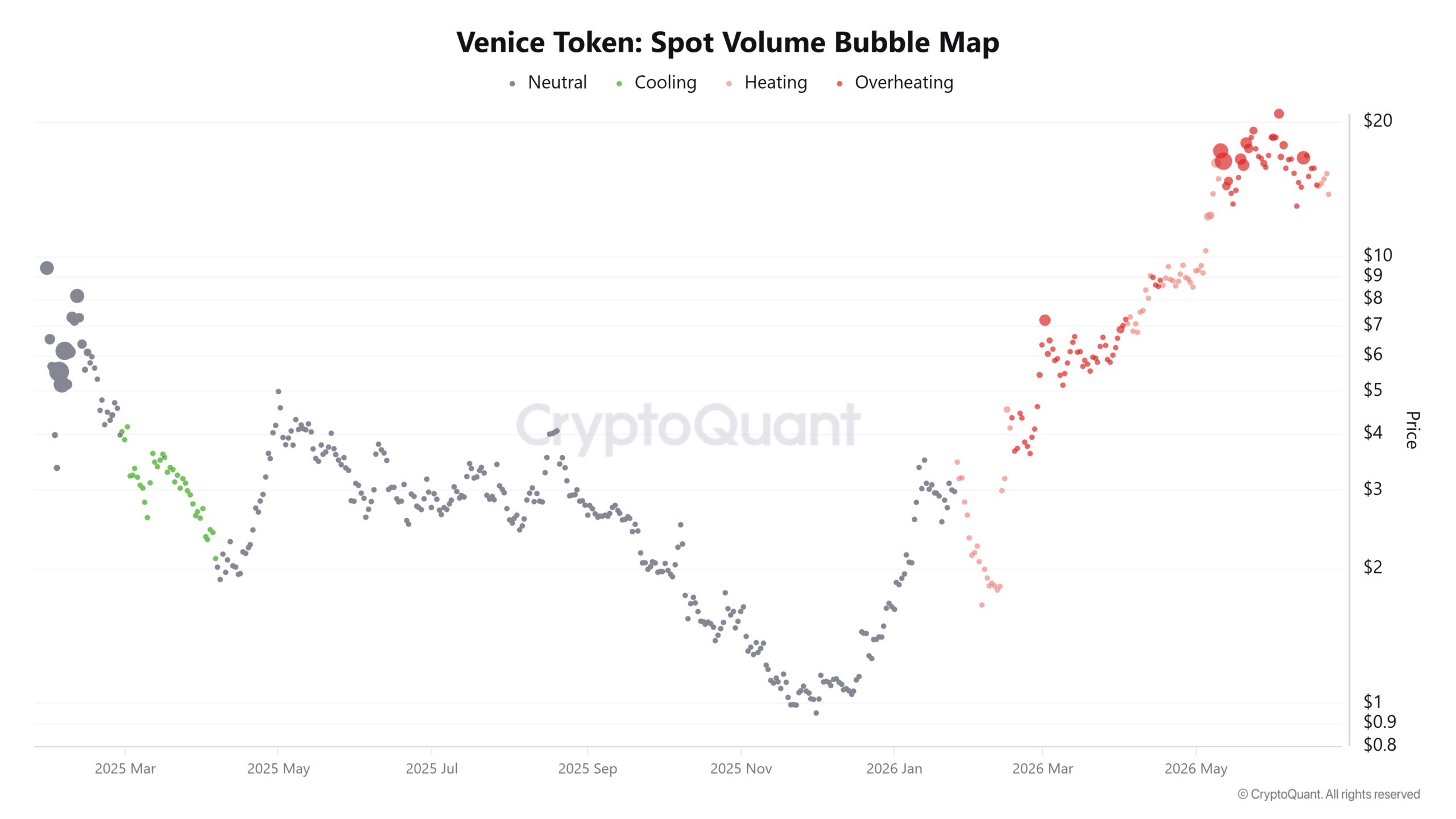
CryptoQuant Spot Volume Bubble Map showed that VVV remained in an overheated zone at the time of writing, following months of aggressive price appreciation.
Large clusters of high trading activity emerged when the token was trading between around $15 and $20. These regions have historically reflected periods where speculation has intensified and traders have sought out bullish moves. However, recent bubbles appeared smaller than those recorded near the peak, indicating that participation gradually cooled as the recovery lost strength.
Prices also retreated from the overheated region to lower levels where demand had previously emerged. Although overheating conditions remained visible on the broader chart, the latest figures indicated a moderation rather than a further acceleration.
Therefore, market participants seemed more focused on preserving capital than aggressively chasing higher prices.
Foreign exchange withdrawals continue despite the drop
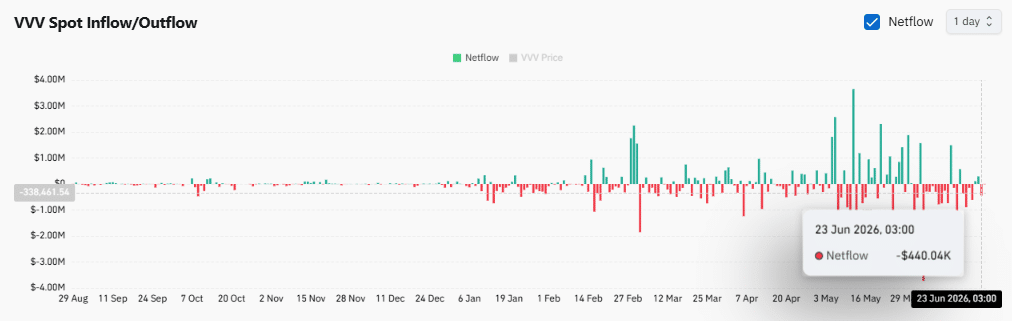
At the time of writing, spot flow data revealed that VVV continued to exit exchanges even as the token saw a double-digit daily decline. The latest figure shows net outflows of around $440,000, continuing a broader trend that has emerged in recent months.
Several larger outflow spikes also appeared in May and June, reflecting a steady movement of tokens away from trading platforms. Such activity often reduces the immediately available supply of foreign exchange and may indicate a preference for holding rather than selling. Nevertheless, the continued decline in prices showed that capital outflows alone did not create sufficient buying demand.
Selling pressure has always exceeded available offers during the last correction. Nonetheless, the continued pullback trend suggests that some market participants have retained their confidence in VVV despite continued weakness and increased market uncertainty.
Technical structure tests key support amid bearish backdrop
At the time of analysis, VVV was hovering near a critical support zone around $12.87, forming a potential triple bottom pattern after several retests over the past few weeks. This level remained crucial as repeated defenses suggested underlying demand, even if its confirmation required a sustained rebound.
Price action remained below the 9-day ($14.72) and 21-day moving averages ($15.30), reinforcing short-term bearish momentum and establishing these levels as immediate resistance.
At press time, the MACD still supported this outlook, with the MACD line located below the signal line and both positioned below the zero mark, while the histogram printed consistent negative values. These signals indicate continued bearish pressure despite attempts to stabilize.
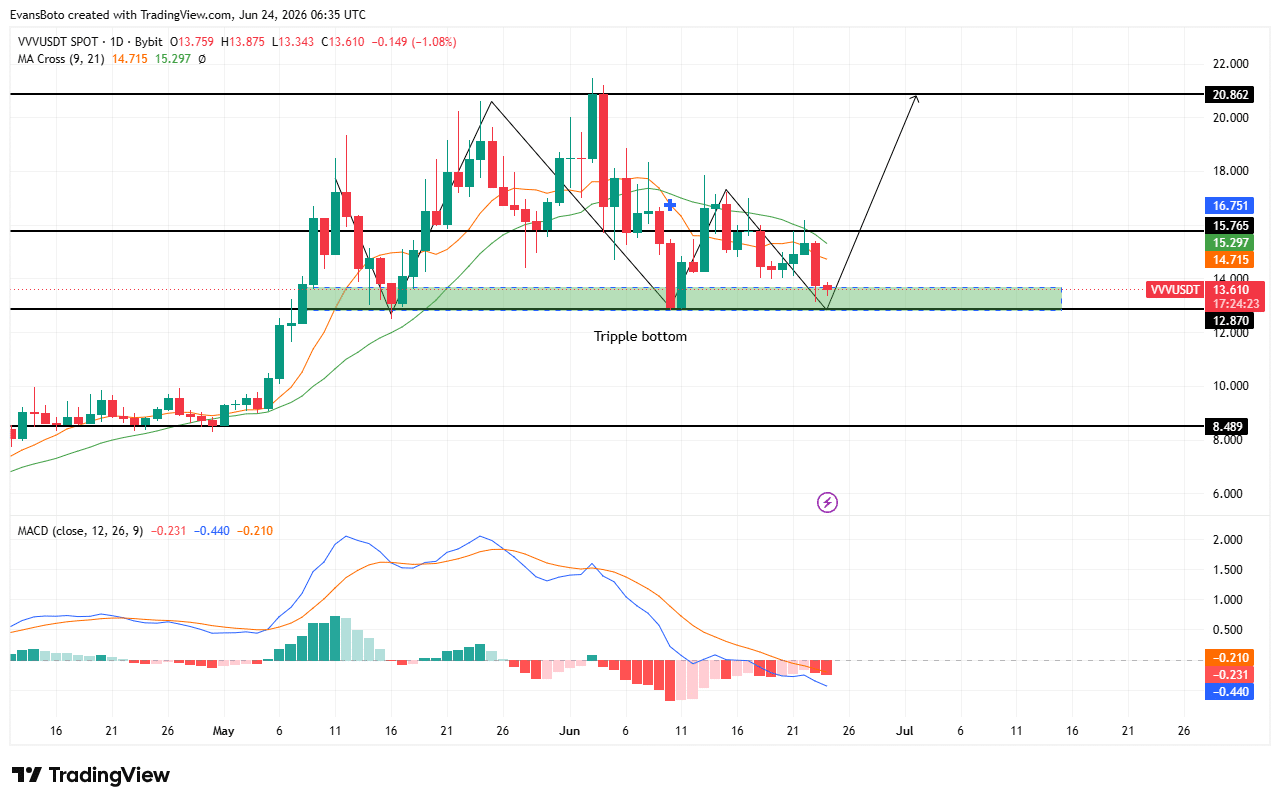
A successful hold above $12.87 could trigger a rally towards $15.76, while a breakout would invalidate the trend and likely accelerate losses towards lower support zones.
Final summary
- Currency outflows persist despite the weakness, suggesting that some holders continue to accumulate VVV.
- Triple bottom support near $12.87 remains crucial to avoid further losses.


