



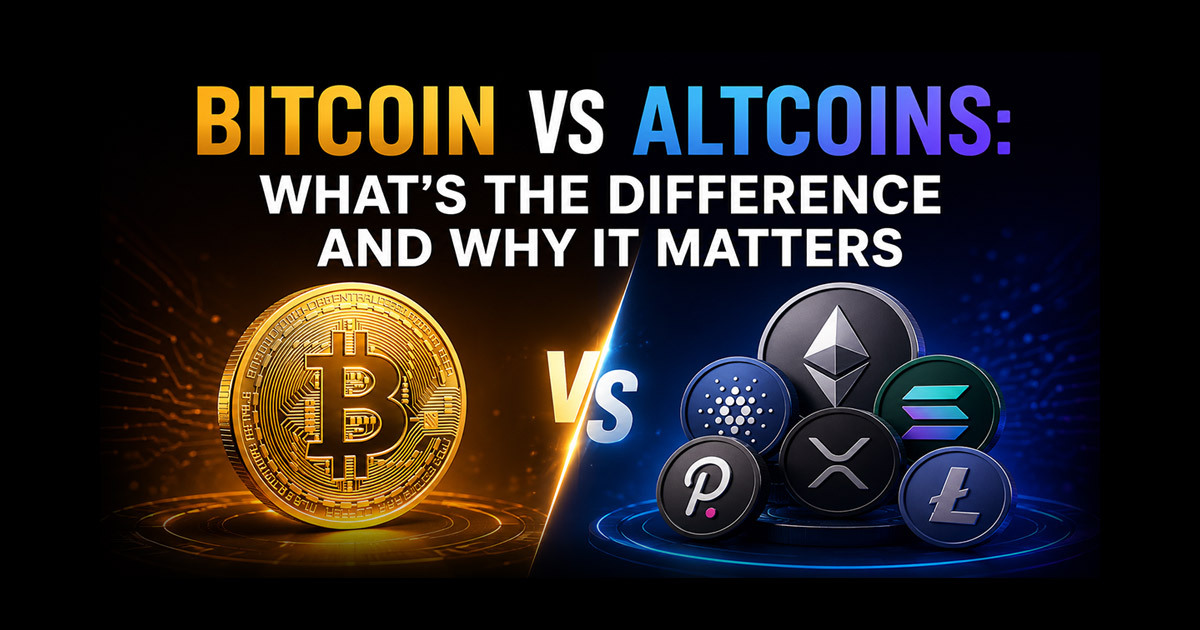

If you’re new to crypto, a question arises almost immediately. What is the difference between Bitcoin and all other cryptocurrencies?
The answer starts with Bitcoin, but it certainly doesn’t end there.
Today, there are thousands of cryptocurrencies on the market. Some are designed to power decentralized finance, others focus on gaming, artificial intelligence, or the tokenization of real-world assets. Still, Bitcoin remains the benchmark for the entire industry, accounting for approximately half of the total cryptocurrency market capitalization at the time of writing.
Anything that is not Bitcoin is called an altcoin. Although this definition seems simple, the differences between Bitcoin and altcoins go far beyond which came first. They differ in their focus, technology, and the problems they attempt to solve.
Bitcoin remains the foundation
Launched in 2009, Bitcoin introduced the idea of a decentralized digital currency. More than a decade later, it remains the largest and most widely recognized cryptocurrency in the world. Its reputation has contributed to its adoption in the real world. Businesses that start accepting cryptocurrency payments often integrate Bitcoin first, as it is the asset that most users already know and trust.
An example is online gambling. Many crypto casinos allow users to deposit Bitcoins quickly and securely before playing their favorite games.
Traditional casino games have also adopted cryptocurrency. Bitcoin has become a popular payment option for blackjack players who want faster deposits and withdrawals while maintaining the familiar gaming experience.
Although many platforms now support multiple cryptocurrencies, Bitcoin often remains the first choice due to its wide recognition and long-standing reputation.
What Altcoins Bring to the Table
Altcoins include all cryptocurrencies besides Bitcoin. Ethereum is the best-known example, but the category also includes networks such as Solana, XRP, Cardano, Avalanche and thousands of other projects.
Unlike Bitcoin, many altcoins are built with specific goals in mind.
Some focus on faster transaction speeds. Others aim to reduce costs, improve scalability, or support entirely new blockchain applications.
One of the biggest innovations introduced by many altcoins is smart contracts.
Smart contracts are self-executing programs that automatically execute agreements when predefined conditions are met. This technology allows developers to create decentralized exchanges, lending platforms, NFT marketplaces, blockchain games, and countless other applications that go far beyond simple payments.
This flexibility has made altcoins the driving force behind much of the innovation in the blockchain sector.
Different designs for different purposes
Bitcoin has remained remarkably consistent throughout its history.
Its main objective is security, decentralization and maintaining a predictable monetary policy. Major upgrades are carried out carefully, helping to preserve trust in the network.
Altcoins take a different approach.
Many are experimenting with new consensus mechanisms, governance models, scaling solutions and token economics. Some are designed for enterprise use, while others target consumers or developers creating decentralized applications. Even memecoins have gained a place in the ecosystem. Although many start as internet jokes, some develop highly engaged communities and eventually achieve significant market value.
Each altcoin reflects the goals of the team and community behind it, making the sector one of the fastest growing areas of technology.
Innovation moves faster
Another key difference is the pace of development.
Bitcoin is evolving cautiously thanks to broad community consensus. This slower approach prioritizes stability over rapid change. Altcoin ecosystems tend to evolve much more quickly.
Development teams frequently release upgrades, test new features, and experiment with emerging technologies. While this creates more opportunities for innovation, it can also introduce additional risks. Communities also play a major role. Developers, validators, investors and users all contribute to improving their networks. Strong communities often become one of the main reasons why a blockchain project succeeds in the long term.
Different Roles in the Crypto Economy
Bitcoin is widely considered a digital currency and a long-term store of value. Many investors even call it digital gold due to its fixed supply and long history. Altcoins serve a much wider range of purposes.
Some power decentralized financial applications. Others enable blockchain gaming, artificial intelligence, tokenized real-world assets, digital identity or cross-border payments. Business-focused blockchains also help businesses explore new ways to use distributed ledger technology.
Rather than replacing Bitcoin, altcoins expand what blockchain technology can accomplish.
Final Thoughts
Bitcoin remains the foundation of the cryptocurrency industry. Its simplicity, security, and global recognition continue to make it the benchmark against which all other digital assets are measured. Altcoins build on this foundation by introducing new technologies, specialized use cases, and faster innovation. Together, they create an ecosystem that continues to evolve and mature every year.
Instead of viewing Bitcoin and altcoins as direct competitors, it is often more useful to view them as complementary parts of the same digital economy, each playing a different role in the future of finance.
If you want to explore one of Bitcoin’s growing real-world use cases, you can learn more at Bitcoin Casino Blackjack.

The information discussed by Altcoin Buzz does not constitute financial advice. This is for educational, entertainment and informational purposes only. Any information or strategy consists of thoughts and opinions relevant to the author/reviewer’s accepted levels of risk tolerance and their risk tolerance may be different from yours. We are not responsible for any losses you may incur as a result of any investment directly or indirectly related to the information provided. Bitcoin and other cryptocurrencies are high-risk investments, so please do your due diligence.
This article is sponsored by Thunderpick.
Copyright Altcoin Buzz Pte Ltd.


