




In today’s Bitcoin News, Strategy (MSTR), Michael Saylor’s Bitcoin treasury company, revealed in a June 29 filing with the SEC that it could sell up to $1.25 billion worth of Bitcoin, the most explicit signal yet that the company’s long-term accumulation model is giving way to active balance sheet management.
This disclosure was dropped as Bitcoin continues to struggle to reclaim $60,000, currently trading at $59,150, down -1% over the past 24 hours and almost -6% for the week.
MSTR is trading today at $92.68, down -41% over the past month, while STRC is trading at $83.67, up +12% on the day but still down -15.4% since the beginning of June.
Bitcoin News: What the Strategy’s Bitcoin Monetization Program Actually Does
The strategy framed the potential sale as part of a recently announced Bitcoin monetization program, with sales to be executed “from time to time” based on market conditions, capital needs and other strategic considerations, according to the filing.
The proceeds would go into the company’s cash reserve, which currently stands at about $2.55 billion, and cover preferred stock dividends, interest payments and other corporate obligations.
The company’s annual preferred dividend and interest expense is approximately $1.76 billion, based on filing period research. Together, the $2.55 billion cash reserve and the $1.25 billion Bitcoin sales authorization provide approximately 25.9 months of coverage against these obligations.
The council has set a minimum coverage floor of 12 months; falling below this threshold requires explicit approval from the board of directors before any drawdown from reserves. Along with the disclosure of the Bitcoin sale, Strategy authorized two separate billion-dollar share buyback programs.
This includes one for its Class A common stock and one for its digital credit securities, which is the umbrella term the company uses for its various series of preferred stock.
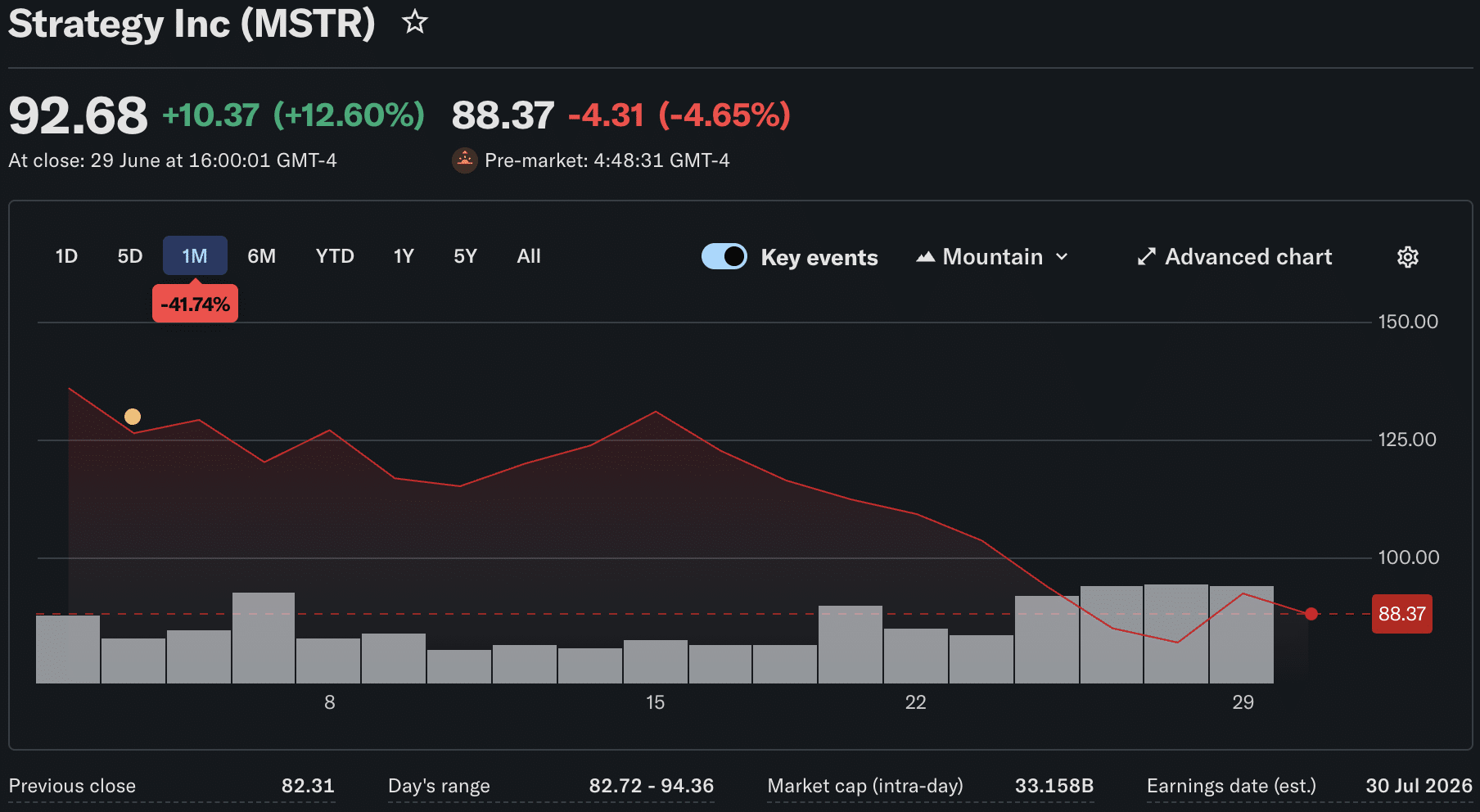
(SOURCE: Yahoo Finance)
DISCOVER: The best Meme Coin ICOs to invest in 2026
The mNAV problem: why the flywheel stalled
The most structurally significant data point in this story is the collapse of Strategy’s mNAV, a valuation metric that compares the company’s enterprise value to the total market value of its Bitcoin holdings. On June 27, Strategy’s mNAV fell below 1.0 for the first time in a meaningful way, according to data cited by several market trackers.
When mNAV is greater than 1, the strategy can issue new shares at a premium to Bitcoin equity, use the proceeds to buy more Bitcoin, and effectively manufacture an accretion of Bitcoin per share, a self-reinforcing mechanism around which Saylor has built the entire capital strategy.
Below 1, this flywheel reverses: new equity is diluted rather than accumulated, access to debt markets becomes more expensive, and direct monetization of Bitcoin goes from a last resort to a rational tool.
This is not the company’s first Bitcoin sale. Strategy sold a small slice of Bitcoin on June 1, a move that immediately caught the market’s attention given the company’s previous “never sell” reputation. The June 29 filing transforms this position into an authorized program.
EXCLUSIVE: Join 99Bitcoin’s 1,000 USDT Airdrop on ByBit
Peter Schiff says the pattern has reversed
"The significance for Bitcoin is that Saylor just surrendered. The strategy shifted from the biggest buyer to the biggest seller"
Peter Schiff explains why the going short strategy is turning the entire Bitcoin market upside down
"He can hide and say we are still net buyers. He is not. He is… pic.twitter.com/hzVP33CkD8
– The wolf of all streets (@scottmelker) June 29, 2026
In other Bitcoin news, longtime BTC critic Peter Schiff responded to the June 29 filing by stating that Strategy was “now a Bitcoin seller” in an article on X. After the June 1 sale, Schiff wrote, “What Saylor gives, Saylor takes back.”
Schiff argued that Strategy’s aggressive accumulation helped inflate the price of Bitcoin during the bull run, and that any sustained selling would reverse this dynamic.
Saylor and CEO Phong Le framed the change differently. Le said Strategy “sells Bitcoin when it makes sense for the company,” with the choice between dividends, debt reduction, and reserve building determined by what is most accretive to Bitcoin per share.
The board-level constraints, limiting BTC sales to three specific uses and requiring a new board vote for anything outside of those, are designed to signal that monetization will be rules-based rather than reactive.
Bitcoin has retreated sharply from its late 2025 high of around $125,000, falling below $59,000 last week before a modest recovery to current levels.
How long Strategy’s mNAV remains below 1 and how aggressively the company tests its new monetization playbook will be the metrics to watch in the coming weeks.
EXPLORE: Best Crypto Presales with Asymmetric Upside Potential in Today’s Market
The post Strategy Clears Sale of $1.25 Billion of BTC Under New Monetization Plan appeared first on 99Bitcoins.


