




The Aave community has officially voted to approve the deployment of Aave V4 on the Ethereum mainnet, triggering one of the most significant architectural overhauls in the history of decentralized finance.
This isn’t just a version change; This is a fundamental restructuring of how the protocol manages risk, aimed at preventing the type of systemic contagion that has hit DeFi in the past.
LATEST: AAVE V4 ACTIVATION ON ETHEREUM MAINNET PASSES GOVERNANCE SNAPSHOT@Aave Labs gained community approval to deploy Aave V4 on Ethereum Mainnet after a year-long security review spanning a cumulative 345 days of audits, formal verification, fuzzing, and $1.5 million… pic.twitter.com/qBi8RbrWUW
– BSCN (@BSCNews) March 23, 2026
 LATEST: AAVE V4 ACTIVATION ON ETHEREUM MAINNET PASSES GOVERNANCE SNAPSHOT
With ARFC (Aave Request for Comment) adopted, the protocol now enters a rigorous “security first” phase, with full deployment planned for 2026 after nearly a year of planned audits and testing.
The AAVE crypto is trading up +5% on the day, around $110. With V4 fast approaching, AAVE trading volume has spiked, with over $357 million transacted in the last 24 hours.
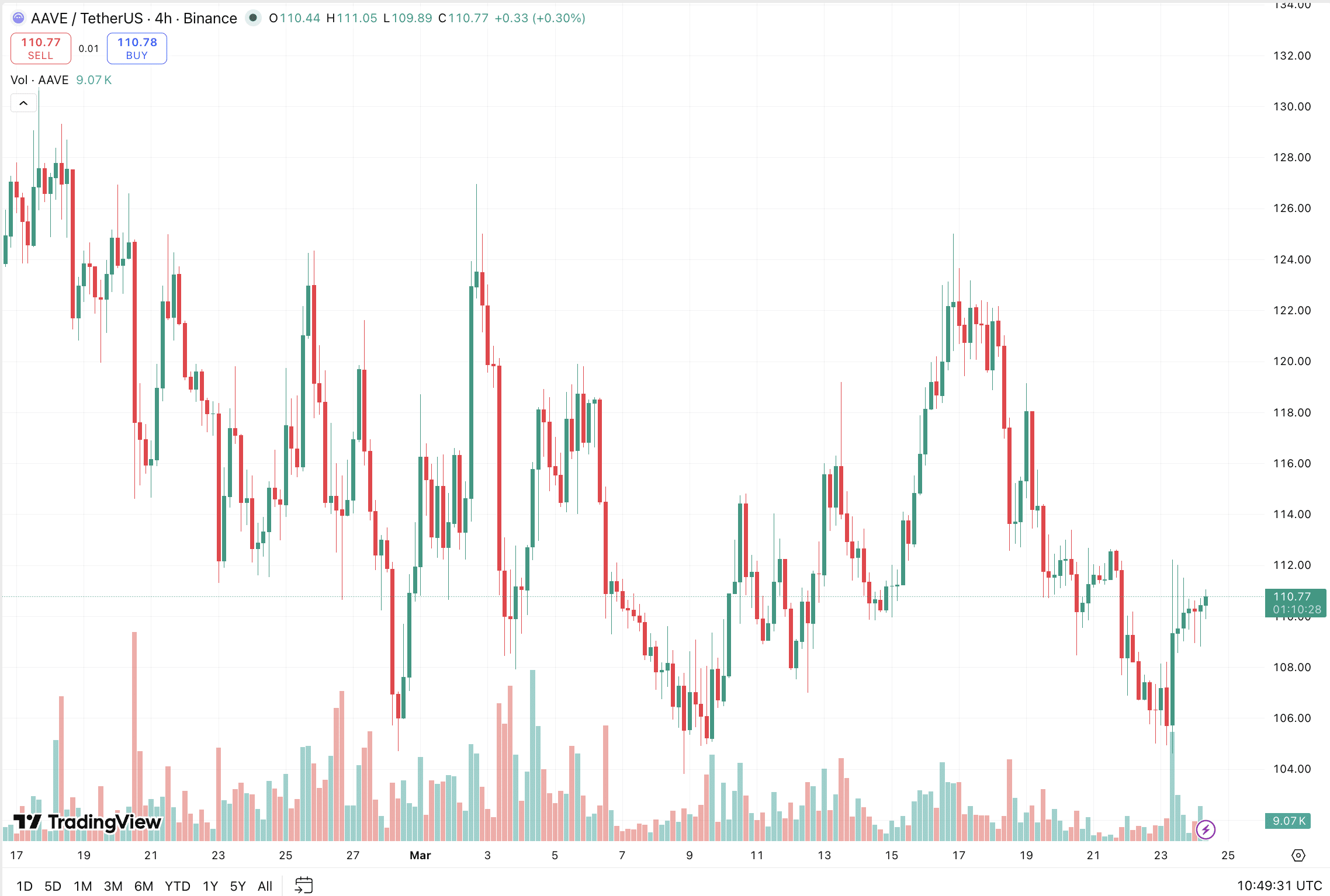
(SOURCE: TradingView)
What is Aave Crypto V4?
To understand what has changed, you need to understand how the current version of Aave crypto differs from V4. Right now, most lending protocols operate like huge shared swimming pools.
Aave V4 introduces a new architecture built around Liquidity Hubs and Spokes. Think of it less as a single swimming pool and more as a modern ship designed with watertight compartments. The “Hub” acts as the central liquidity engine, managing the total supply of assets.
Spokes are distinct borrowing environments with their own specific rules and risk limits. If a department goes bankrupt or incurs unrecoverable debt, the damage is contained in that specific compartment. It doesn’t sink the whole ship.
This allows Aave to be more aggressive with new experimental assets in one radius while keeping borrowing rates for core assets like ETH and USDC completely isolated in another.
This is a move toward modularity that echoes broader security trends in the Ethereum ecosystem, where risk isolation is becoming just as important as maximizing yield.
$AAVE showing a strong bullish divergence over 15m with a 1h bias. The price is near VAL, with buyers absorbing supply as the delta increases while the price falls. Target POC and VAH for profit. Own configuration of auction rotation. Entry at 105.22, tight stop below. #Aave #Challenge #Crypto #Trade #Altcoins pic.twitter.com/jRIourtFEB
– DailyTradeSetups (@Daily_T_Setups) March 23, 2026
DISCOVER: The next crypto gem 1000x before listing on exchanges
Why It Matters: Risk Pricing and “Bad Debt”
This upgrade addresses the greatest existential threat to lending protocols: shared risk. In the current model, safe borrowers effectively subsidize risky borrowers because everyone shares the same liquidity pool and the same risk of insolvency. V4 changes that with warranty-level pricing.
Under the new system, if you borrow against a virgin asset like ETH, you should not pay the same risk premium as someone borrowing against a volatile memecoin. The protocol can now assess this risk more precisely. This creates a more efficient market where investment costs align with actual security.
This approach is based on difficult lessons. We’ve seen what happens when risk models fail; Aave itself previously had to deal with a crisis in which a technical misconfiguration triggered $27 million in liquidations following an oracle glitch.
This incident highlighted the dangers of widespread systems in which a single point of failure can trigger cascading liquidations. V4’s isolation capability is the direct architectural response to this vulnerability.
EXPLORE: The best crypto presales to watch now
Follow 99Bitcoins on X (Twitter) For the latest market updates and subscribe on YouTube for daily market analysis from experts.
The article Aave Crypto V4 Upgrade: Ethereum’s Giant DeFi Tier appeared first on 99Bitcoins.


