




In today’s Bitcoin news, Bitcoin Depot, once the largest BTC ATM operator in North America with 9,276 kiosks across the United States, Canada and Australia, filed for Chapter 11 bankruptcy in the U.S. Bankruptcy Court for the Southern District of Texas on May 18, 2026 and has already taken its entire ATM network offline.
Here’s the central tension this article uncovers: Chapter 11 is not the same thing as a company disappearing overnight, but Bitcoin Depot has already shut down its machines, meaning the usual reassurances about restructuring don’t fully apply here.
BREAKING: One of the largest Bitcoin ATM operators has filed for bankruptcy.
Bitcoin Depot voluntarily entered Chapter 11 after regulatory pressure made its business model unsustainable.
The company cited stricter compliance rules, transaction limits, lawsuits and… pic.twitter.com/bLGTCWR6bV
– Nehal (@nehalzzzz1) May 18, 2026
 BREAKING: One of the largest Bitcoin ATM operators has filed for bankruptcy.
The safety of your money depends entirely on where it was in the process when the network went down, causing massive panic among its many users around the world.
This news came as BTC USD slipped another -1.5% overnight, continuing its free fall after losing $80,000 at the start of the weekend. It is now trading at $76,900 with a 24-hour trading volume of $28.3 billion.
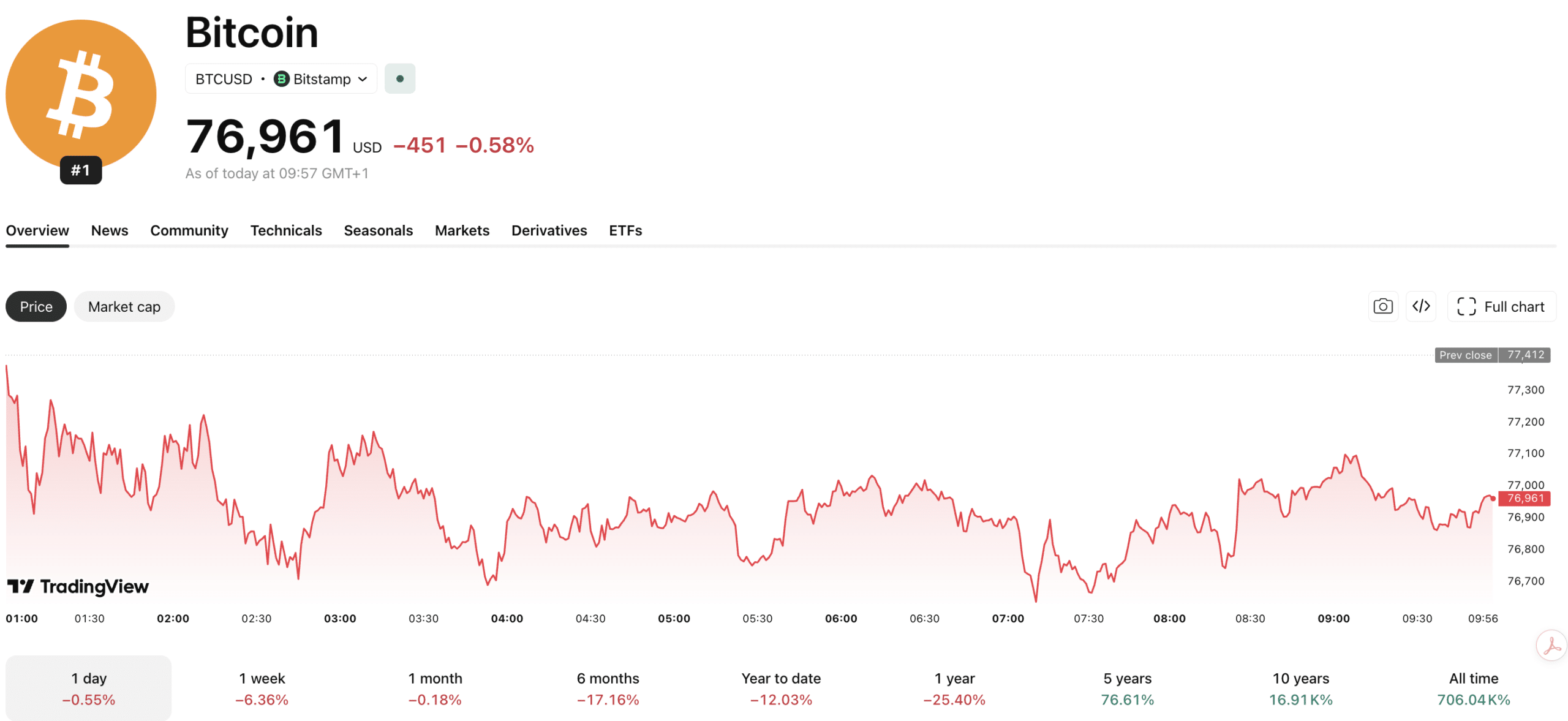
(SOURCE: TradingView)
Bitcoin News Today: Bitcoin Filing Bankruptcy and What Chapter 11 Really Means
Think of Chapter 11 as a restaurant that locks its doors, posts a sign that says “closed for renovation,” and brings in a judge to supervise while it figures out how to pay its debts, compared to Chapter 7, where the same restaurant auctions off every table and chair and never reopens. Chapter 11 is a restructuring tool, not necessarily a death sentence.
In the case of Bitcoin Depot, the company filed voluntarily and states that it intends to cease operations and sell its assets in a court-ordered and supervised process.
The company retained Vinson & Elkins LLP as bankruptcy advisor and Portage Point Partners as restructuring advisor, signaling a structured sale of assets rather than an abrupt demise. Canadian entities are drawn into the same American legal process; operations in other countries will cease in accordance with local law.
A key detail missing from most headlines is that Bitcoin Depot’s machines are already offline. This radically changes the practical issues for users. This is not about restructuring a business while continuing to serve its customers; this is a company that has already stopped serving its customers and is now determining what happens next under the supervision of the court.
Bitcoin Depot voluntarily entered Chapter 11 after regulatory pressure made its business model unsustainable.
The company cited stricter compliance rules, transaction limits, lawsuits and… pic.twitter.com/bLGTCWR6bV
– Nehal (@nehalzzzz1) May 18, 2026
DISCOVER: 99Bitcoin Readers – Earn $10 USDC when you sign up for Binance
Is your money safe? What happens to pending transactions
The answer depends on one thing: whether your Bitcoin transaction was confirmed on the blockchain before the network went dark. If you used a Bitcoin Depot kiosk, deposited money, and received confirmation that Bitcoin was sent to your wallet address and that transaction was confirmed on-chain, your Bitcoin is yours.
If your transaction has been initiated but not yet confirmed, money has been deposited and the receipt has been printed, but Bitcoin does not yet appear in your wallet, your situation is unclear. In a standard Bitcoin ATM transaction, the machine collects your money and then broadcasts a transaction to the network.
If the network went offline before the broadcast, or the transaction remains stuck as unconfirmed, you may need to file a claim in bankruptcy court. You can track the status of any transaction using your wallet address on a public block explorer; if it does not appear, the funds may be in limbo.
In practice: locate your transaction receipt, note your wallet address and any transaction ID printed on it, and check that address on a public block explorer to see if Bitcoin has arrived.
If nothing appears, document everything and monitor the official file site on the Kroll Restructuring Portal for claims procedures. Don’t assume the funds are gone, but don’t assume they will come back quickly either.
Why Bitcoin ATMs Carry Unique Risks and Why Bankruptcy Amplifies Each One
Interesting moment.
I recently exposed Bitcoin Depot for a 3-day time frame to report a $3.6 million exploit and highlighted how its Bitcoin ATM business depends on predatory practices via user fraud. pic.twitter.com/yMR0n8bLHC
-ZachXBT (@zachxbt) May 18, 2026
In other Bitcoin news today, before the bankruptcy, Bitcoin ATMs were already among the riskiest and most expensive options for beginners, with fees often 10-20% higher than the market price. For example, if Bitcoin was trading at $76,000, users could pay up to $88,000. There is no FDIC insurance, no chargeback option, and minimal customer support even during normal operations.
In 2022, crypto ATM fraud reached a record $389 million, a 58% increase from the previous year, leading to lawsuits against Bitcoin Depot for allegedly facilitating scams. These legal issues contributed to a 49% drop in revenue and a shift from a profit of $12.2 million to a loss of $9.5 million in the first quarter of 2026.
During a restructuring, the risks associated with BTMs are compounded due to a lack of staff to resolve disputes and a lack of clarity regarding responsibilities if transactions fail. Currently, using a regulated exchange with transparent protections is a significantly safer alternative to purchasing Bitcoin.
EXPLORE: Best Crypto Presales with Staking Rewards
Follow 99Bitcoins on XYouTube and Telegram for more crypto news and analysis.
The article Bitcoin News Today: BTC ATM Giant Goes Bankrupt appeared first on 99Bitcoins.


