




Bitcoin suffered one of its strongest sell-offs of the year on Tuesday, falling below the six-figure threshold and making lows around the $99,000 area across major composites before rebounding. At press time, bitcoin (BTC) was hovering around $101,700 after an intraday low just above $99,000 on widely used benchmarks, marking a roughly 6% day-over-day decline and the lowest reading since June.
The decline came as U.S. stocks limped midweek, with the Nasdaq up 20.9% year-to-date and the S&P 500 up 15.1% as of Tuesday’s close — gains that underscore how bitcoin has lagged other risk assets over long stretches of 2025. That divergence, along with a growing body of ETF flow data showing multiple sessions consecutive net outflows from US bitcoin spot funds through early November, provided macroeconomic context. for a fragile crypto band. Independent figures from Farside/SoSoValue and several outlets indicate a cumulative loss of approximately $1.3 billion to $1.4 billion over four trading days through November 3 and 4, led by BlackRock’s IBIT.
Why is the price of Bitcoin falling?
In this context, Joe Consorti, head of growth at Horizon (Therea, YC), says the sell-off is less a loss of conviction than a structural transfer of supply. In a video analysis posted on November 4 US time, he described the day’s development as “one of the toughest days of the year, down over 6%, falling to $99,000 for the first time since June,” adding that while stocks would call this “the start of a bear market…for Bitcoin, however, it is typical of a bull market pullback.” He noted that “we have already suffered two separate 30% declines during this bull run” and called the current action “a transfer of Bitcoin’s ownership base from the old guard to the new guard.”
Related reading
Consorti anchored its thesis in a now-viral framework from macro-investor Jordi Visser: the “silent IPO” of Bitcoin. In Visser’s Substack essay, widely shared since the weekend, he posits that pricing in a 2025 range belies an orderly, IPO-like distribution as early holders access the most liquidity the asset has ever had through ETFs, institutional custodians and corporate balance sheets.
“Early-stage investors… need liquidity. They need an exit. They need to diversify,” Visser wrote, arguing that methodical selling “results in a routine that drives everyone crazy.” Consorti adopted the framework bluntly: “This is not a panic sell-off, it is the natural evolution of an asset that has reached maturity… a transfer of ownership from concentrated to distributed hands. »
Evidence of this unsubscription was visible on the channel. Multiple cases of Satoshi-era miner wallets and addresses being revived this quarter (some after 14 years) have been documented, including July’s duo of 10,000 BTC wallets and the late October move from a 4,000 BTC miner address. Although this does not necessarily mean that the parts are sold on the market, this trend is consistent with a redistribution of supply from early concentrates to broader, regulated channels.
Technically, Consorti introduced gout as part of “digestion,” not exhaustion. “The RSI tells us that Bitcoin is at its highest oversold level since April, when the last leg of the bull run began. Every pullback in this cycle, 30%, 35% and now 20%, has built support rather than destroying it.” He added a key condition: “If we spend too much time below $100,000, it could suggest that the distribution is not being made…perhaps we are heading towards a reversal from bull market to bear market.”
The macro, however, is intrusive. The Federal Reserve cut rates by 25 basis points on October 29, to a target range of 3.75% to 4.00%, but Chairman Jerome Powell carefully pushed back on the idea of an automatic cut in December, citing “widely divergent views” within the FOMC and a “data fog” due to the ongoing government shutdown. Markets quickly tempered their odds of further short-term easing. The Consorti’s warning that bitcoin “is extremely correlated” to withdrawals from risky assets is therefore of great importance: if stocks fall significantly or funding tensions re-emerge, crypto will feel it.
Related reading
If Visser’s “silent IPO” is correct, ETFs are both a symptom and a cure. They provided the bilateral depth needed to absorb existing supply, but also introduced a new, faster cohort whose buyouts can amplify downdrafts. This dynamic was on display again this week in IBIT’s four-day series of concentrated net outflows, even though long-term assets under management remain enormous by historical standards.
Consorti’s conclusion was decidedly patient and not euphoric. “For every seller looking to liquidate their position, a new participant steps in over the long term… It’s slow, it’s uneven, and it’s psychologically exhausting, but once complete, it unlocks the next step higher. Because the marginal seller is gone, and what’s left is a base of holders who don’t need to sell.”
Whether Tuesday’s crossing of the six-figure bottom proves the climactic breakout – or just another chapter in a months-long ownership shift – will depend on how quickly prices recover and bases above $100,000, how ETF flows stabilize and whether the Fed’s path from there restores risk appetite or starves it. For now, the most important Bitcoin story may be happening beneath the surface, not on the chart.
At press time, BTC was trading at $101,865.
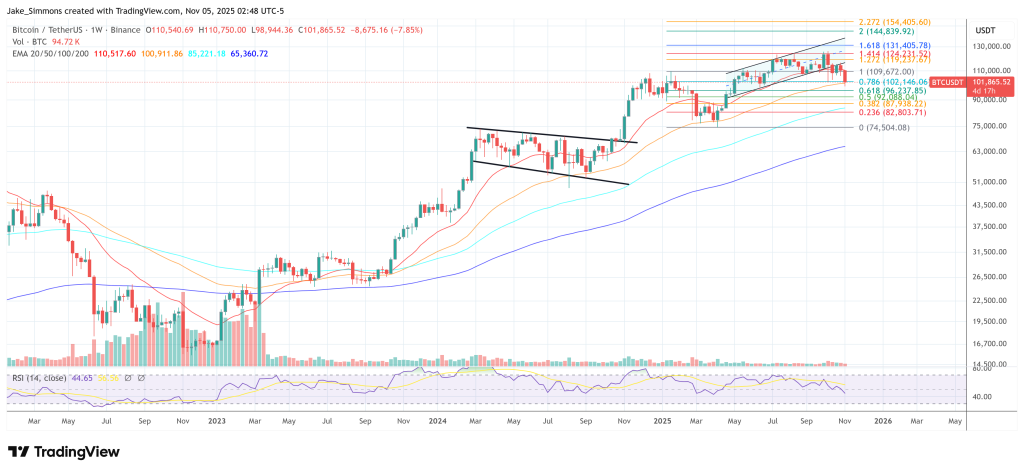
Featured image created with DALL.E, chart from TradingView.com


