




Bitget CEO Gracy Chen posted on X on April 7, calling out Hyperliquid “immature, unethical and unprofessional” – and called the platform an overmarketed fake crypto DEX that poses ‘FTX 2.0’ risks for users. The post landed like a grenade on Crypto Twitter, sparking one of the sharpest CEX vs DEX trades the industry has seen in years.
It’s not background noise. Hyperliquid has generated significant volume – consistently over $1 billion in daily transactions, directly cannibalizing the perpetual businesses of mid- and upper-tier centralized exchanges, including Bitget.
- The accusation: Gracy Chen, CEO of Bitget, publicly called Hyperliquid a ‘over-commercialized’ fake DEX on April 7, warning of systemic risks comparable to FTX and describing it as a “Offshore CEX without KYC/AML. »
- The trigger: Hyperliquid’s small set of validators unanimously delisted the JELLY memecoin perpiste market on March 26 and forcefully settled positions at $0.0095 after an attacker used a $6 million short to exploit the HLP vault, exposing the platform’s centralized emergency replacement capability.
- Structural criticism: Chen argued that Hyperliquid’s mixed vaults expose all users to collective risk from individual manipulators, and that foundation-level intervention in open markets establishes a ‘dangerous precedent.’
- The volumetric context: The growth of Hyperliquid’s HYPE tokens and platform poses a direct threat to CEX’s stakeholder revenues – making Chen’s criticism fall somewhere between principled concern and competitive self-interest.
- Industry breakdown: BitMEX co-founder Arthur Hayes echoed decentralization concerns but downplayed the long-term damage; The Hyperliquid community reacted strongly, accusing Chen of confusing valid criticism with CEX protectionism.
- What’s next: Hyperliquid reported validator extensions and HLP upgrades after JELLY; Bitget’s volume figures for Q2 2026 will indicate whether the controversy has changed any market share.
Discover: The Best Crypto Exchanges for Active Traders
What Chen Really Said and Why the Liquidity Hit a Nerve
Chen’s message was direct: hyperliquid works like a “Offshore CEX without KYC/AML” dressed in the DeFi brand, and the JELLY incident proved it. Its main mission – that the decision to close the JELLY market and force positions “creates a dangerous precedent” – targeted the exact mechanism Hyperliquid uses to separate itself from traditional finance: on-chain, non-custodial execution with validator consensus.
Update: Gracy Chen, CEO of Bitget, calls out Hyperliquid saying it operates more like an offshore CEX than a true DEX.
She highlighted the JELLY token incident in 2025, in which the platform closed the market and forcefully settled positions, leading to significant user losses.
This restarts the… pic.twitter.com/uy1zxCgLK2
—OGAudit
Cryptocurrency Reviews (@OGAudit) April 7, 2026
 Cryptocurrency Reviews (@OGAudit)
 The March 26 JELLY incident gave bite to Chen’s criticism. An attacker opened a $6 million short position in the new perp JELLY memecoin – a token launched in January 2025 by Venmo co-founder Iqram Magdon-Ismail – then increased the token’s on-chain price to trigger self-liquidation, threatening over $10 million in losses for the HLP vault.
Hyperliquid validators responded by unanimously delisting the market and forcing a settlement at $0.0095, protecting the vault but canceling users’ open positions in the process.
This intervention is living proof that Chen is working with. Hyperliquide built its brand – and its symbolic HYPE valuation on the demand for decentralization. Forced determination of user positions via coordinated validator action is not what decentralization looks like. And Chen said it loud and clear, with FTX in the title.
Explore: Best Pre-Launch Token Sales with Asymmetric Upside Potential
Why Bitget is really scaling – and what hyperliquid crypto has to lose
The real story is not just about the leadership problem. It’s the volume. Hyperliquid has consistently generated over $1 billion in perpetual daily volume – the commodity category that CEXs, such as Bitget, depend on for their fee income.
As the dynamics of centralized exchanges change and traders become more comfortable with on-chain execution, every dollar transferred to Hyperliquid is a dollar that is not cleared by a CEX order book.
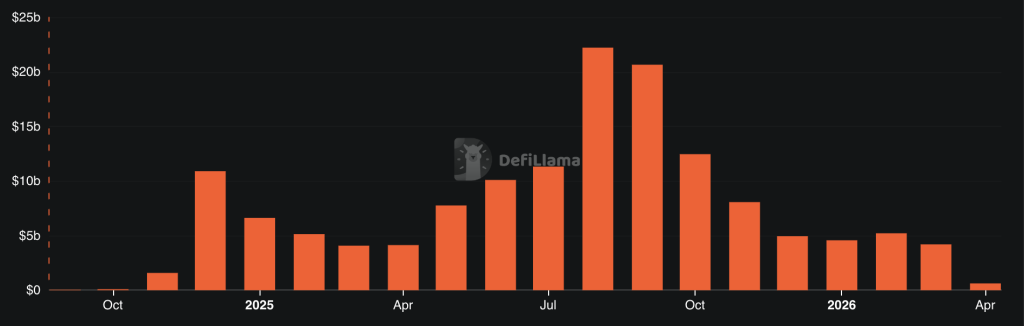
Chen’s timing is important. His message came about two weeks after the JELLY incident exposed a concrete structural failure to him.
This is not a coincidence, it is the competitive calculus of a CEO who watches market share chain-migrate and identifies the moment when the migration narrative cracks.
AP Collective founder Abhi had previously publicly detailed the self-liquidation tactic short of $6 million; Chen amplified the structural critique to a wider audience by adding a framing of the issues at the FTX level.
The HYPE token is also one of them. Hyperliquid’s native token had become an indirect bet on the platform’s continued volume growth and positioning in the expanding DeFi infrastructure landscape. Attacking the platform’s decentralization credentials directly attacks the thesis behind HYPE’s valuation – and everyone in the community knows it.
Is hyperliquid really decentralized?
Hyperliquid runs on a purpose-built L1 using HyperBFT consensus, with on-chain order matching and a non-custodial settlement model via its HyperLiquidity Provider vault.
On paper, it is very different from a CEX, no risk of withdrawal, no opaque internal correspondence. But the set of validators is small, licensed and managed by a select group – and the Hyper Foundation retains the emergency response capacity it exercised in the JELLY case without a community governance vote.
Arthur Hayes, co-founder of BitMEX, said the community should “Stop pretending that Hyperliquid is decentralized” – echoing Chen’s vision from a less commercially confrontational position.
Hayes returned to the severity, later saying that initial reactions had overestimated the reputational damage and urged a focus on the platform’s resilience.
But the structural question has not disappeared with its reassessment.
Check out: the best crypto presales live right now
The post Bitget Boss Gracy Chen Calls Hyperliquid a Fake DEX and Crypto Twitter Explodes appeared first on Cryptonews.


