



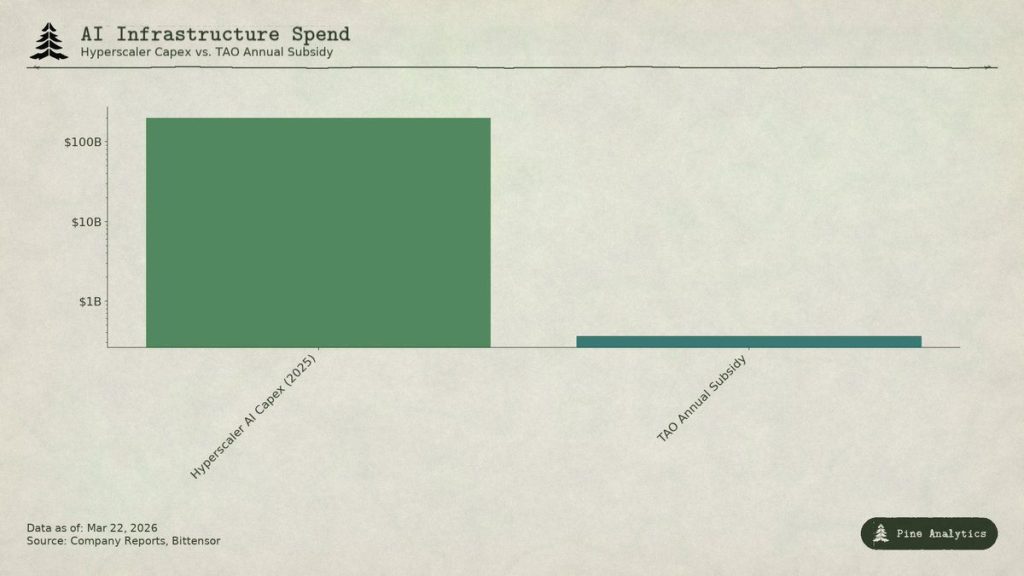
Bittensor (TAO crypto) is currently priced on an annual subsidy of $52 million, not organic revenue.
The decentralized AI protocol incentivizes its subnet to issue 518 TAOs daily to top performers like Chutes, masking a short-term liquidity crisis.
With a subnetwork market cap of $1.37 billion and an organic validation yield close to zero, the network faces a structural “revenue desert.”
Halving the TAO effectively triggers a timer on this valuation model. As TAO price has recovered from its Q1 2026 low to trade above $330, the gap between symbolic incentives and actual utility is widening. If external revenues don’t replace inflationary rewards before miners bleed out, the math no longer works.
- Dependence on emissions: Major subnets like Chutes receive $52 million in annualized subsidies while generating negligible external revenues.
- Cost reversal: Unsubsidized decentralized computing costs are approximately 1.6-3.5x higher than centralized competitors like Deepseek.
- Valuation gap: The network supports a $1.37 billion market capitalization of the subnet despite the bulk of the validator’s return coming from inflation rather than clients.
In-Depth Tao Crypto Data Analysis: The Emissions Problem
Subnets are currently paid to exist, not to serve. Falls (SN64), a top-performing subnetwork, captures approximately 14.4% of the network’s total emissions. This is approximately equivalent 518 TAÔ per day. At current market prices, this constitutes an annual operational subsidy of $52 million shared between miners and validators.
Without this subsidy, the economic situation immediately reverses. Data from Pine Analytics indicates that unsubsidized inference on Chutes would cost 1.6 to 3.5 times more than centralized competitors like Deepseek or TogetherAI.
The protocol acts as a significant subsidizer of computation, creating a cost advantage that is artificial rather than structural. When broadcasts stop covering propagation, the user value proposition evaporates. This reflects the structural inefficiencies seen in existing market infrastructures, where capital is trapped in systems that do not generate velocity.
The Halving Catalyst: Why Time is Running Out
The TAO hlive in December 2025, daily emissions were reduced from 7,200 to 3,600 TAO. The stamp has disappeared. Miners who previously relied on large block rewards are now fighting over a shrinking pie, making “revenue desert” a solvency issue rather than just a theoretical concern.

This scarcity mechanism is designed to support the price, but it strains the business model. If organic revenue fails to replace the 3,600 TAO lost per day, miners will operate at a loss. Much like the sustainability challenges that forced Balancer Labs to restructure, Bittensor’s subnets cannot operate at a deficit indefinitely. Halving reveals which subnets are businesses and which are zombie chains feeding on inflation.
The Valuation Gap: What the Subnet’s $1.37 Billion Market Cap Really Reflects
The market currently values Bittensor subnets at approximately $1.37 billion. This figure implies a massive growth multiple based on future adoption of Crypto AI, as current organic cash flow is close to zero. The gap is glaring.
Investors pay a premium for infrastructure that is currently less efficient than centralized alternatives. In a proof-of-work system like Bittensor, the valuation must ultimately be supported by miner income.
If the price of TAO drops or the cost of the service remains high, the security budget collapses. The current price of $332 assumes a smooth transition from subsidized growth to organic profitability. The data does not yet support this hypothesis.
The article Bittensor Income Desert: Why $52M in Subsidies Masks Crypto Valuation Risk TAO appeared first on Cryptonews.


