



Ethereum price spent much of the previous cycle lagging its own institutional and on-chain progress, and Bitwise says the reason is simple: ETH still trades primarily as a Bitcoin proxy, not as a fundamentally valued network. In a new factor model analysis, the asset manager found that BTC has been the dominant force in ETH’s weekly returns since 2018, with macroeconomic conditions, network activity and ETP flows playing a secondary role.
This discovery is important because it flies in the face of one of the most persistent narratives around Ethereum. Regulatory clarity has improved, institutional access has expanded, and Ethereum still underpins a significant portion of stablecoin and tokenized asset activity. Still, ETH remains about 62% below its all-time high, a disconnect that Bitwise attempted to explain with a model based on 406 weekly observations dating back to May 2018.
The answer, at least statistically, is that Bitcoin outperforms almost everything else. Bitwise said ETH “moves nearly 1:1 with BTC on a weekly basis,” with a coefficient of around 0.99. BTC alone explains about 65% of Ethereum’s return variance, clearly making it the primary driver of price direction.
Related reading
The firm’s broader conclusion is stark. “Adoption fundamentals, such as active addresses, clearly have less impact on the price of Ethereum than many believe,” the report said. “Broadening this out, revenue generation seems even less relevant, as it has been removed from the GETS model as “noise rather than signal.” The combination of these two findings supports the idea that since the model began in 2018, Ethereum’s price has more closely resembled that of a network-driven commodity than a business with sustainable cash flows.
Other Factors Impacting Ethereum Price
This framing is reflected in the rest of the report. Financial conditions, measured by the Bloomberg US Financial Conditions Index, emerged as the second most important explanatory variable. Bitwise assigned the factor a coefficient of around 0.05, with an average explanatory power of 11.3%, although this rises to around 40% at peak periods. Network activity, represented by active addresses, had a smaller coefficient, close to 0.03, and an average explanatory power of 6%, rising to 30% in stronger phases.
ETF flows showed a different trend. Their coefficient was only about 0.01, but Bitwise said they were “highly significant,” explaining about 10% of the variance in ETH on average and up to 40% at maximum. In other words, flows matter consistently, but not with the same strength as BTC-led market beta.
This distinction becomes clearer in different market regimes. Between June and August 2025, Bitwise said Ethereum behaved like a leveraged Bitcoin exchange, with its BTC coefficient increasing between 1.5 and 1.6 as BTC approached new highs.
Related reading
During the post-FTX stress period in the second half of 2022, the dynamic became even harsher: “All factors except BTC had a negative coefficient, as returns were up to 90% explained by BTC. In times like these, what matters is the liquidity of cash. Not fundamentals, flows, or macro. As such, ETH was essentially anchored to BTC.”
There have been exceptions. Bitwise identified May 2021 as the lowest BTC sensitivity period, when Bitcoin had already peaked but Ethereum continued to recover as active addresses increased during the NFT boom. Yet these idiosyncratic windows seem episodic rather than structural.
The report also challenges the idea that a richer multifactor framework significantly improves short-term forecasting. Although the model explains historical returns quite well, Bitwise said its out-of-sample performance failed to beat a much simpler AR(1)+BTC model. Most of the predictive value came from Bitcoin exposure and price persistence, while other factors added only limited predictive power.
This leaves Ethereum in what Bitwise called a “paradoxical position”: a network with growing institutional relevance, a dominant stablecoin and tokenization market share, and an increasingly focused roadmap, but a price still determined primarily by external beta.
At press time, ETH was trading at $2,305.
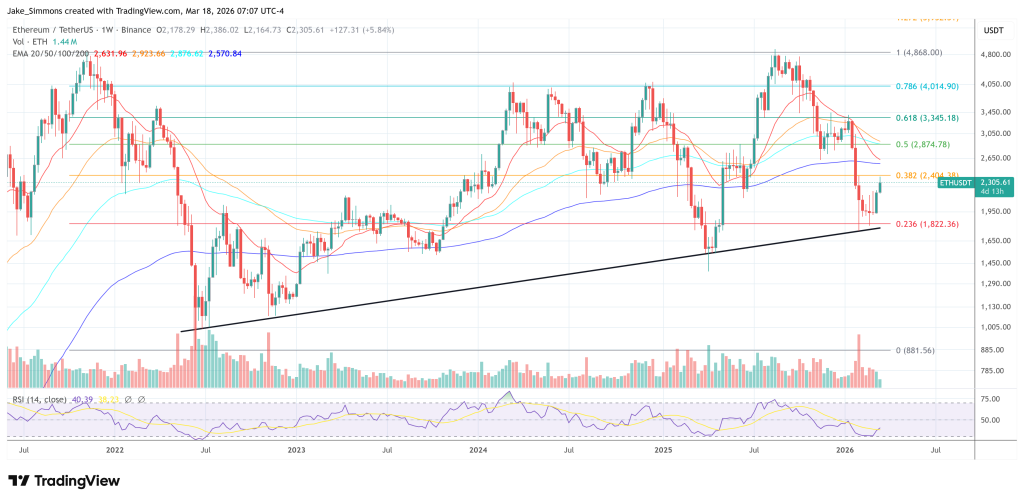
Featured image created with DALL.E, chart from TradingView.com


