





Vitalik Buterin argues that Ethereum’s long-term credibility depends on a standard generally applied to applications, not base layers: the chain should remain meaningfully usable even if its managers “walk away.” In a January 12 post on
Buterin’s premise is that Ethereum’s fundamental promise fails if the protocol itself depends on continuous, human-managed upgrades to remain secure and competitive. “But building such applications is not possible on a base layer that itself depends on continuous updates from a vendor in order to continue to be usable – even if that ‘vendor’ is the primary development process,” he wrote. “Ethereum blockchain must have the characteristics that we are looking for in Ethereum applications. Therefore, Ethereum itself must pass the exit test.”
Ethereum cannot rely on endless upgrades
The post arrives amid a broader, recurring tension in Ethereum culture: the desire to continue evolving against the benefits of stability. Buterin’s wording does not call for freezing the protocol immediately. Instead, he argues that Ethereum should reach a position where it could “ossify” without sacrificing its value proposition.
“That means Ethereum has to get to a place where we can ossify if we want to,” Buterin said. “We shouldn’t stop making changes to the protocol, but we need to get to a point where Ethereum’s value proposition isn’t strictly dependent on features that aren’t already in the protocol.” In other words, Ethereum can continue to improve, but it shouldn’t be necessary to remain a credible foundation for sustainable user-owned systems.
From there, Buterin outlines the technical and economic conditions that he considers prerequisites for passing the test. The most time-sensitive topic in its framing is cryptography. “Total quantum resistance” should not be seen as an improvement to be postponed until the last possible moment, he says, warning against “the trap” of delaying in exchange for short-term effectiveness.
According to him, the protocol should be able to make a simple statement about long-term security: being able to say that Ethereum “as it is today is cryptographically secure for a hundred years.”
Scalability is presented as an architectural destination rather than a perpetual series of feature-driven forks. Buterin highlights “ZK-EVM validation and data sampling via PeerDAS” as key elements, and suggests an ideal end state where improvements increasingly come via “parameter-only” changes, potentially implemented by validator voting mechanisms similar to how the gas limit can be adjusted.
It also highlights that the state’s growth constitutes a sustainability risk that must be addressed at the protocol level. The goal, as he describes it, is a “state architecture that can last for decades,” including “partial statelessness and state expiration,” so that maintaining thousands of transactions per second over long periods of time does not make timing or hardware requirements untenable. Along with this, it signals scalable storage structures suitable for this environment.
Other elements of the framework target known fault lines for decentralized execution: moving toward a more general account model via “full account abstraction,” ensuring gas timing is resilient to denial-of-service risks during execution and ZK proofing, and strengthening the economics of proof-of-stake so the system “can endure and remain decentralized for decades,” including the role of ETH as “trustless collateral.”
Finally, Buterin points out that block building is a centralization pressure point, saying that Ethereum needs a model that can “withstand centralization pressure and guarantee censorship resistance even in unknown future environments.”
Buterin’s final message is less about a single roadmap item and more about a governance and engineering posture: do the heavy lifting now so that later progress can be dominated by customer optimization and parameter tuning, not perpetual rework.
At press time, ETH was trading at $3,132.
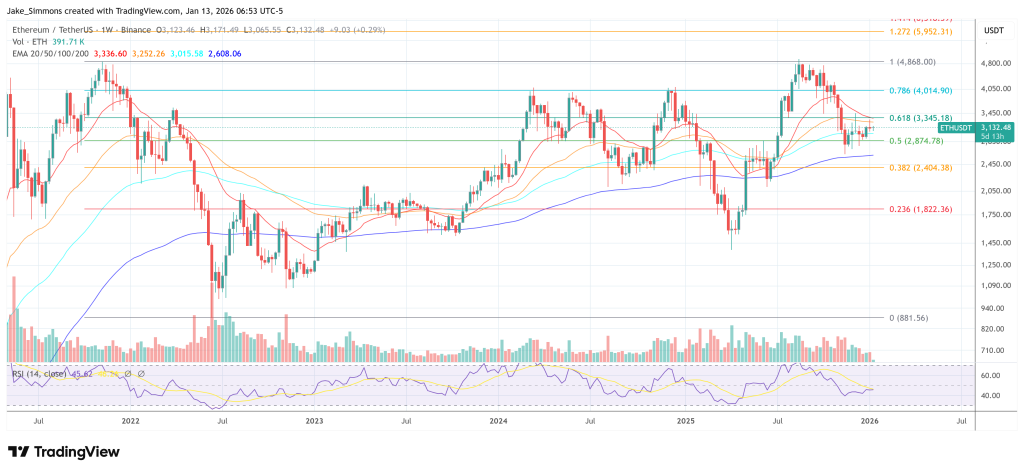
Featured image created with DALL.E, chart from TradingView.com
Editorial process as Bitcoinist focuses on providing thoroughly researched, accurate and unbiased content. We follow strict sourcing standards and every page undergoes careful review by our team of top technology experts and seasoned editors. This process ensures the integrity, relevance and value of our content to our readers.


