



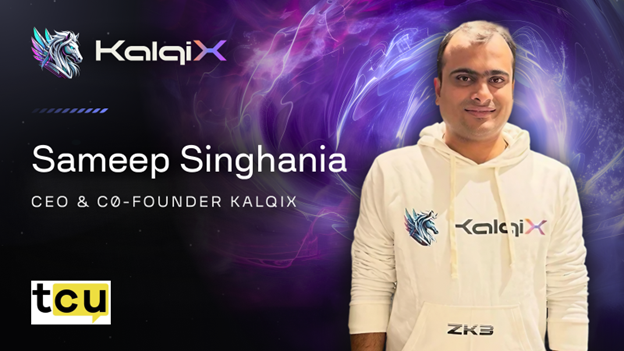

As decentralized finance continues to mature, the industry is rapidly moving toward a more efficient, scalable, and institution-ready infrastructure. At the center of this evolution is Sameep Singhania, co-founder and CEO of KalqiX and a key force behind Quick exchangeone of Polygon’s leading decentralized exchanges.
With roots in blockchain development dating back to 2017, Sameep has always been ahead of the curve, contributing to the growth of DeFi from its early experimental phase to today’s multi-billion dollar ecosystem. Now, with KalqiX, he is focused on solving some of the most persistent challenges in cryptocurrency trading by introducing a zero-knowledge-powered central limit order book (CLOB), a model designed to combine the speed of centralized trading with the transparency and security of decentralized systems.
In this interview, Sameep shares his journey, key lessons learned from building DeFi, and how KalqiX aims to redefine the future of on-chain trading.
T1. You’ve been developing Web3 since 2017 and played a key role in scaling QuickSwap. What initially attracted you to blockchain and how has your view of DeFi evolved over the years?
Answer: In 2017, after leaving my 9-6 job, I started freelancing, and that’s when I landed my first blockchain project. I was amazed by what crypto has made possible. The ability to transact with anyone in the world in minutes, without needing to trust an intermediary, completely changed my perspective. That’s when I decided to pursue a career in this field.
The goal of DeFi has always been to enable fast, secure, and fair transactions on a global scale, and I have been part of this movement since its beginning. Early on, the focus was primarily on enabling trustless transactions, with less emphasis on user experience and speed. But now that the basic idea has been proven, I see the next major change happening to make DeFi faster, more user-friendly, and more accessible to the general public. We are moving from proof of concept to production-grade DeFi.
Q2. QuickSwap has become one of Polygon’s largest DEXs, reaching significant daily volumes. What were the biggest lessons you learned while building and scaling to this level?
Answer: One of the biggest lessons I learned was the importance of building long-term partnerships and integrations. QuickSwap has nearly 5,000 integrations, and this network effect is what makes it so resilient and powerful on Polygon.
Another major lesson is that user experience matters more than pure technological innovation. No matter how advanced the technology, its adoption ultimately depends on how simple and intuitive the product is for users.
Q3. KalqiX uses a zero-knowledge powered order book. How is this different from traditional DEX models and why is it important?
Answer: Traditional DEX models typically rely on AMMs or application chain-based designs. While both approaches have their strengths, neither is truly globally scalable for high-performance trading.
KalqiX uses zero-knowledge technology to deliver the same type of efficiency and performance that users expect from platforms like Binance or Coinbase, while remaining trustless. The market can verify that transactions are valid, fair and correctly executed without exposing the sensitive details behind them. This is important because it helps eliminate MEV mining, improves execution quality, and provides high speed while remaining on-chain and non-custodial.
Q4. You’ve talked about ending the “age of compromise” in crypto, a concept at the heart of KalqiX. Simply put, what does this era represent and how do you plan to end it?
Answer: The “age of compromise” represents the reality that traders today are forced to compromise. You can have speed, privacy, or lack of trust, but usually not all three at the same time.
Every public exchange reveals a strategy. MEV bots unobtrusively extract value from users. And if you want real performance, you’re often pushed toward centralized exchanges, where you give up custody of your assets and must trust that trades are executed fairly.
The idea behind KalqiX is simple: we move sensitive business information such as intent, size, and strategy into a zero-knowledge layer. This allows the market to verify that transactions are valid, fair and correctly executed without exposing the underlying details. In practice, this provides traders with centralized performance at the exchange level with trust, transparency, and verified matching at the DeFi level.
Q5. As DeFi matures and institutional players enter the space, how do you see platforms like KalqiX balancing performance and decentralization?
Answer: In my opinion, we do not need decentralization everywhere. The main goal of Bitcoin, the first major application of blockchain, was to enable truly trustless transactions, and at the time, decentralization was the only practical way to achieve this.
But today, thanks to advances in research and zero-knowledge hardware, we can achieve the same level of lack of trust without requiring complete decentralization at every level. I think this is a massive change because it allows us to build completely trustless systems at the scale and performance level of platforms like Binance or even traditional exchanges like NASDAQ.
And this is exactly what serious institutional players need. Every mature market eventually moves toward privacy, fairness, and performance, and I think that’s where DeFi is heading too.
Final take
Sameep Singhania‘s journey reflects the broader transformation of decentralized finance, from early innovations to building robust, high-performance infrastructure. With KalqiX, it takes a bold step toward eliminating long-standing tradeoffs between speed, efficiency, and decentralization.
As the next phase of DeFi unfolds, solutions like zero-knowledge order books could play a crucial role in bridging the gap between traditional finance and blockchain technology, paving the way for a more transparent and scalable trading experience.


