



Key takeaways
Why did the whale lose $6 million?
Low liquidity caused fluctuations and subsequent devaluation of the funds traded.
What is the status of Cardano DeFi?
In addition to a relatively low TVL, the Cardano ecosystem is struggling with a limited supply of stablecoins.
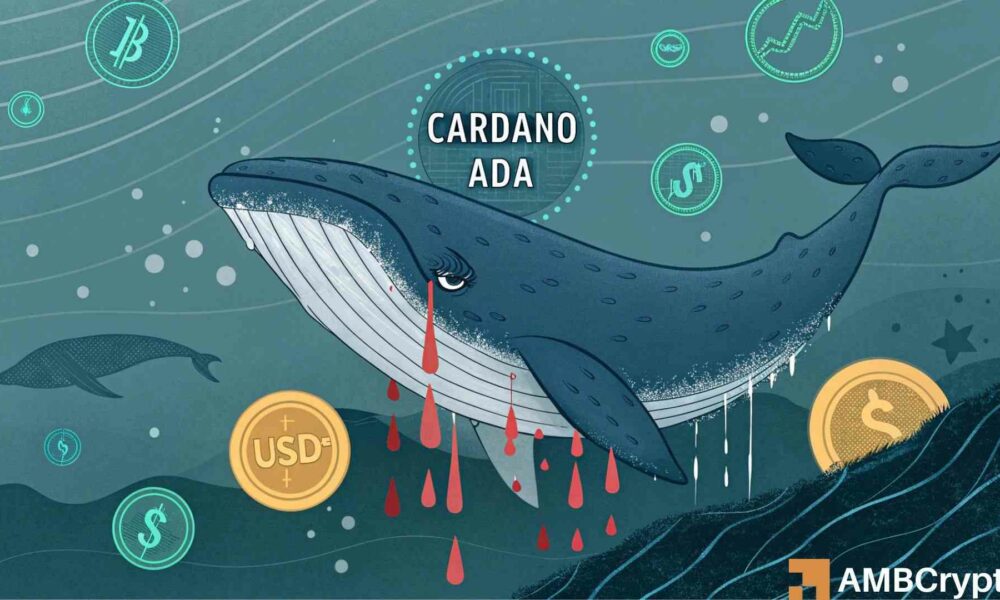
A Cardano (ADA) Whale received a painful lesson about trading on illiquid platforms this weekend.
The 5-year holder traded 14.4 million ADA tokens, worth $6.9 million, for just 847,695 USDA, a little-known USD-backed stablecoin by Anzens on the Cardano blockchain.
This resulted in a loss of $6.05 million, or a devaluation of approximately 90% of its initially transferred ADA reserve. According to a renowned Web3 security analyst ZachXBTthe fluctuation was due to the low liquidity of the stablecoin.

Source: ZachXBT/Telegram
Interestingly, the whale made a small transfer as a test before making the big ill-fated transfer. As of this writing, it has picked up Turtlecoin (TRTL) and other lesser-known coins.
Cardano DeFi liquidity problem
That said, Anzens USDA only had a market cap of $10 million, highlighting its liquidity risk, especially for large transactions.
For a frictionless trading experience, the volume and liquidity of a platform, as well as its assets, are always crucial.
Players can enter and exit positions smoothly without distorting the market or incurring losses in a more liquid market.
On centralized platforms, Binance, Coinbase and others occupy high positions in terms of liquidity, which attracts players with large orders.
On blockchain platforms, DEXs on Ethereum (ETH), Hyperliquid (HYPE), Solana (SOL)And BNB Channel the platforms have demonstrated significant liquidity levels, providing a seamless experience.
But such depths are lacking in the Cardano ecosystem. Its low supply of stablecoins is one of the telltale signs of Cardano’s DeFi ineffectiveness.
There was only $38 million in stable liquidity, mainly dominated by the Dollar Moneta (USDM) and Anzens USDA.

Source: DeFiLlama
In contrast, BNB Chain has a stable supply of $13.3 billion, while Solana has a stable supply of $13.4 billion. Hyperliquid, on the other hand, weighs $4.7 billion.
In other words, Cardano has a stable coin supply of less than 0.3%, compared to Solana and BNB Chain. Its TVL (total value locked) is also relatively low ($226 million).
However, these are his L1 competitors. In June, Charles Hoskinson, the founder of Cardano, admitted that the limited supply of stablecoins was hurting its DeFi growth.
Recent integration projects with the Bitcoin(BTC) network or swapping some of the ADA treasury for BTC has received mixed reactions. However, none appear to be resolving their DeFi issues, at least at the time of writing.


