



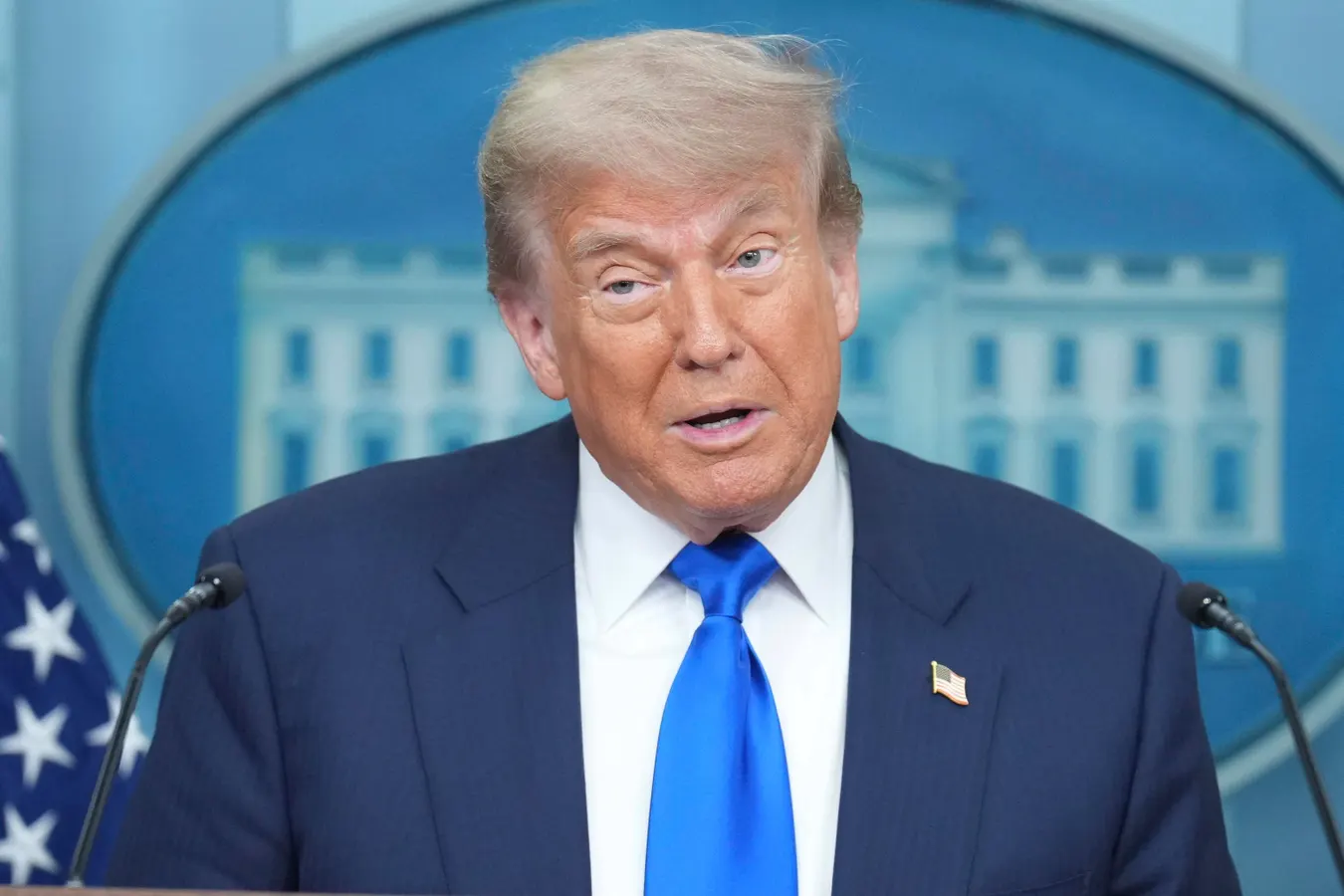

President Donald Trump is still waiting for Congress to introduce a bill on the structure of the cryptocurrency market.
Copyright 2025 The Associated Press. All rights reserved.
In a new Brookings Institution paper, Timothy Massad, former CFTC chairman and senior fellow at the Brookings Institution, argues that the best way to regulate digital assets is to combine the two key agencies involved in overseeing the U.S. market into a single markets regulator with a unified mandate for digital assets. Massad says President Trump might just be the president who can get his head around it and whose time may have finally crossed the finish line. Although Massad has been critical of Trump’s crypto profits in the past, he said in an interview: “…Look, he’s been able to do something that other presidents haven’t been able to do. And, you know, maybe this could be one of them.”
Massad argues that the cleanest way to fix the structure of the US crypto market is not to create new categories of tokens, but to merge the Securities and Exchange Commission and the Commodity Futures Trading Commission into a single authority. As he said: “The main thing that concerns me is the possibility that the proposals currently being considered could undermine securities regulation, traditional market regulation, because of the way they define this new asset class. He added: “I think these provisions are driven by the crypto industry. I think they are designed to promote existing business models and to promote technology when the law should be technology neutral.”
Why merge the SEC and CFTC
Massad’s fundamental concern is that current Congressional “market structure” proposals risk weakening fundamental securities regulation by creating a tailor-made asset class for crypto at the behest of industry lobbyists. He argues that lengthy exemptions and bespoke definitions will be exploited by lawyers and platforms to ensure lighter treatment while continuing to sell what are effectively securities to retail investors.
Merging the agencies, he said, would address the underlying problems that arise from a fragmented system, where products might fall between historic jurisdictional boundaries. This would lead to better regulation of the digital goods spot market and better disclosure rules for tokens based on their function and how they are sold. A single authority could also draft technology-neutral rules for tokenized securities, derivatives and spot digital assets, aligning “back-office” requirements such as reporting, clearing, settlement and custody for all products, regardless of their type.
A continuum, not a binary
Massad’s article pushes back against the idea that tokens are clearly divided into “securities” and “commodities.” Instead, it presents a continuum of symbolic categories in which disclosure and regulatory obligations vary depending on how the asset is used and the key issues a regulator should consider. “It makes a lot more sense to say that the two agencies should come together because they can refine this taxonomy and the disclosure rules over time, and make changes as the technology develops, the market grows, and the use cases change. That’s much better than letting Congress lock itself into definitions today based on what it hears today from industry lobbyists.”
He notes that even leading crypto venture firms like Andreessen Horowitz’s a16z have advanced multi-bucket “token taxonomies” that implicitly recognize more than a binary split. To Massad, this is precisely why a merged agency – rather than Congress – should design and refine the taxonomy over time, adjusting categories and standards as technologies and use cases evolve, instead of freezing current definitions in law, especially when the technology is still evolving.
KYC/AML and digital identity
Regarding illicit financing, Massad is blunt that the industry needs to abandon the idea that a digital financial system can rely on anonymous, or even pseudonymous, high-value transactions. “Anyone who thinks we are going to rebuild the financial system based on anonymous wallets, or even pseudonymous wallets and peer-to-peer transactions, is deluding themselves,” he said, while distinguishing small, low-risk payments – where anonymity may be tolerable – from larger flows for which authorities must be able to identify parties when there is a legal reason.
He also criticizes the current public blockchain model, calling it “upside down”: everyone can see every transaction linked to a known address, but the government cannot necessarily identify who the beneficial owner of an address is, making it difficult to enforce sanctions, anti-money laundering rules and controls against terrorist financing. Its preferred answer is a digital identity framework in which credentials are “pinged” before a smart contract is executed, enabling privacy-preserving verification while ensuring regulators can step in behind transactions if necessary; he argues that stablecoin issuers in particular should be responsible for monitoring on-chain activity and filing suspicious activity reports, not just direct KYC customers.
Trump’s role and political timing
Perhaps Massad is right, Trump may well be able to see this long-discussed consolidation through, leveraging his political capital to push Congress to realign committee jurisdictions and protect the crypto industry from future interagency turf battles that have stalled previous efforts. This argument comes at a time when Congress is already legislating digital assets, so if ever there was an opportunity to integrate a merger provision or deep coordination mechanism into broader crypto or market structure packages, it would be now.


