




When a trader clears $50 million in seconds, the industry generally assumes it is a bridge hack or sophisticated exploit. However, on Thursday, March 12, a crypto whale incinerated almost its entire balance with a single click on crypto exchange AAVE.
The user attempted to exchange $50 million worth of USDT for AAVE in a single on-chain transaction. Due to a complete lack of liquidity on an order of this magnitude, the trade suffered a catastrophic skid, returning only 324 AAVE cryptocurrencies, worth approximately $50,000, for the $50 million spent.
Poor guy traded $50 million -> $35,000 on eth mainnet
pic.twitter.com/QGW8NnTikh
– deebeez (@deeberiroz) March 12, 2026

Transaction data shows that the wallet interacted with the Aave interface via CoW Swap. According to Aave Labs founder Stani Kulechov, the interface “explicitly warned the user of an extraordinary slip-up and required confirmation via a checkbox.”
In a statement on X, CoW Swap confirmed that clear price impact warnings were displayed and the transaction followed the signed parameters. This comes down to user error and a lack of self-preservation by not using MEV bot protection.
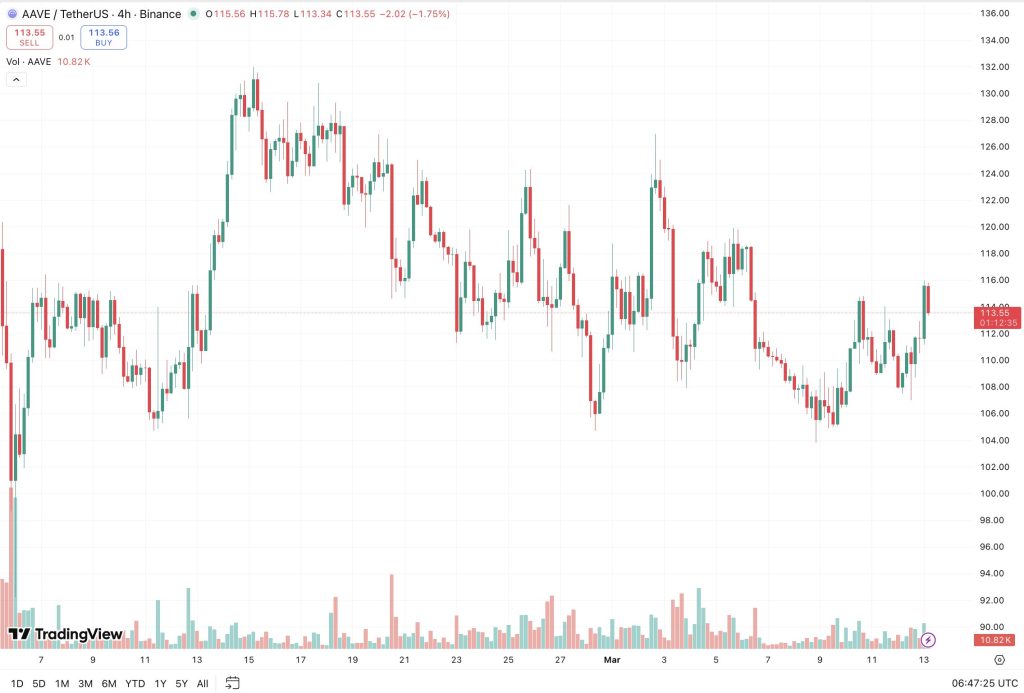
How a Single Exchange Cost a Whale $50 Million When Buying AAVE Crypto
The mechanics behind this loss are brutal but standard. Decentralized exchanges (DEXs) rely on liquidity pools. When a buy order exceeds the liquidity available at the current price, the automated market maker (AMM) moves the price up the curve to fill the order.
To fulfill the $50 million order, the protocol had to purchase available AAVE at astronomically higher prices, resulting in an average entry price that immediately wiped out capital.
This shows why institutional players typically break these transactions into thousands of small pieces or use over-the-counter desks.
As Ethereum quickly establishes itself as the backbone of institutional settlement, this event shows that the UI layer still allows for catastrophic human errors. Smart contracts do not judge the wisdom of a transaction; it only executes settings signed by the wallet.
DISCOVER: The 16 Best Meme Coins to Buy in March 2025
What this reveals about the structure of the DeFi market
This event exposes the dangerous reality of “fat finger” trading in DeFi, where human intervention or reporting systems would likely put an end to such an anomaly in traditional finance.
The current liquidity on Aave, or almost any DEX pool, cannot absorb $50 million in a single tick without massive price distortion.
Interestingly, the AAVE crypto token is up +5% in the last 24 hours, a price rise that may have been supported by an unfortunate user who purchased $50,000 worth of the token for $50 million.
We’ve seen similar risks highlighted recently, as just yesterday the Bonk.fun website was hacked, leading to a drain on user funds.
Although this incident involved malicious actors, the AAVE exchange shows that users can cause similar losses to themselves without a compromised platform.
What happens next for the whale and how to avoid its mistake
There is no reversal button on the blockchain. However, Kulechov noted that Aave Labs was attempting to contact the user to return approximately $600,000 in fees collected during the transaction.
Although this is a gesture of sympathy, it represents just over 1% of the funds lost. For the market as a whole, the lesson is stark: liquidity warnings are not suggestions.
If the interface warns you of “extraordinary slippage,” take note. And even for smaller transactions, let alone five-digit transactions, always enable MEV protection when executing transactions, thereby protecting users from sandwich and elevating attacks.
EXPLORE: Best Crypto Presales to Buy in 2026
The post AAVE Crypto Swap Costs Nearly $50M Lost: ETH MEV Pocketed $9.9M appeared first on Cryptonews.


