



Unlock the White House Watch newsletter for free
Your guide to what Trump’s second term means for Washington, business and the world
Big crypto players have turned against a landmark bill to regulate digital assets, which industry lobbyists had hastily pushed into favorable regulation before the midterm elections.
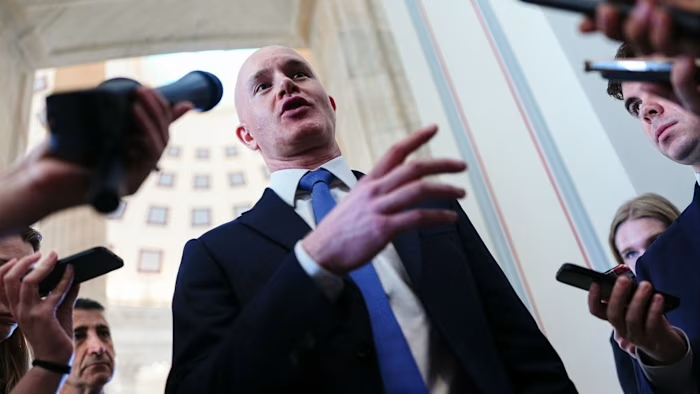
The bill known as the Clarity Act, a sweeping bill aimed at governing the multi-trillion dollar US crypto industry, was delayed in the Senate this week after Coinbase Chief Executive Brian Armstrong publicly withdrew his support.
Infighting over the legislation, a version of which passed the House of Representatives in July with the support of crypto lobbyists, jeopardizes efforts to pass the bill in the Senate before lawmakers turn their attention to this fall’s congressional elections.
“There is certainly an assumption that crypto will not have a friendly Congress after the midterms,” said Gabe Rosenberg, a partner at law firm Davis Polk. “That’s it.”
Discontent around the legislation marks the first major political setback for the US crypto industry since Donald Trump returned to the White House.
His administration has made crypto a national priority and sought to implement crypto-friendly regulations, as well as pardoning well-known crypto figures and signing the so-called Genius Act to regulate stablecoins.
The Clarity Act introduces a broad regulatory framework for digital assets, ranging from bitcoin to obscure derivatives, and determines which agency among the nation’s securities and commodities regulators should exercise oversight.
Crypto companies have faced bank lobbyists over the bill, with the main dispute over rewards paid to people with stablecoins, digital tokens pegged to the U.S. dollar.
Banks have fought to limit these rewards – arguing that allowing individuals to earn more interest on dollar-pegged tokens than on their bank accounts would lead to “deposit flight” and subprime lending.
Bank of America Chief Executive Brian Moynihan, in a conference call this week, said a movement of funds out of the traditional banking system would “reduce the lending capacity of banks, (which would) particularly hurt small and mid-sized businesses” compared to larger borrowers who have access to other sources of debt.

U.S. banks are “spending a lot of money in Washington” lobbying to stop crypto companies from paying interest, said Geoff Kendrick, global head of digital assets research at Standard Chartered, adding that banks “know they’re in trouble” when it comes to competition.
Tokens that represent stock ownership are another sticking point, with crypto players crying foul over a last-minute addition of language that would make it harder for these assets to gain permission to trade.
Jonathan Jachym, global head of policy and government relations at Kraken, said the changes “have created unnecessary friction and distraction.”
Meanwhile, decentralized finance groups are battling more traditional politicians and market makers over obligations related to anti-money laundering and other controls. They argue that these rules would make it more difficult for software developers to create cryptosystems without centralized oversight, which would hinder innovation.
Those disputes contributed to Coinbase’s last-minute change of heart and led to the cancellation of a Senate committee review, known as a markup, the day before it was scheduled to take place.
“There are a lot of forces at play here, and they came together at the last second for a bill that was still being negotiated hours before the markup itself,” said Ron Hammond, policy and advocacy manager at Wintermute.
Democratic politicians have pushed to limit officials who profit from their ties to crypto companies — a move that partly targets the Trump family’s vast crypto interests.
Crypto lobbyists fear that if Democrats gain seats after the midterm elections in November or take control of either house of Congress, the digital assets industry will face a much more skeptical environment.
The fate of the nearly 300-page bill is uncertain because the Senate is in recess and no deadline has been set for another committee vote.
“There’s always a dynamic, and that’s the main killer or driver here,” Hammond said. “The second this bill loses political momentum, I would consider it dead, but right now it has tremendous momentum because of all this outside pressure, including from the White House.”
Additional reporting by Joe Miller


