




The crypto market is trading largely lower today, with Bitcoin hovering around $88,000, Ethereum around $2,950, and XRP defending the $1.89 zone. The decline follows increased macroeconomic caution after the Federal Reserve’s rate decision, coupled with a significant crypto options expiration that amplified short-term volatility.
Macroeconomic pressures are driving risk-averse sentiment in the crypto market today
Today, selling pressure in the crypto market is driven by a combination of macroeconomic and structural factors rather than asset-specific weakness. The Federal Reserve’s decision to keep interest rates steady between 3.5% and 3.75% has provided little clarity on the timing of potential rate cuts. As a result, traders remained on the defensive, particularly amid lingering concerns about tariff-induced inflation.
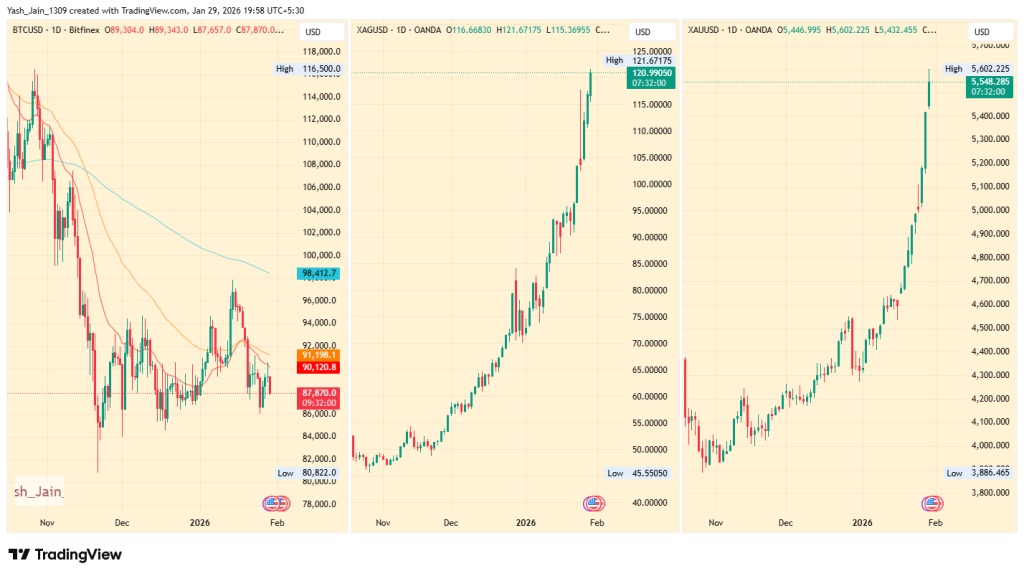
Meanwhile, exchange Deribit highlighted a concern over more than $9.5 billion worth of crypto options expiring this Friday, leading to increased hedging activity. This has increased short-term volatility while keeping directional conviction muted. At the same time, capital turned to traditional safe havens, with gold (XAU/USD) hitting record highs above $5,550 an ounce, reinforcing a broader risk-averse environment.
Bitcoin Supply Data Shows Holder Conviction Despite Price Weakness
Current sentiment is defensive and the crypto market is technically capped, as shiny metals rise. As a result, digital gold like Bitcoin continues to consolidate near $88,000, holding above the $87,000 to $87,400 support zone, clearly indicating that investors still do not view BTC as a risk-free asset, which is why it is low-key compared to the shiny metals. While short-term pressure may persist, the chart still holds, suggesting that selling pressure is being absorbed by larger players rather than accelerating price hemorrhage.
At the same time, open interest in Bitcoin also remains structurally high. This combination of sideways price action and high derivatives participation gives signals of confident positioning rather than forced liquidation. Supply distribution data reinforces this view, as addresses holding between 1,000 and 10,000 BTC continue to show an upward trend, indicating long-term accumulation behavior.
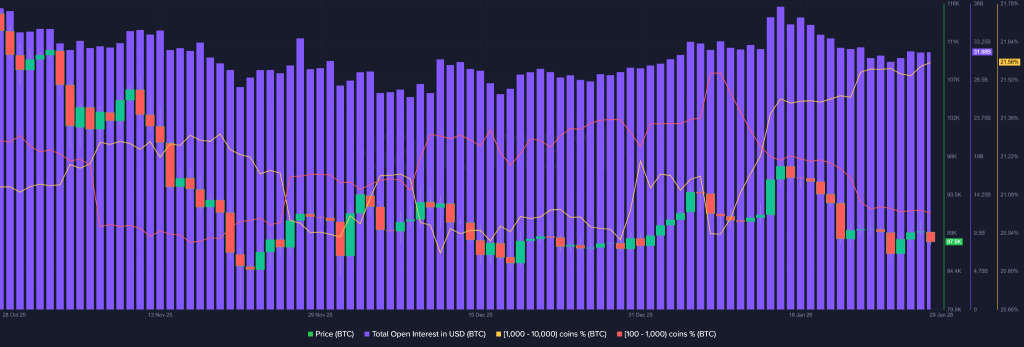
Meanwhile, holders of 100-1,000 BTC are showing controlled distribution rather than sharp outflows. This rotation generally reflects healthy market restructuring rather than capitulation, although the crypto market remains subject to macroeconomic stress today.
Ethereum Consolidation Reflects Supply Shifting to Stronger Hands
Ethereum is trading near $2,950, struggling to regain the psychological $3,000 level. Nonetheless, ETH price action remains limited above previous structural lows, leading to higher reactions in demand zones. That said, Ethereum open interest continues to grow despite a sideways move, which also suggests gradual position building.
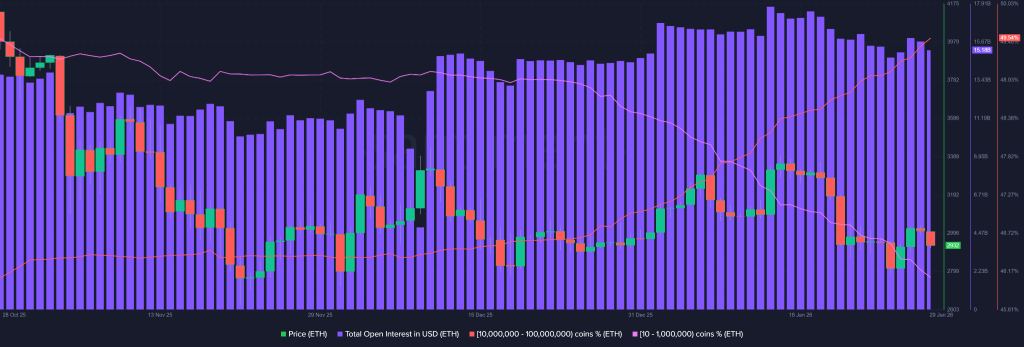
Supply metrics provide additional clarity. Addresses holding between 10,000,000 and 100,000,000 ETH remain stable, highlighting the continued dominance among large holders. In contrast, mid-tier holders between 10 and 1,000,000 ETH have reduced their exposure. This transfer of supply from weaker to stronger hands often improves the sustainability of the trend once the expansion resumes.
XRP Shows Active Participation Across All Holder Classes
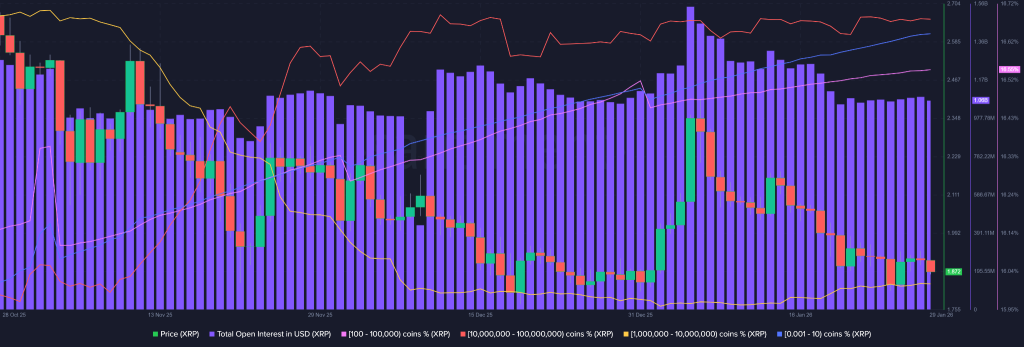
XRP has shown relative resilience against the broader market weakness, holding above $1.89 despite high volatility. Price continues to react strongly in demand areas, suggesting active participation rather than disengagement.
Notably, XRP open interest remains high during the consolidation, indicating sustained trading activity. Supply distribution data shows growth among cohorts of retailers holding 0.001 to 10 and 100 to 100,000 XRP. At the same time, the largest holders in the 1,000,000 to 10,000,000 and 10,000,000 to 100,000,000 ranges have also increased slightly since January.
Overall, the crypto market today reflects near-term caution driven by macroeconomic forces, while supply-side data on BTC, ETH, and XRP prices continues to signal structural stability rather than distribution.


