Trusted Editorial content, reviewed by leading industry experts and seasoned editors. Advertising disclosure
The crypto market continues to face intense selling pressure as Bitcoin and Ethereum struggle to regain key psychological levels. The repeated rejection near areas of resistance has reinforced the sense of caution across the sector, with investors growing more defensive after months of declining liquidity and price volatility. Although correction phases are typical after a strong bull market advance, the persistence of downward pressure suggests that a longer period of adjustment may be unfolding.
On-chain data provides additional context for this shift in market dynamics. According to a recent analysis, growth in stablecoin reserves peaked shortly before the price decline in late 2025. In the 30 days leading up to November 5, reserves increased by approximately $11.4 billion, reflecting the strong liquidity availability and risk appetite of the time. However, this trend quickly reversed as market conditions deteriorated, with reserves falling by approximately $8.4 billion on December 23 as the bear phase began to take shape.
More recently, the pace of capital outflows has moderated, with reserves falling by about $2 billion over the past month. This slowdown may indicate a stabilization of liquidity conditions, but it does not yet confirm a lasting recovery. For now, the market remains sensitive to macroeconomic conditions, capital flows and investor confidence.
Stablecoin Liquidity Concentration Highlights Binance’s Dominant Role in the Market
The data further shows that stablecoin liquidity remains heavily concentrated on Binance, reinforcing its role as the primary liquidity hub of the crypto market. Current figures indicate that the exchange holds approximately $47.5 billion in combined USDT and USDC reserves, a 31% year-over-year increase from approximately $35.9 billion. This concentration is significant, as Binance alone accounts for approximately 65% of all USDT and USDC held on centralized exchanges, underscoring its dominant position in facilitating trade flows and providing liquidity.
Other major exchanges lag significantly in terms of stablecoin reserves. OKX holds about $9.5 billion, or about a 13% share, while Coinbase holds about $5.9 billion, or about 8%. Bybit follows with almost $4 billion, which equates to around 6% of the exchange’s stablecoin liquidity. These balances are distributed primarily across the Ethereum and TRON networks, which continue to serve as the primary infrastructure layers for stablecoin settlement.
Within Binance itself, liquidity remains predominantly focused on USDT. Around $42.3 billion of its reserves are held in USDT, reflecting a 36% year-over-year increase from around $31 billion. In contrast, USDC reserves stand at nearly $5.2 billion and have remained broadly stable over the same period, suggesting stable but limited growth compared to USDT’s dominance.
Total Crypto Market Cap Tests Key Structural Support
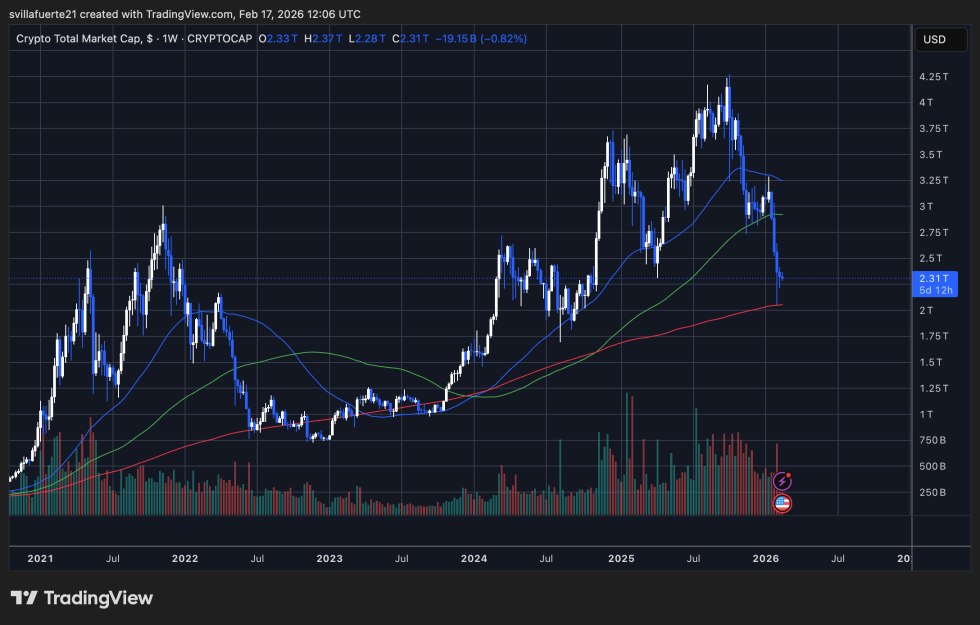
The total crypto market cap chart shows a clear corrective phase after the late 2025 peak near the $4 trillion region. Since this peak, the market has declined significantly, with capitalization recently stabilizing around the $2.3 trillion level. This area appears to be functioning as an interim support zone, although price action remains fragile and characterized by reduced upward momentum.
Total market capitalization of cryptocurrencies | Source: TOTAL chart on TradingView
From a trend perspective, the market has fallen below short-term moving averages and is now interacting with longer-term trend indicators. This change generally signals a transition from expansion to consolidation or correction. Failure to sustain bounces above the mid-range moving average suggests that buying pressure remains subdued, while sellers continue to dominate rallies.
The dynamics of the volumes reinforces this interpretation. High sales volume accompanied the most recent decline, indicating active distribution rather than passive drift. However, the subsequent moderation in volumes suggests that panic selling may be easing, although conviction buying has not yet decisively resumed.
Structurally, the broader uptrend remains intact only as long as the capitalization holds above the long-term trend support zone. A sustained breakdown below this level would likely confirm a deeper cyclical correction, while a stabilization here could support a prolonged consolidation phase before any further crypto market expansion.
Featured image from ChatGPT, chart from TradingView.com
Editorial process as Bitcoinist focuses on providing thoroughly researched, accurate and unbiased content. We follow strict sourcing standards and every page undergoes careful review by our team of top technology experts and seasoned editors. This process ensures the integrity, relevance and value of our content to our readers.