




The total supply of stablecoins increased by about $8 billion to a record $315 billion in the first quarter of 2026, even as broader crypto markets contracted, according to data released by CEX.IO – with Circle’s USDC increasing its market share while Tether’s USDT recorded its first quarterly decline in supply since the second quarter of 2022.
The divergence between the two dominant issuers marked one of the most significant structural changes in the stablecoin sector in recent years, coinciding with stablecoins capturing 75% of total crypto trading volume, the highest proportion ever recorded.
We believe the $315 billion figure underestimates the directional importance of the quarter. Converting capital into stablecoins during a period of widespread market weakness is not passive: it represents deliberate positioning, a decision by market participants to preserve dollar-denominated exposure within the crypto ecosystem rather than exiting fiat entirely.
The record share of trading volume and total trading volume of $28 trillion during the quarter reinforces the notion that stablecoins have become the primary liquidity layer of the digital asset market, a structural role that is unlikely to reverse as institutional adoption deepens.
DISCOVER: Coin Supercycle: Top Performers This Week
USDT stablecoin supply contraction: what the first quarterly decline since 2022 represents
Tether’s USDT supply declined by approximately $3 billion in the first quarter of 2026, its first net quarterly contraction since the second quarter of 2022 – a period that coincided with the collapse of the Terra-LUNA ecosystem and the subsequent crypto credit crisis.
This decline is notable precisely because it occurs in a different market context: it is not a systemic shock, but a slow decline caused by stagnating retail adoption and accumulating regulatory headwinds. USDT’s market share among stablecoins, which peaked at nearly 70% in 2022, has gradually shrunk as compliance-focused alternatives have gained institutional acceptance.
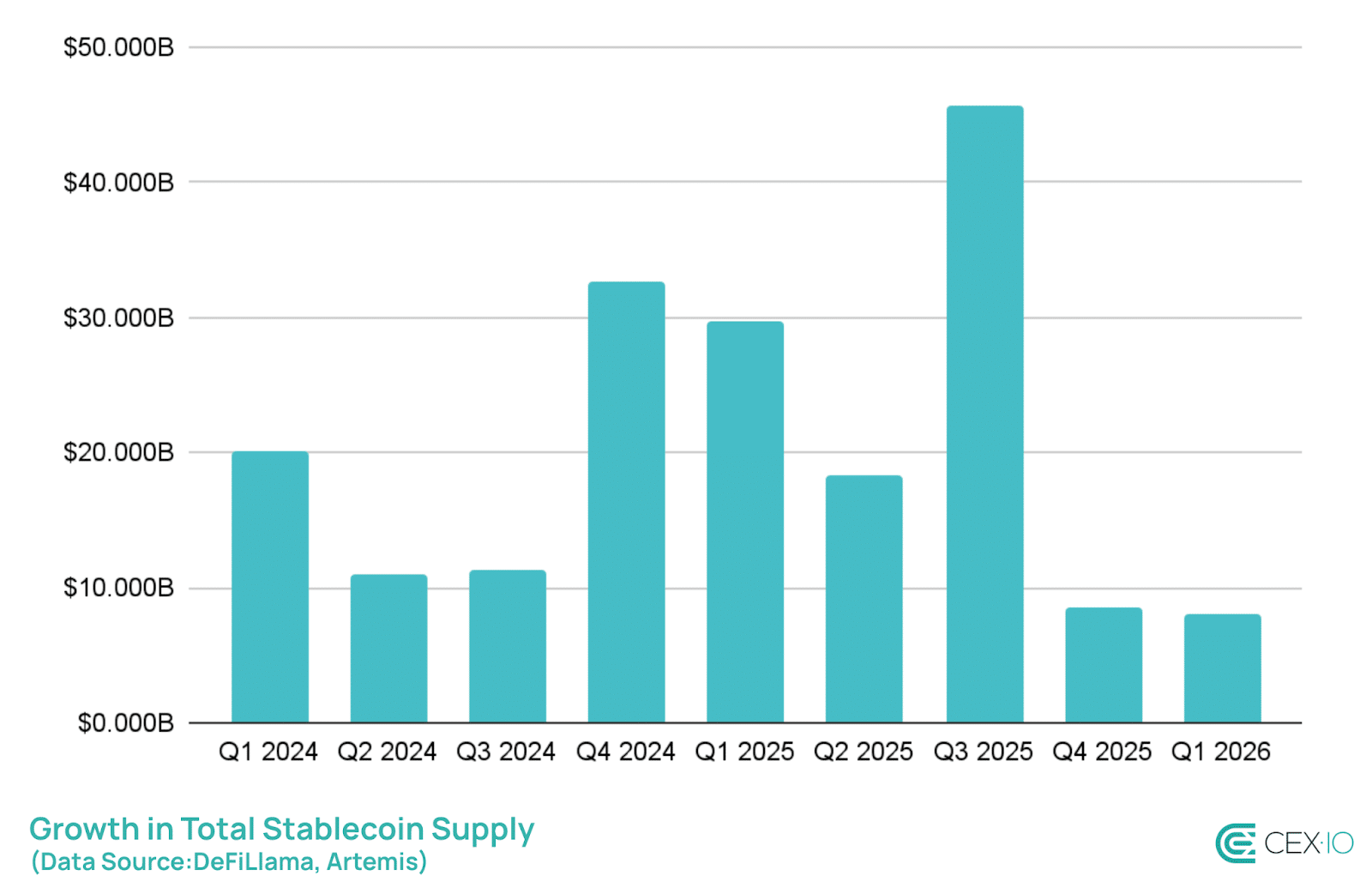
Source: CEX.IO
The mechanism behind the USDT contraction operates on two levels. At the retail demand level, CEX.IO data showing a 16% drop in retail stablecoin transfers – the steepest drop on record – is directly reflected on Tether, which has historically derived a greater share of its float from retail and emerging market usage than USDC.
At the regulatory level, the European Union’s crypto-asset markets framework has effectively reduced the distribution of USDT across EU-regulated venues, removing an important demand channel that had supported supply growth through 2024. The combination of weakening retail flows and narrowing regulatory access represents a structural headwind, not a cyclical decline, and the first quarter data should be read accordingly.
Tether has not released a quarterly report addressing the decline, and the company’s reserve certifications – while more frequent than in previous years – have not resolved lingering questions from institutional compliance officers about the composition of its collateral assets.
This unresolved opacity continues to create a bifurcation of institutional demand, with a growing share of dollar-denominated on-chain capital preferring issuers whose reserve structures can withstand the legal and regulatory scrutiny of U.S. and European jurisdictions.
EXPLORE: Crypto Breakout Alerts This Week
USDC Expansion: What the Supply Increase to $78 Billion Reflects
Circle’s USDC reached approximately $78 billion in circulating supply at the close of Q1 2026, a figure that represents growth of approximately 220% since Q4 2023 and a significantly larger share of the total stablecoin float than the issuer commanded two years ago.
Growth has been focused on Ethereum and Solana, where USDC functions as the primary settlement asset across a range of DeFi protocols, on-chain trading operations, and B2B institutional payment flows. The average transaction size is well below retail standards – around $557 per transfer – with transaction speed around 90x, patterns consistent with programmatic and algorithmic use rather than large bulk institutional transfers.
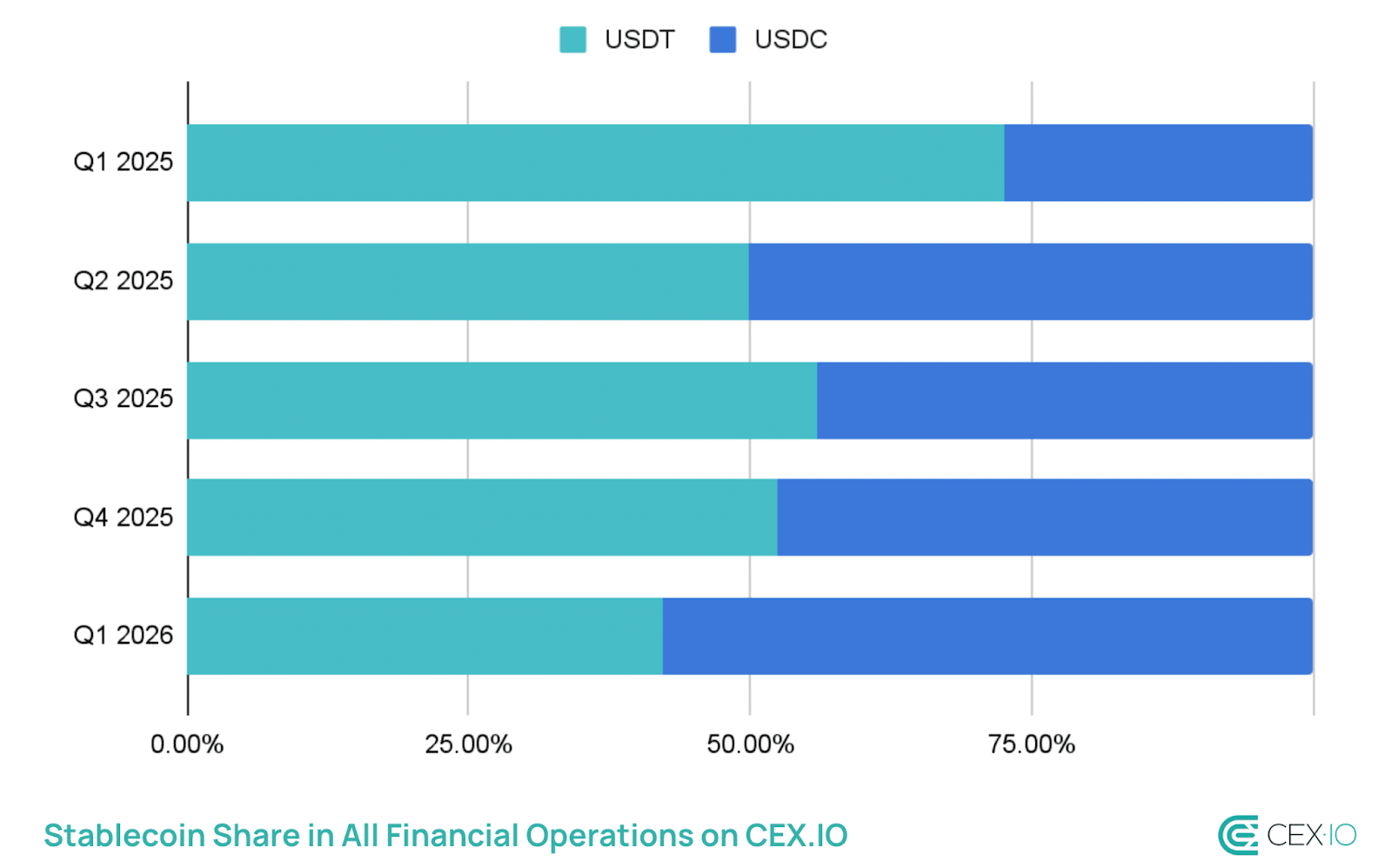
Source: CEX.IO Research
The structural catalyst behind USDC expansion lies, in our view, less in organic retail demand and more in compliance-driven issuer selection. Circle’s positioning ahead of the National Stablecoin Innovation Guidance and Establishment Act in the United States – commonly referred to as the GENIUS Act – has made USDC the default choice for treasury teams, payroll processors and financial institutions seeking a stablecoin whose reserve structure, blacklisting capabilities and regulatory disclosures align with US legal requirements.
This compliance posture involves real operational tradeoffs, as illustrated by Circle’s decision to freeze and then unblock a blacklisted USDC wallet, a move that drew criticism from parts of the crypto community but signaled to institutional counterparties that the issuer would cooperate with the legal process. This is a significantly different risk profile than USDT, and institutional capital has begun to price in the difference.
Changing regulations at the state level have added an additional tailwind. Frameworks such as those advanced by Delaware’s stablecoin banking legislation create supervised issuance pathways that favor issuers already operating under federal compliance standards – a category that USDC occupies more credibly than most of its competitors.
following
Disclaimer: Coinspeaker is committed to providing unbiased and transparent reporting. This article is intended to provide accurate and current information, but should not be considered financial or investment advice. Because market conditions can change quickly, we encourage you to verify the information for yourself and consult a professional before making any decisions based on this content.

Daniel Frances is a technical writer and Web3 educator specializing in macroeconomics and DeFi mechanics. Hailing from crypto since 2017, Daniel leverages his experience in on-chain analytics to write evidence-based reports and in-depth guides. He holds certifications from the Blockchain Council and is dedicated to providing “insight gain” that overcomes market hype to find real utility for blockchain.


