




What do a vape company, a European football investment company, market permabull Tom Lee and Sam Altman’s Worldcoin have in common?
Everyone wants to know if AI is a bubble, but there is perhaps no clearer sign of market froth than this year’s craze for crypto cash strategies, and all of the things listed above are associated with the trend’s recent explosion. A quick summary:
- July: Bitmine Immersion announces Ethereum treasury game, with Fundstrat’s Tom Lee joining the board. The stock soars 3,000% in five days.
- July: A little-known vape company sees its shares rise 800% after announcing it is embarking on a BNB treasury operation.
- September: A company that invests in football teams across Europe announces that it will begin accumulating solana. Its stock climbs 400%.
- September: Shares of a company called Eightco Holdings jumped 5,600% amid a plan to amass a trove of Worldcoin, the crypto associated with the eyeball analytics project founded by OpenAI CEO Sam Altman. Wedbush analyst and tech bull Dan Ives joins board.
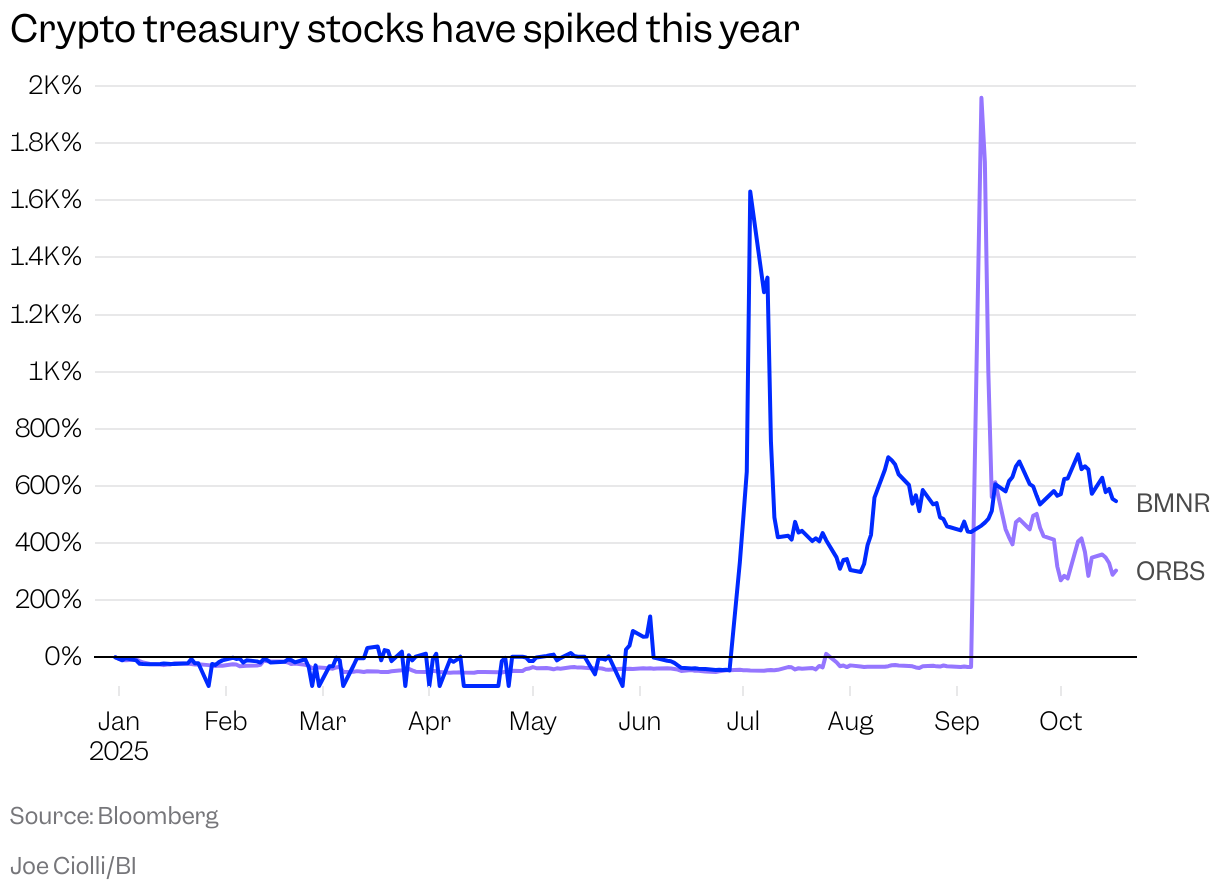
The trend has roots dating back to 2017, when a company seemingly unrelated to crypto slapped the word “blockchain” on its name and quickly saw its shares rise 500%.
Some observers this year, including crypto bull Mike Novogratz, were warning as early as August that the trend had peaked, but the surge in new Treasuries continued. For the most part, these companies are looking to replicate the success of Strategy, Michael Saylor’s business software company that went all-in on Bitcoin in 2020 and achieved stellar results for its stock price.
There are now 172 publicly traded companies that have adopted bitcoin holding strategies, and 48 appeared in the last quarter alone, Cointelegraph reported this week.
Many companies were trading at the penny stock level before getting into crypto. Many of them had little or no prior activity in digital assets. For investors, that should be a wake-up call, Chris Brodersen, managing director at Eisner Advisory Group, told Business Insider.
“I think some companies are looking at crypto as a way to save their skin,” Brodersen said.
He said he sees parallels with the dot-com boom, when small stocks soared as they announced new Internet businesses, only to quickly fall again and burn out investors eager for exposure to the shiny new technology.
According to Brodersen, investors should carefully evaluate a company’s actual business plans and strategy, as well as the digital assets it plans to hold.
Andrew Duca, founder of crypto tax platform Awaken Tax, believes the bubble in the space has already formed.
Related Stories

Business Insider tells the innovative stories you want to know
Business Insider tells the innovative stories you want to know
“Most digital asset treasuries don’t actually run on-chain businesses – they just buy tokens and call it a ‘strategy,’” he said. “This is how bubbles are born: companies chasing trends without asking why they are doing it.”
Fears about a bubble in crypto treasuries have intensified of late, as major tokens such as Bitcoin and Ethereum continue to trend downward, dragging crypto holding company stocks with them.
Duca is not surprised by this. “Companies are forced to sell, which accelerates the decline,” he said. “Confidence drops quickly as people realize how many of these Treasuries were essentially token bets with no real strategy behind them.”
Duca expressed the same concerns to Brodersen, highlighting the possibility that overleveraged Treasuries could trigger margin calls and liquidity crises by devaluing collateral.
So what happens if the bubble bursts?
“If a bubble bursts, it will likely expose companies that have adopted crypto treasury strategies purely as a lifeline rather than out of a true strategic interest in digital assets,” predicted Chris Kline, COO and co-founder of BitcoinIRA.
Kline added that, in his view, the investors who will bear the brunt of the impact are those who bought into the cash flow craze without understanding the underlying financial health of companies.


