




Ethereum co-founder Vitalik Buterin unveiled “The Splurge,” a comprehensive set of protocol upgrades aimed at addressing various challenges within the Ethereum ecosystem. In his latest blog post titled “Possible Futures of the Ethereum Protocol, Part 6: The Madness,” Buterin delves into the technical intricacies of upcoming improvements that aim to propel Ethereum toward a more performant, secure, and scalable future.
“The Splurge” is designed to tackle a set of “little things” in the design of the Ethereum protocol that don’t fit neatly into existing upgrade categories. According to Buterin, these elements are “very valuable to the success of Ethereum” but require special attention due to their complexity and importance.
What is Ethereum “madness”?
The Splurge’s primary goals include bringing the Ethereum Virtual Machine (EVM) to a higher-performance, more stable “end state” by integrating account abstraction directly into the protocol to improve security and convenience. user, optimizing transaction fee economics to increase scalability while mitigating risk. , and explore cutting-edge cryptographic techniques to significantly improve Ethereum in the long term.
Buterin highlights the need to refine the EVM, stating that “EVM today is difficult to analyze statically, making it difficult to create highly efficient implementations, formally verify the code, and make further extensions.” over time.” The introduction of the EVM Object Format (EOF) is the first step in the EVM improvement roadmap, planned for inclusion in the next hard fork. EOF introduces features such as separating code and data, banning dynamic jumps in favor of static jumps, removing gas observability in EVM code, and adding a subroutine mechanism explicit.
EOF lays the foundation for new upgrades such as EVM Modular Arithmetic Extensions (EVM-MAX) and the integration of Single-Instruction-Multiple-Data (SIMD) capabilities. These improvements aim to make EVM more efficient for advanced cryptographic operations without relying heavily on precompilations. “Once EOF is introduced, it becomes easier to introduce other upgrades,” notes Buterin.
Account abstraction has been a long-standing goal for Ethereum, aimed at allowing smart contract code to control transaction verification. “At its core, account abstraction is simple: allow transactions to be initiated by smart contracts, not just EOAs,” explains Buterin. This capability could enable a range of applications, from quantum resistance cryptography to transparent key rotation and improving wallet security.
ERC-4337 serves as a current solution to implement account abstraction without changing the core protocol. It introduces a new object called “user operations” and separates transaction processing into validation and execution phases. However, Buterin points out the inefficiencies of this approach, particularly the “fixed gas overheads of around 100,000 per pack.”
EIP-7702 is proposed to bring the practical benefits of account abstraction to all users, including external accounts (EOA), by integrating it directly into the protocol. This move could unify the ecosystem and eliminate the need for relays in privacy protocols. “The EIP-7702 today makes the ‘convenience features’ of account abstraction available to all users, including EOAs,” writes Buterin.
Although EIP-1559 improved average block inclusion times and fee predictability, Buterin acknowledges the imperfections of its implementation. He notes that “the formula is slightly imperfect” and “does not adjust quickly enough under extreme conditions.” The proposed EIP-7706 aims to address these issues by introducing multi-dimensional gas charges, enabling separate pricing and limits for different resources such as call data, state reads/writes and expansion of the size of the state.
“Multidimensional gas has two main tradeoffs: it adds complexity to the protocol and the optimal algorithm needed to fill a block to capacity,” Buterin explains. However, it suggests that the benefits in terms of efficiency and resource management could outweigh these complexities.
The introduction of Verifiable Delay Functions (VDFs) aims to improve the randomness of Ethereum’s proposator selection process. “Ideally, we would find a more robust random source,” says Buterin. VDFs could offer a solution by providing outputs that are computationally intensive to produce but easy to verify, thereby reducing the potential for manipulation. Challenges remain, such as “unexpected optimization” via hardware acceleration or parallelization. “Currently, there is no VDF construct that fully satisfies Ethereum researchers on all axes,” admits Buterin, indicating that further research and development is needed.
Additionally, Buterin explores “the distant future of cryptography” by discussing advanced concepts such as indistinguishability obfuscation and unique signatures. He calls them “Egyptian divine protocols,” extremely powerful cryptographic primitives that could revolutionize blockchain technology. Obfuscating indiscernibility allows the creation of “encrypted programs” that perform arbitrary calculations while keeping internal details hidden. “By combining obfuscation and one-time signatures, we can create near-perfect trustless third parties,” says Buterin.
Potential applications include secure DAOs and auctions, universal trust configurations, and simplified zero-knowledge proof verification. Despite their promise, these technologies are still in their infancy. “There remains a lot of things to do,” concedes Buterin. Implementations of indistinguishability obfuscation currently face significant performance hurdles, and practical quantum computers capable of enabling point signatures remain theoretical.
By tackling EVM improvements, account abstraction, transaction fee optimization, and exploring the frontiers of crypto, Buterin aims to keep Ethereum at the forefront of blockchain innovation. While recognizing the complexities and trade-offs involved, he remains optimistic. “Extremely powerful cryptography could be a complete game changer,” he concludes.
At press time, ETH was trading at $2,627.
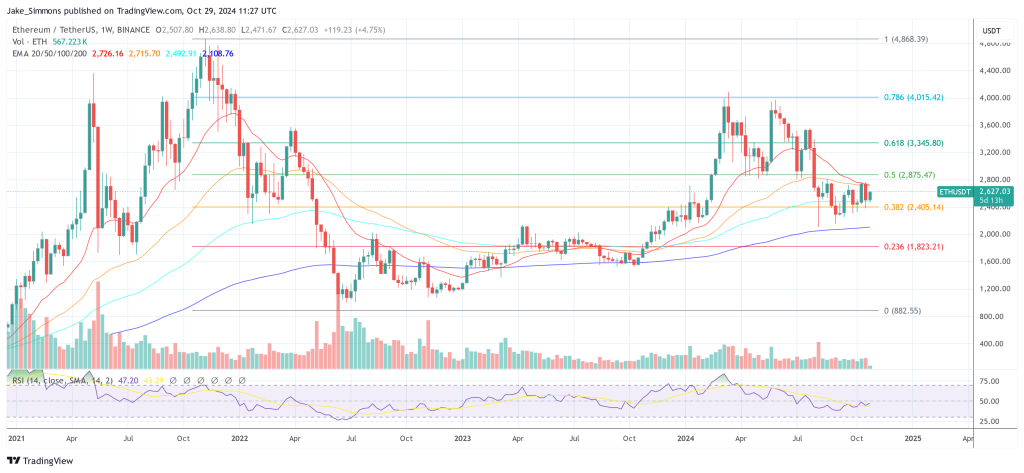
Featured image created with DALL.E, chart from TradingView.com


