





Ethereum (ETH) is gaining significant attention from institutional investors and everyday users as on-chain data shows growing participation in the areas of staking, cash accumulation, and wallet creation.
Related Reading: New Ethereum Addresses Hit Record Highs: What’s Driving Growth?
Likewise, price forecasts remain mixed. While big banks and market analysts believe there is room for further upside, others warn that macroeconomic conditions, ETF flows and technical resistance levels could limit near-term gains.
With ETH trading near the $3,300-$3,400 range in mid-January, the network’s foundations appear stronger than in previous quarters. However, it remains to be seen whether these developments will result in a lasting increase in prices.
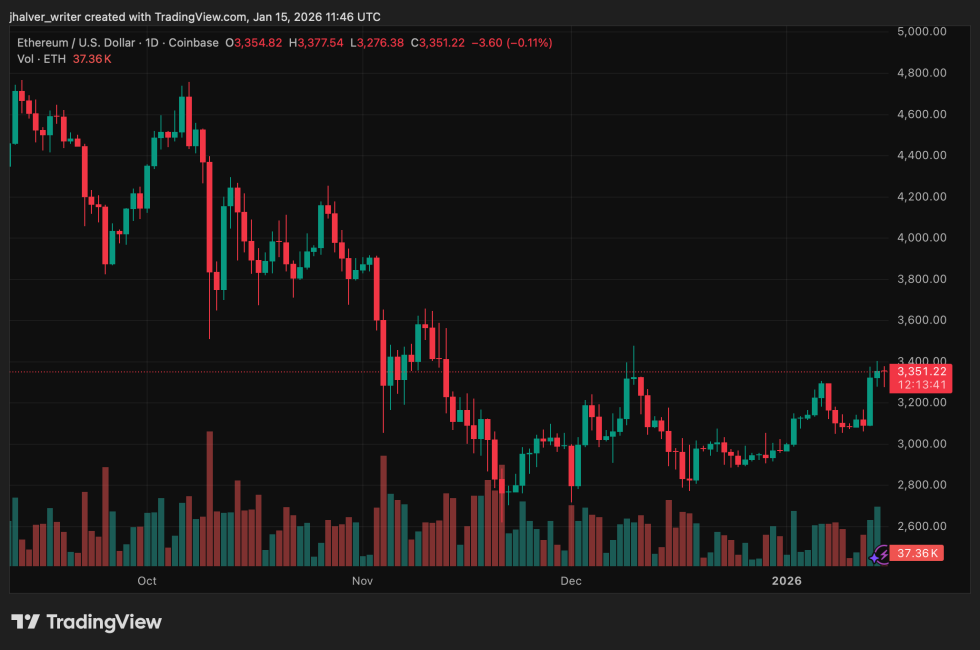
ETH's price trends upwards on the daily chart. Source: ETHUSD on Tradingview
Ethereum Staking and Cash Demand Signal Long-Term Commitment
Ethereum staking reached an all-time high of around $118 billion, with around 35.8 million ETH locked on the Beacon chain. This represents almost 30% of the circulating supply, suggesting a growing preference among holders to earn yield rather than sell.
Participation in networks is also increasing. Active validators now exceed 976,000, while approximately 2.3 million ETH is queued for future staking. Lido Finance remains the largest staking provider, holding around a quarter of all ETH staked.
Corporate treasury activity contributed to this trend. BitMine Immersion, one of the largest Ethereum treasury companies, recently staked an additional 154,304 ETH, worth approximately $514 million at current prices. The company’s total ETH holdings now exceed 4 million tokens.
Institutional forecasts point to higher goals
Several financial institutions have revised their outlook for Ethereum in 2026. Standard Chartered recently raised its year-end price target for ETH to $7,500, up from a previous estimate of $4,000. The bank cited growing demand from corporate treasuries, ETH spot investment products, and expectations for network fee growth.
According to analysts, treasury companies and ETF-related flows have absorbed nearly 4% of Ethereum’s circulating supply since mid-2025. Treasury buyers alone reportedly acquired approximately 2.3 million ETH in just over two months, a pace the bank compares favorably to previous phases of Bitcoin accumulation.
Standard Chartered also suggested that Ethereum could outperform Bitcoin if real-world usage, stablecoin activity, and adoption of tokenized assets continue to grow on its network. Longer-term scenarios predict costs of up to $25,000 by 2028 and $40,000 by 2030, although these projections are based on optimistic assumptions.
User growth increases, but ETH price faces technical limits
Ethereum’s user base is also expanding. In early January, the network recorded nearly 393,600 new wallet addresses in a single day, with a weekly average of more than 327,000 new addresses.
Analysts associate the increase with the Fusaka protocol upgrade, which reduced data costs for Layer 2 networks, as well as record stablecoin transfer volumes of around $8 trillion by the end of 2025.
Related Reading: Boycott Called for CLARITY Bill: Expert Raises Concerns Over Bank Manipulation
Despite stronger fundamentals, price developments remain cautious. ETH recently tested the $3,400 resistance level, with key hurdles near $3,550 and $3,650 based on the long-term moving averages. Support stands at around $3,000, and failing to hold this level could expose ETH to further declines.
Cover image from ChatGPT, ETHUSD chart from Tradingview
Editorial process as Bitcoinist focuses on providing thoroughly researched, accurate and unbiased content. We follow strict sourcing standards and every page undergoes careful review by our team of top technology experts and seasoned editors. This process ensures the integrity, relevance and value of our content to our readers.


