





Ethereum continues to face sustained selling pressure as broader crypto market sentiment shifts toward caution and, in some segments, outright panic. Price action has struggled to regain stability in recent weeks as repeated rebound attempts have failed to produce sustained upward momentum. High volatility, tightening liquidity conditions, and continued macroeconomic uncertainty have reinforced a defensive posture among retail and institutional participants, leaving Ethereum vulnerable to further near-term weakness.
A recent CryptoQuant report provides additional context through on-chain activity. According to the data, user ETH Binance deposit address metric recorded a sharp increase. The number of unique addresses depositing Ethereum on Binance increased from approximately 360,000 to over 450,000, representing the highest level seen since August 2025. Deposit address tracking metrics often serve as an indicator of potential selling intentions, as assets moving to exchanges are generally more accessible for liquidation, use of collateral, or portfolio rebalancing.
However, such spikes do not automatically translate into immediate sales. In some cases, they reflect positioning adjustments, hedging activity or preparation for derivatives trading. Nonetheless, the magnitude of the recent increase suggests increased market anxiety and warrants close monitoring as Ethereum operates in an increasingly fragile market environment.
Foreign exchange deposits rise as price correction deepens
The report highlights that this metric breakout occurred alongside a severe price correction. Ethereum has declined sharply from its October high near $4,900 to around $1,900. The simultaneous drop in prices and increase in exchange deposit addresses suggest two main on-chain interpretations that merit careful consideration.

The first scenario points to the capitulation of retail. A rapid increase in the number of unique deposit addresses often reflects panic behavior among small investors. Participants who held on to their securities during the early stages of the decline could now shift their assets to exchanges to exit their positions, adding to short-term selling pressure.
The second interpretation concerns the positioning on the derivatives market. With ETH trading below the $2,000 threshold, some deposits likely represent a replenishment of collateral. Traders facing liquidation risk could add margin to maintain leveraged long positions rather than selling their holdings outright.
In the short term, increased deposits increase potential supply on exchanges, which can intensify volatility if sales materialize. However, historically, extreme spikes in deposit activity have frequently occurred during late remedial phases. Such conditions sometimes precede seller exhaustion.
Monitoring FX outflows, spot volume absorption and derivatives positioning will be key to determining whether this activity signals continued downside risk or the early formation of a local market bottom.
Ethereum tests structural support as downtrend persists
Ethereum continues to trade under sustained pressure, with the weekly chart showing a clear loss of bullish momentum following the rejection near the $4,800-$5,000 region. The price has now moved back towards the $1,900 area, an area that previously served as consolidation support during previous cycle phases. The inability to hold above mid-cycle moving averages suggests that sellers still maintain structural control.
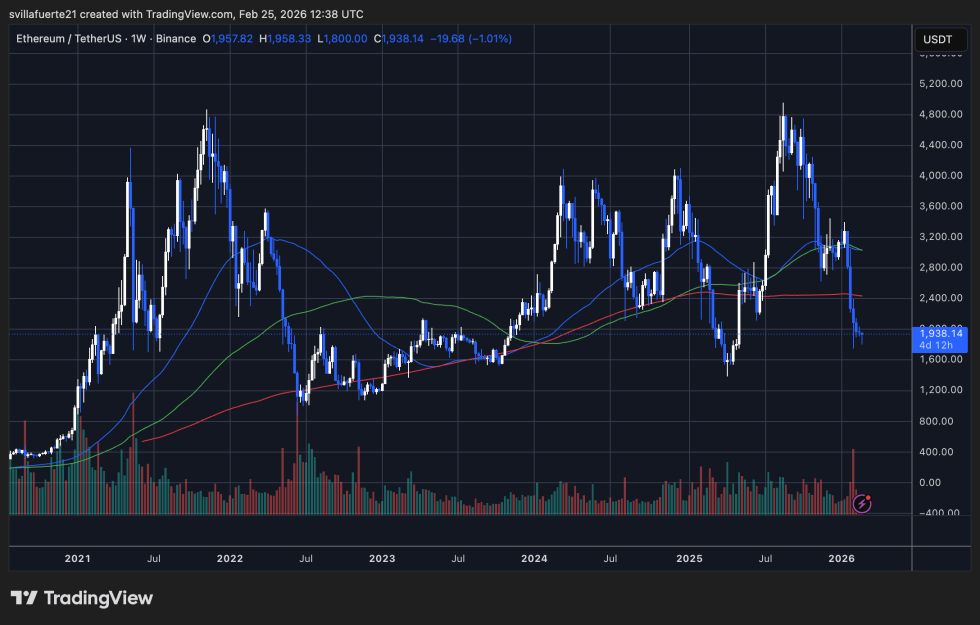
The 50-week moving average has reversed and is now acting as overhead resistance, while the 100-week average appears to be flattening. Meanwhile, price is approaching the long-term 200-week moving average, a level historically associated with major cyclical support. A decisive break below this zone could expose a deeper decline, while stabilization here could encourage accumulation in the medium term.
Volume patterns indicate intermittent spikes on declines, which generally reflect distribution rather than sustained buying interest. This reinforces the interpretation of a defensive phase of the market rather than a confirmed recovery trend.
Despite this weakness, the compression of volatility close to long-term averages sometimes precedes transition periods. However, confirmation would require sustained closes above recoverable resistance levels and improvement in participation metrics. Until then, Ethereum remains in a fragile technical situation, with the risk tilted towards continued consolidation or downward drift rather than immediate bullish continuation.
Featured image from ChatGPT, chart from TradingView.com
Editorial process as Bitcoinist focuses on providing thoroughly researched, accurate and unbiased content. We follow strict sourcing standards and every page undergoes careful review by our team of top technology experts and seasoned editors. This process ensures the integrity, relevance and value of our content to our readers.


