





Ethereum faces new volatility as escalating tensions in the Middle East reshape the macroeconomic landscape and weigh on digital assets. Price action has become increasingly responsive to external risk signals, with liquidity dwindling during periods of heightened geopolitical uncertainty. While short-term fluctuations grab the headlines, the underlying dynamics of the chain suggest that a more structural change could be taking place beneath the surface.
According to a recent analysis by CryptoQuant, Ethereum reserves on Binance have decreased to approximately 3.46 million ETH – the lowest level recorded since 2020. This contraction in the supply held on the exchange is not a marginal fluctuation but a multi-year structural low. Such a development has significant implications on the positioning of investors and on the evolution of the balance between available supply and latent demand.
Historically, declining foreign exchange reserves indicate that investors are withdrawing their assets into cold storage or long-term custody solutions. This behavior is usually associated with a holding preference rather than imminent distribution. When fewer coins remain easily accessible on centralized platforms, the pool of immediately tradable supply contracts is reduced. In theory, this reduces the likelihood of abrupt sales-side shocks caused by excess foreign exchange liquidity.
The longer-term trajectory of Ethereum reserves on Binance reinforces the structural nature of this shift. Since previous cycle highs above 5 million ETH, exchange balances have been in a steady downward trend, interrupted only by brief counter-trend rebounds that failed to establish higher highs. The pattern of successive lower highs signals persistent net outflows rather than episodic movements. At around 3.46 million ETH, reserves are now at their lowest level in almost six years, highlighting the scale of the contraction.

This development aligns with broader behavioral changes in the Ethereum ecosystem. The rise of self-custody solutions and the expansion of staking participation have structurally reduced the float available on centralized locations. Coins removed from exchanges are less likely to be deployed for immediate trading, especially when assigned to long-term custody or yield generation mechanisms.
The timing is remarkable. With ETH trading near $2,027, the market occupies a technically sensitive zone. A continued decline in reserves at this level could indicate growing conviction among holders reluctant to sell amid volatility. If additional demand emerges as FX supply continues to tighten, the resulting imbalance could generate upward pressure.
On a 4-hour time frame, Ethereum remains structurally weak despite attempts to stabilize near the $1,950-$2,000 zone. Price continues to trade below the 50-, 100-, and 200-period moving averages, all of which are falling – a clear alignment that confirms near-term bearish control.
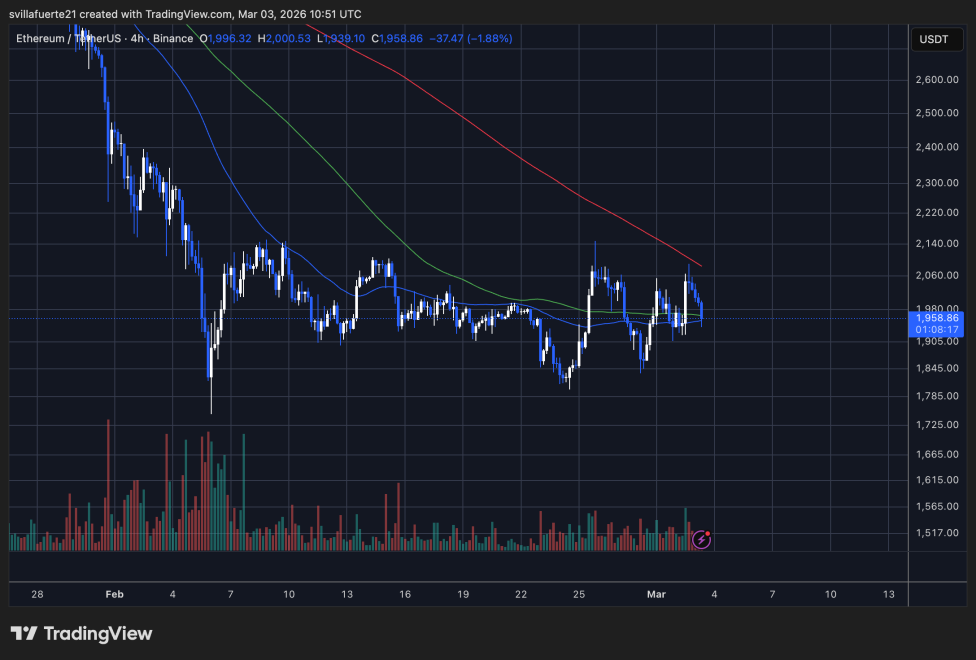
The early February sell-off established a lower and higher structure, and subsequent bounces have failed to reclaim the 200-period moving average (red), currently positioned well above price near the $2,100 region. This level now acts as a decisive dynamic resistance ceiling. At the same time, the 100-period moving average (green) has repeatedly capped intraday rallies, reinforcing the broader downtrend.
Support developed around $1,900, where buyers had previously stepped in following a strong selloff. However, each rebound has produced increasingly weak tracking, suggesting that demand remains reactive rather than proactive.
Volume increased during breakup phases but has since decreased, indicating temporary equilibrium rather than accumulation. The squeeze between $1,900 and $2,000 reflects indecision in a bearish structure.
For momentum to change significantly, ETH would need a sustained breakout above $2,050 to $2,100 to challenge the descending moving averages. However, a loss of $1,900 would likely result in a further decline towards the $1,800 liquidity pocket.
Featured image from ChatGPT, chart from TradingView.com
Editorial process as Bitcoinist focuses on providing thoroughly researched, accurate and unbiased content. We follow strict sourcing standards and every page undergoes careful review by our team of top technology experts and seasoned editors. This process ensures the integrity, relevance and value of our content to our readers.


