





Ethereum is trading above $2,200 and running into key resistance levels. The price is at a decision point. And simultaneously on four of the world’s largest exchanges, the supply of ETH available for sale has quietly and persistently disappeared.
A CryptoQuant analysis tracking Ethereum’s exchange reserve structure has identified a development that directly changes the conditions under which the current stress test is taking place. ETH reserves are not dwindling on one platform, nor on two, but on Coinbase, Binance, Gemini, and OKX – the four major venues that collectively represent the deepest and most liquid ETH trading infrastructure available.
This multi-site confirmation is the analytical distinction that the report makes most clearly. A drop in reserves on a single exchange can reflect a number of platform-specific explanations: custody transfers, institutional migration, internal exchange movements. When the same directional decline appears simultaneously on four separate sites with different user bases and ownership structures, platform-specific explanations lose credibility. What remains is the structural problem: ETH is leaving the sell side of the market on a large, coordinated basis.
Ethereum testing resistance above $2,200 in a market where the available supply of ETH ready to sell is decreasing across all major venues is a structurally different test than those that have failed before. Overhead costs have not gone away. It has become thinner, and low overhead reacts differently to buying pressure than high overhead.
The numbers behind the drain are not small.
CryptoQuant data gives the contraction of multi-site supply its precise dimensions. On Coinbase, Ethereum reserves fell from 5.6 million to 3.2 million between early August 2025 and April 9, 2026, a reduction of 2.4 million ETH withdrawn from the largest US institutional trading platform over eight months. On Binance, reserves increased from 4.75 million to 3.3 million ETH during the same period, or 1.45 million ETH withdrawn from the exchange, processing the largest share of global ETH derivatives volume.

These two numbers alone describe a sustained eight-month supply leak of nearly 4 million ETH across the two most systemically important sites in the market. Then other exchanges add their own data.
Gemini recorded a single-day reserve drop of around 74,000 ETH on February 19 – an institutional-wide withdrawal concentrated in a single session. OKX produced the most dramatic reading of all: reserves fell from around 990,000 ETH on March 20 to just 167,000 ETH on April 9, an 83% collapse in less than three weeks.
If we consider all four sites, the extent of the withdrawal is not ambiguous. Millions of ETH have left the sell-side pool immediately available over the past eight months, and the pace has not slowed. The market pushing back against resistance above $2,200 is doing so with a fraction of the sell-side depth that existed at the start of the current cycle. This is not a minor structural detail. This is the context in which every buyer and seller currently operates.
Ethereum Holds Key Weekly Level as Structure Compresses
On the weekly timeframe, Ethereum is holding near the $2,200 level, an area that increasingly defines the structural pivot of the market. This level has acted as both support and resistance over several cycles, and the current interaction suggests a market in transition rather than a continuation of the trend.
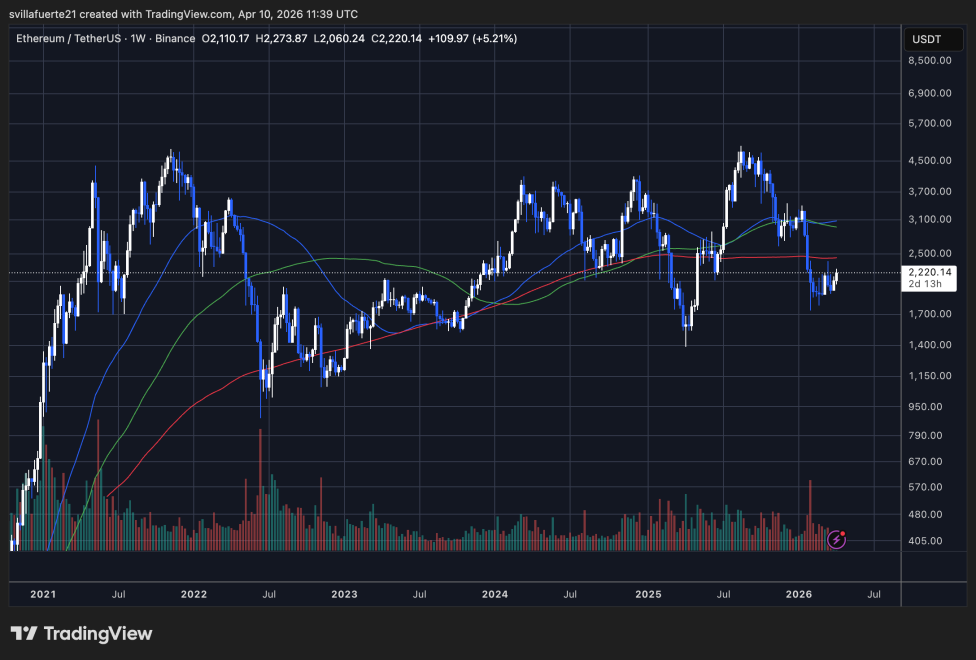
The broader structure shows that Ethereum remains below its previous cycle highs, with the recent rejection from the $4,000-$4,500 region confirming a lower high. However, the ensuing decline found support above the ascending 200-week moving average (red), which continues to serve as a long-term structural floor. This is a crucial detail: despite the volatility, the macroeconomic trend has not completely deteriorated.
The 50-week (blue) and 100-week (green) moving averages are converging toward current price levels, reflecting a squeeze. Price is now trading around these averages, indicating a balance between buyers and sellers rather than directional control.
Volume models reinforce this interpretation. Spikes during sell-offs indicate liquidation-related moves, while recent normalization suggests reduced stress but also limited conviction.
Structurally, Ethereum wraps around a wide range. A sustained move above $2,500 to $2,800 would signal renewed strength, while a loss of $2,000 would expose the 200-week support. For now, the market remains balanced, awaiting resolution.
Featured image from ChatGPT, chart from TradingView.com
Editorial process as Bitcoinist focuses on providing thoroughly researched, accurate and unbiased content. We follow strict sourcing standards and every page undergoes careful review by our team of top technology experts and seasoned editors. This process ensures the integrity, relevance and value of our content to our readers.


