




Dragonfly Managing Partner Haseeb Qureshi has refined his defense of Ethereum’s valuation, arguing that critics are using the wrong financial framework and that ETH should be analyzed more like an early-stage Amazon than a mature “value” stock.
Speaking at the Milk Road Show on December 9, 2025, Qureshi reflected on his now-viral valuation dispute with investor Santiago “Santi” Santos, hosted by ThreadGuy, which reignited the debate over how to price layer 1 blockchains. At the heart of Qureshi’s thesis is a simple but controversial assertion: revenue from fees on Ethereum is in fact pure margin and should be treated as profit, not “revenue” in the sense traditional term of business.
“Blockchains don’t generate revenue. They generate profit,” he said. “When chains charge fees, that’s profit. There are no fees for a chain. Chains don’t pay fees, right? There are no AWS hosting fees for Ethereum.”
Qureshi pushes back against claims that Ethereum is overvalued
Santos argued that Ethereum trades at “over 300” times sales, calling these price/sales (P/S) levels “embarrassing” compared to traditional companies and suggesting that valuations are “way ahead of their skis.” Qureshi did not dispute the magnitude of the multiples but rejected P/S as the correct lens.
Related reading
“He insisted in the debate that the right way to look at these things is the sale price. So if you look at the sale price of Ethereum, it’s something like 380. If you look at Amazon, I think Amazon hit a sale price of 42. And that was during the bubble,” Qureshi said.
He countered that for a blockchain, what equity investors would call “sales” is closer to the GDP or GMV of the on-chain economy, which is not directly measured at the protocol level. The only clear, observable line is fee income, which he treats as net income.
“In some sense, sales are like blockchain GDP that we don’t measure,” he argued. “The right thing to understand for a chain is profit…The right thing to understand is what is Ethereum’s profit versus Amazon’s profit.”
This opens the door to the Amazon analogy. Qureshi pointed out that Amazon had delayed profitability for nearly two decades to prioritize growth, but the public markets still gave it extremely high earnings multiples.
“Amazon literally made no profit, no profit until about 20 years in business,” he said. “I think it was 2013…Amazon had a PE ratio…over 600 whereas today Ethereum’s PE ratio is of course around 380.”
Since Ethereum’s P/S and P/E converge under its “fees = profit” hypothesis, Qureshi’s argument is that investors should compare ETH’s 300-380x multiple to Amazon’s historical P/E, not its much lower P/S, if they want to use a single overall ratio.
The broader context, he pointed out, is that Ethereum and other L1s are still in an exponential development phase, closer to early internet or e-commerce infrastructure than late-cycle dividend payers.
Related reading
“This technology has become more and more important over time. It has engulfed the entire world of finance from where it started,” he said, referring to his essay “In Defense of Exponentials.” “None of these technologies started generating much profit immediately in the first five or even ten years.”
Despite the volatile price action and underperformance of altcoins relative to AI stocks and gold, Qureshi said his belief in Ethereum’s long-held thesis has increased, not weakened, through public debate.
“If anything, I have become more confident in my view,” he said, adding that nothing material has changed in recent months to warrant a major portfolio overhaul. “What exactly has changed in the last 2 months between, you know, ETH is going to like $4,800 and ETH is at $3,000? The answer is basically nothing.”
I shared some post-debate thoughts about my L1 debate with @santiagoroelmy rebuttal to the “crypto is a big casino” condemners, and where I think we are in the crypto macro cycle 👇
— Haseeb >|< (@hosseeb) December 9, 2025
For Qureshi, a true repositioning would require a clear invalidation of fundamental assumptions, such as a quantum breakdown of cryptography or a structural collapse in demand for on-chain stablecoins. According to him, short-term fluctuations are just the pendulum of sentiment swinging around a still-fixed fundamental anchor.
His message to skeptics is that while markets have tolerated Amazon at 600x earnings as it has become a dominant platform, rejecting Ethereum at around 300-380x based solely on a “too high P/S” argument is analytically inconsistent.
At press time, ETH was trading at $3,325.
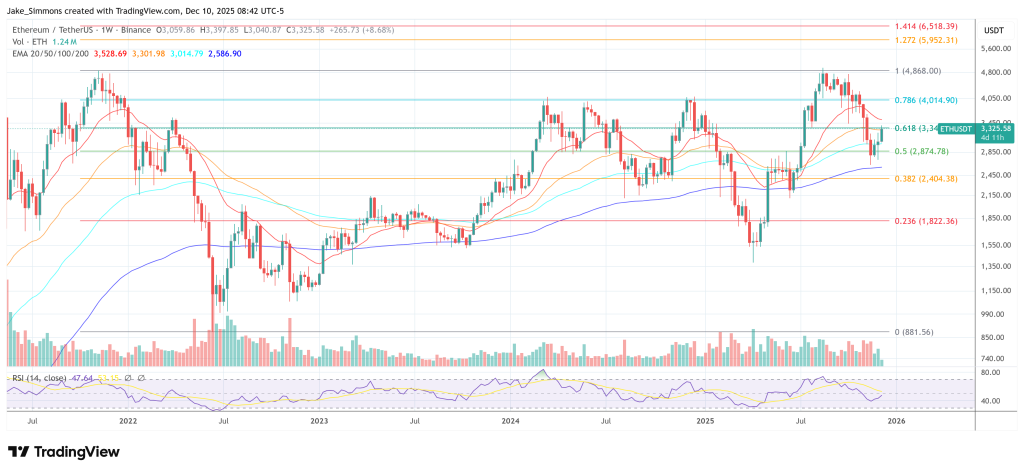
Featured image created with DALL.E, chart from TradingView.com


