



The Federal Reserve voted Wednesday (March 18) to keep benchmark interest rates stable within a target range of 3.50% to 3.75%, opting for caution amid rising energy costs that threaten to complicate the U.S. economic recovery, which has had a significant impact on the price of Bitcoin.
The decision to pause rather than cut rates immediately cooled risk-off markets, with BTC USD sliding -5.4% overnight to trade dangerously close to $70,000 shortly after the announcement.
While the hold was widely expected, traders were glued to the Fed’s accompanying statement for clues about future liquidity. With inflation still above the central bank’s 2% target and unemployment reaching 4.4%, the Fed is walking a tightrope.
This uncertainty led central banks around the world to tighten policyweighing heavily on other crypto assets like Ethereum, which fell -6.2% to $2,170.
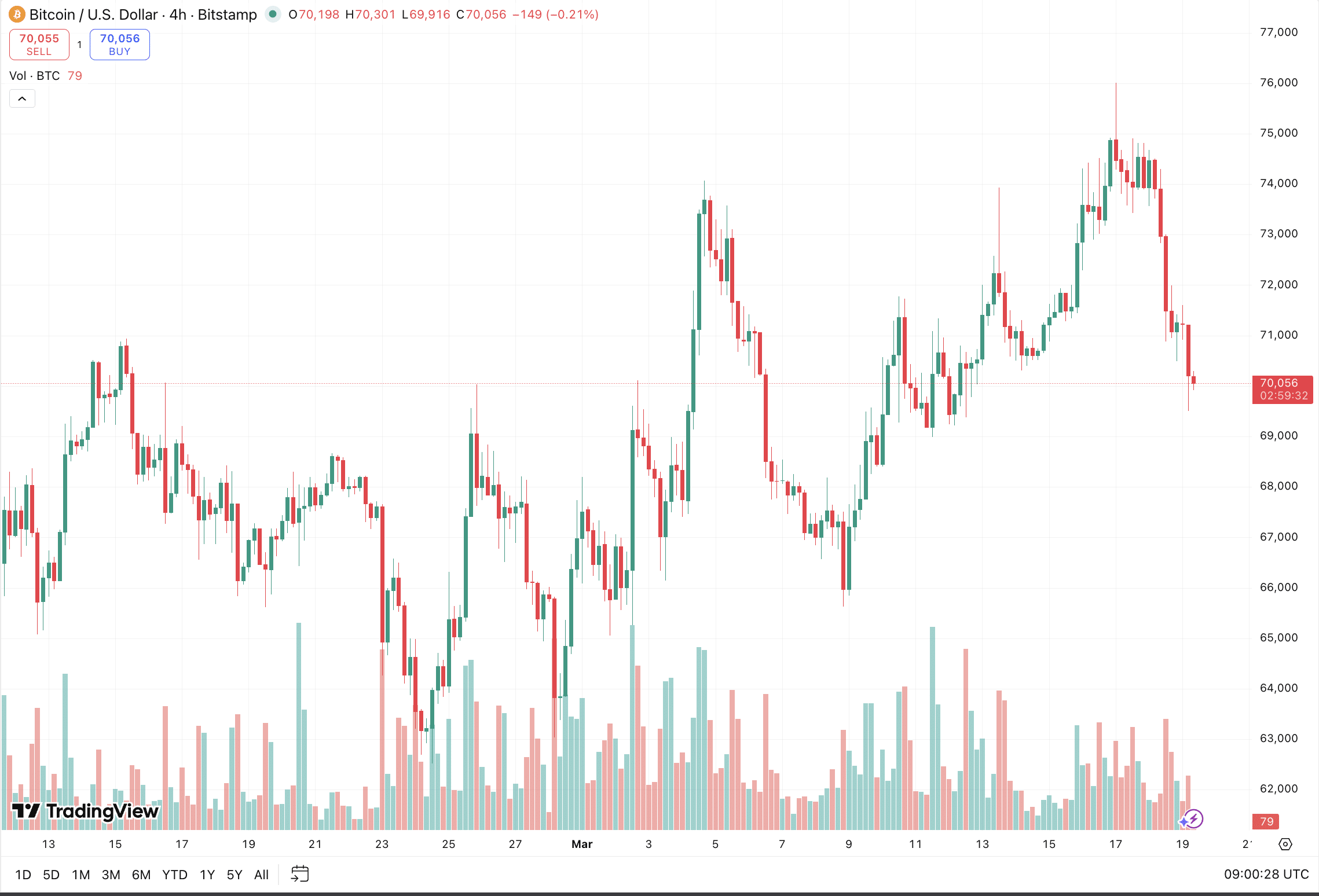
(SOURCE: TradingView)
Why is the Fed’s decision moving crypto markets?
For beginners, how a government meeting in Washington affects the price of Bitcoin may seem confusing, but it’s simple: interest rates influence risky assets.
When the Fed keeps interest rates high, safer investments like government bonds offer higher returns, prompting investors to pull money out of riskier assets like stocks and cryptocurrencies. Conversely, if rates fall, borrowing becomes cheaper, leading investors to seek higher returns in riskier markets like the price of Bitcoin.
By holding rates steady, the Fed is signaling that it is not prepared to reduce this “gravity,” which can cause markets to fall when expected rate cuts do not materialize. This “wait and see” approach means liquidity remains expensive for now.
DISCOVER: The next crypto gem 1000x before listing on exchanges
Bitcoin Price Reaction: Can $70,000 Hold Despite Inflation Fears?
$BTC now testing the most critical level of this entire rally.
$70-71,000. The exact area we marked yesterday.
Why is this level important?
Both the Trendline support and the horizontal support are found here, making this a two-level support area. When two structures converge in this way, the… pic.twitter.com/U8GXLEVx2N
-Ardi (@ArdiNSC) March 18, 2026
Bitcoin’s immediate reaction was negative, falling -5.4% overnight to test psychological support at $70,000. The main factor here is not just maintaining rates; it’s the context behind it.
Escalating tensions with Iran have driven up oil prices, which historically leads to “persistent” inflation. If energy costs remain high, the Fed cannot cut rates, which hurts Bitcoin’s bullish scenario.
Despite the drop, the price of Bitcoin is still up +1% over the past week. If buyers manage to defend the psychological $70,000 level, the long-term trend remains intact. Many analysts still expect a change in course later this year.
For example, experts such as Arthur Hayes’ forecast of a Fed pivot suggest that once the central bank is forced to print money to support the economy, Bitcoin could react explosively.
If the $70,000 support breaks down, the next major bottom will be significantly lower. The fear is stagflation, an unpleasant mix between rising inflation and a slowing economy, with US unemployment at 4.4%. In this scenario, investors could flee stocks and cryptocurrencies to make money, pushing BTC towards $65,000.
Currently, Bitcoin is trading in a tight range. Traders are closely watching the $70,000 line; a daily close below could signal a deeper correction that would reset all gains since late February.
Ethereum Response: Volatility Around the $2,200 Level
$ETH | Every day
Reject the daily movement to the bottom.
Can swing some HTF resistance support here.
I think I don’t need to explain why it’s important to hold between $2,200 and $2,100.
If you are bullish on ETH, you should be a buyer here… pic.twitter.com/vBIB1fqgH5
-TraderJqrit (@TraderJqrit) March 18, 2026
Ethereum reacted more violently than Bitcoin price, losing -6.3% to trade at $2,215. This is typical behavior of ETH during macro events, as it has lower liquidity than Bitcoin and often swings stronger in either direction.
The key issue for Ethereum at the moment is the risk appetite of institutional investors. While the price of Bitcoin has the narrative of “digital gold” to protect it somewhat during times of uncertainty, Ethereum is often viewed more as a tech stock. When the Fed signals caution, tech-adjacent assets typically sell off first.
Traders view the $2,200 level as critical support. If ETH drops below this threshold, a psychological panic could set in, potentially targeting $2,000. On the positive side, ETH needs to reclaim $2,350 to invalidate the current bearish momentum.
Unlike Bitcoin, which saw massive inflows into ETFs that cushioned its falls, Ethereum remains more vulnerable to these macroeconomic changes. However, a -5% decline is relatively standard volatility for the asset class.
What’s Next for Bitcoin Price? On the way to the April meeting
The Federal Open Market Committee (FOMC) will not meet until April, leaving investors in a month-long limbo. The Fed’s statement emphasizes that the economic outlook is “uncertain”, particularly highlighting the conflict in the Middle East.
Stephen Miran was the only committee member to vote in favor of a cut, indicating that the Fed majority is still concerned about a pick-up in inflation. This unit suggests that unless the economy collapses, rates could stay high for longer than expected.
DISCOVER: The Best Crypto Presales to Watch Now
Follow 99Bitcoins on X (Twitter) For the latest market updates and subscribe on YouTube for daily market analysis from experts.
The article Fed Keeps Rates Steady: Here’s What It Means for Bitcoin and Ethereum Prices appeared first on 99Bitcoins.


