




A screenshot attributed to Fundstrat Research is sparking debate over whether Tom Lee’s company is forecasting a sharp correction in crypto markets in the first half of 2026, despite Lee’s recent public optimism on Ethereum.
Wu Blockchain shared the image via
Fundstrat bearish call against. The Case of the Bull by Tom Lee
The document is credited to Sean Farrell, Fundstrat’s head of digital assets strategy, and includes a base case scenario calling for a “significant pullback in the first half of 2026,” with target ranges of bitcoin between $60,000 and $65,000, ether between $1,800 and $2,000, and solana between $50 and $75. The note adds that these levels would represent “attractive opportunities through the end of the year” and that if the view is wrong, the preference is still to “play defense” until strength is confirmed.
The ETH range is what started the market chatter. Ether is trading around the $3,000 zone, making $1,800 a significant bearish scenario if taken at face value.
Related reading
The controversy, such as it is, comes from proximity to Lee’s own message. At Binance Blockchain Week, Lee said that Ethereum, at around $3,000, appeared “severely undervalued,” a position that reads very differently from a research framework explicitly mapping a potential move toward $1,000. In recent weeks, Lee has even publicly shared his predictions that ETH could reach $20,000 next year and $62,000 in the next few years.
Farrell responded directly to X on December 20, arguing that the definition of “internal conflict” did not include how Fundstrat operates. The firm, he said, is home to multiple analysts with independent processes, each designed for different client goals and time horizons.
Lee’s work, Farrell wrote, is aimed at large institutions that might allocate 1-5% to BTC and ETH and is structured around longer-term macro and “secular” trends. Farrell’s research, on the other hand, is positioned for investors with higher crypto exposure (he referred to portfolios with allocations around 20% and above) where active risk management and rebalancing are more important than maintaining a single long-duration thesis due to volatility.
Related reading
This distinction is essential for interpreting escape-type targets. Farrell’s public explanation was not “we are bearish”, but rather “we are cautious in the short term.” He said markets appear priced at “near perfection” while risks remain elevated – citing government shutdown dynamics, trade volatility, uncertainty around AI investments and the Federal Reserve chairmanship transition, as well as tight high yield spreads and low volatility across assets.
He also highlighted mixed flow conditions. According to Farrell, long-term ETF demand could improve with the integration of cable companies, but short-term pressures persist due to “OG sell-offs”, miners, fund redemptions and even the possibility of a delisting from MSCI MicroStrategy – something that stood out because it suggests the risk perspective extends beyond spot crypto into the crypto-stock complex that has become a key barometer of liquidity and sentiment.
The base case stated by Farrell: “an early-year bounce followed by another half-year pullback, creating a more attractive end-of-year opportunity. If I’m wrong, I prefer to wait for confirmation (trend breaks, flow, momentum, or clear catalyst). Crypto is reflexive, and for my purposes, patience matters in no man’s land.”
The thread ends on a point that many readers missed during the initial screenshot-based outrage cycle: Farrell still expects BTC and ETH to “challenge new ATHs by the end of the year,” describing a shorter, shallower bear that could compress the traditional narrative of the four-year cycle. “For those who have been following the outlook: I still expect BTC and ETH to challenge new ATHs by the end of the year, ending the traditional four-year cycle with a shorter, shallower bear,” he wrote via X.
At press time, Ethereum was trading at $3,043.
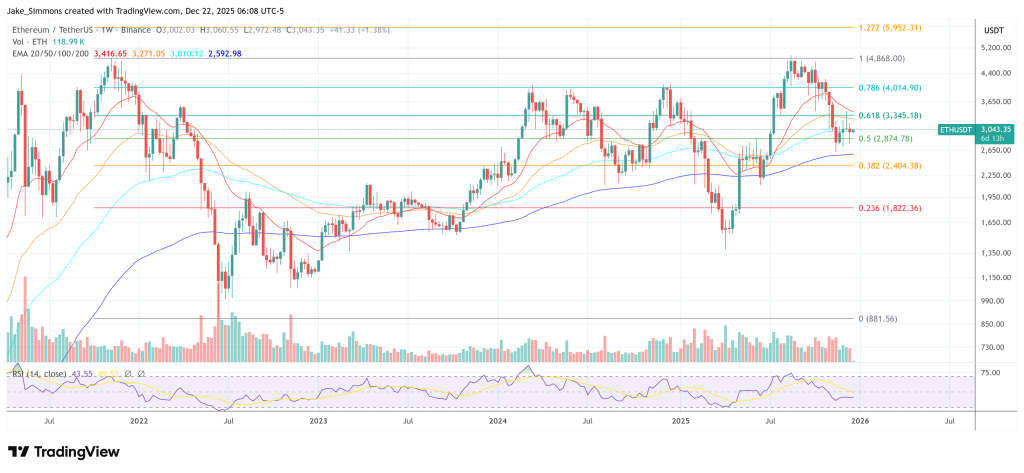
Featured image created with DALL.E, chart from TradingView.com


