





The crypto market has come under heavy selling pressure amid a sharp deterioration in risk sentiment globally. According to a report from CryptoQuant, the latest downturn has occurred alongside a broader cross-selling of assets, where traditional safe havens and risk assets have both been hit.
Gold posted a sudden correction of around 8%, while silver fell almost 12%. Bitcoin was relatively more resilient, down around 9%, but it was not immune to the broader liquidation wave. US stocks also weakened, with the S&P 500 and Nasdaq participating in the decline, reinforcing the idea of a synchronized risk aversion event rather than an isolated crypto-specific shock.
The initial trigger came from announcements related to Microsoft, particularly around its investments in artificial intelligence. The news sent Microsoft shares tumbling more than 12%, triggering a domino effect on global markets as investors quickly reduced their exposure to markets saturated with growth and technology. This price revision quickly trickled down to crypto derivatives.
Despite the relatively modest decline in Bitcoin’s price, the leverage built into the market amplified the impact. Nearly $300 million in long positions were liquidated in a matter of hours. Hyperliquid took the largest share, with $87.1 million of long positions wiped out, while Binance recorded around $30 million. The episode highlights how fragile positioning and high leverage can turn moderate price movements into significant liquidation events in the crypto market.
Despite recent drawdowns, leverage remains a defining feature of the current crypto market structure. According to analyst Darkfost, many investors continue to seek market exposure using high leverage, creating conditions where relatively small price movements can trigger large bursts of volatility.
These movements are frequently amplified by cascades of liquidations, to the extent that forced position closures accelerate the downward dynamic. Importantly, this behavior persists even after the events of October 10, which previously led to significant destruction of liquidity and capital in the market.

The persistence of this risk appetite is clearly visible in derivatives data. A useful way to isolate true positioning trends is to look at open interest expressed in terms of BTC rather than notional value. In doing so, the distortion caused by price fluctuations is removed, providing a clearer picture of traders’ true exposure. This approach helps determine whether debt is actually being rebuilt or whether it simply appears higher due to price effects.
Seen in this light, the open interest on Binance stands at around 123,500 BTC. This already exceeds the level recorded just before the October 10 sell-off, when open interest fell to around 93,600 BTC. The increase of around 31% since this low point indicates that risk appetite has gradually returned. Rather than a crypto market operating defensively, current positioning suggests leverage is building up again, leaving prices vulnerable to further volatility if sentiment changes abruptly.
Bitcoin price action continues to reflect a fragile and corrective market structure. After failing to reclaim the $95,000-$100,000 zone, BTC extended its pullback and is now trading near the $82,800 zone, marking a clear break from the recent consolidation range. The decline is occurring below the short- and medium-term moving averages, with price firmly capped by the falling 50- and 100-day averages, reinforcing the loss of bullish momentum.
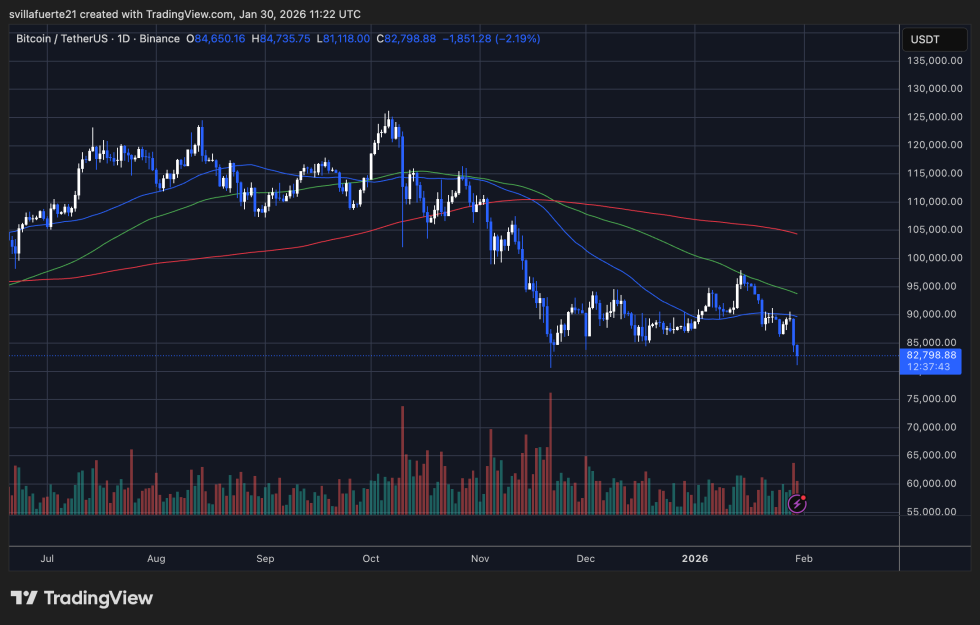
The 200-day moving average remains well above current levels, highlighting the broader deterioration in trend strength since the October peak. Structurally, Bitcoin has moved from higher highs to a trend of lower highs and lower lows, signaling that sellers continue to control rallies rather than buyers defending breakouts. Volume spikes during sell-offs, particularly in November and December, suggest distribution rather than healthy turnover.
The $82,000 to $85,000 area now stands out as a critical support zone. A sustained hold could allow for near-term stabilization or range formation, but a decisive breakout would expose a deeper decline toward the $78,000-$80,000 region, where previous demand had emerged. On the positive side, any recovery attempt will likely face immediate resistance near $88,000 to $90,000, followed by a stronger bid near $95,000.
Featured image from ChatGPT, chart from TradingView.com
Editorial process as Bitcoinist focuses on providing thoroughly researched, accurate and unbiased content. We follow strict sourcing standards and every page undergoes careful review by our team of top technology experts and seasoned editors. This process ensures the integrity, relevance and value of our content to our readers.


