




Bitcoin price traded cautiously on Friday after the Bank of Japan kept its benchmark interest rate at 0.75%.
Summary
- The Bank of Japan kept its benchmark interest rate at 0.75%, but future hikes are possible if inflation persists.
- Bitcoin traded slightly below $90,000, reflecting near-term calm but continued caution amid yen-linked liquidity pressures.
- Technical indicators point to weakening momentum, making support near $89,500 to $90,000 a key level to watch.
Investors are balancing short-term relief and lingering liquidity concerns from Japan’s policy decision.
The BoJ voted by 8 votes to 1 on January 23 to keep its interest rate at the level set after its increase in December. This is the highest rate in around 30 years.
Why the BOJ decision matters for Bitcoin
Markets widely expected the BoJ rate to remain stable, and the move removed the risk of an immediate policy shock. Instead of moving sharply as it had after previous rate hikes, Bitcoin’s (BTC) initial response reflected calm, remaining slightly below $90,000.
The central bank’s statement was not entirely neutral. The BoJ raised its inflation forecast, allowing further rate hikes if price pressures persist.
Japan’s shift in stance away from extremely loose monetary policies over the past two years has significantly influenced global liquidity, a factor that carries considerable weight for cryptocurrency markets.
Following the BOJ’s interest rate increase in July 2024, Bitcoin fell by approximately 26%, from $68,000 to $50,000 in the following days. A similar move in January 2025 resulted in a drop of around 25% in a matter of weeks, from $74,000 to almost $55,000.
After the December 2025 increase to 0.75%, Bitcoin remained relatively stable contrary to expectations. It was hovering around $90,000, showing that traders had already priced in some of the move.
The Bank of Japan’s decision to keep rates steady removed the immediate shock of another rise, explaining why Bitcoin is moving sideways between $89,000 and $90,000. Analysts say the cryptocurrency could stay near this range or fall further unless buyers push it above $92,000 to $94,000.
Any significant gains will depend on investors taking risks or improving global economic conditions.
Technical analysis of the Bitcoin price
Bitcoin appears to be on shaky ground. The price has fallen below the 20-day moving average and is testing the 50-day average near $92,000, a level that has repeatedly capped recovery attempts in recent weeks. The overall trend suggests that the market is still in a corrective phase.
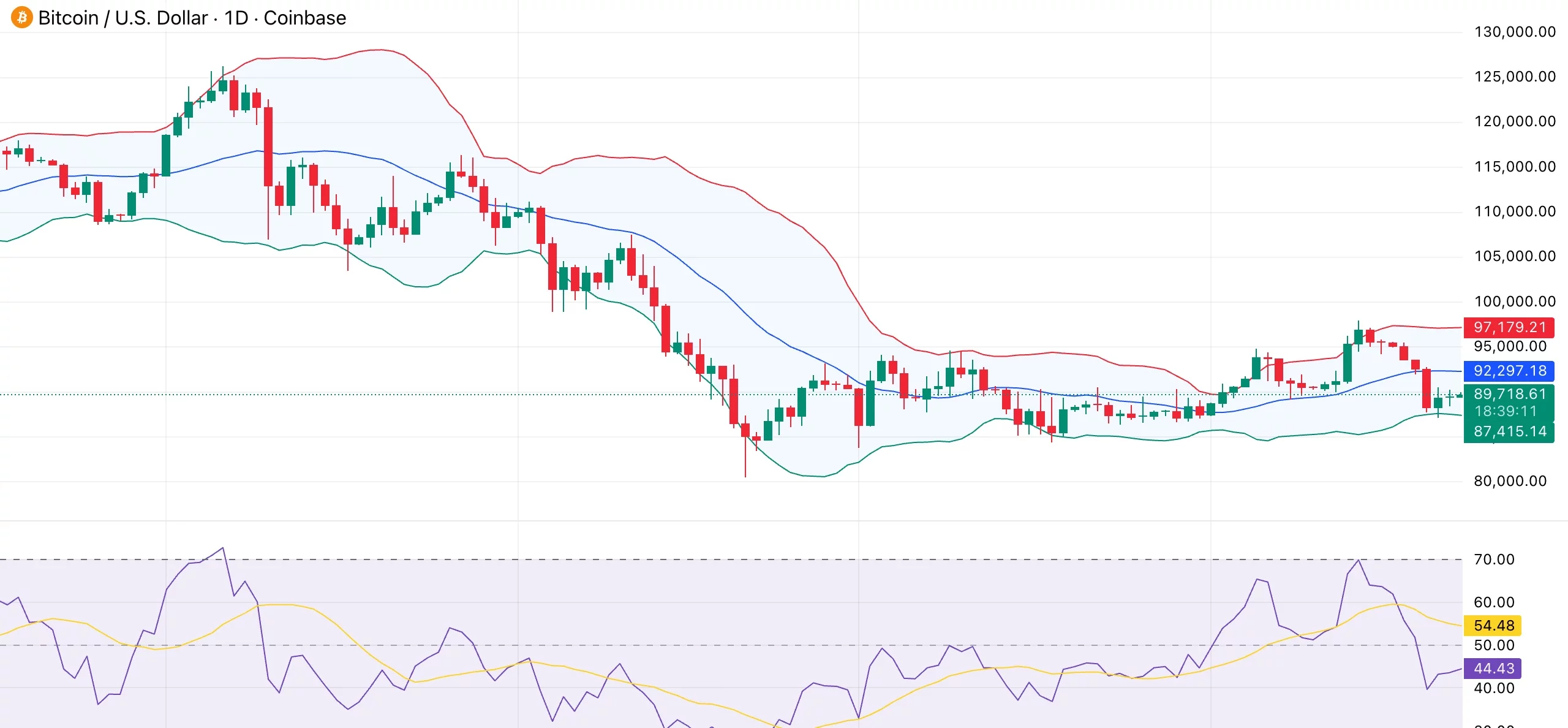
As sellers stepped in during the most recent bounce, the rally stalled between $97,000 and $98,000, creating a lower high. This rejection occurred in the upper Bollinger band, which often limited upward movements.
Momentum indicators show caution. The Relative Strength Index fell to the mid-45s after reaching overbought levels earlier this month, suggesting a decline in demand rather than sideways consolidation.
After a squeeze period, volatility began to increase, making downward moves more likely.
Immediate support lies between $89,500 and $90,000. This area has held so far, but a daily close below $89,000 could lead to a larger pullback towards $87,000 – $88,000, near the lower Bollinger band.


