




The cryptocurrency market is showing signs of near-term relief as Bitcoin and major altcoins attempt to stabilize after weeks of sustained selling pressure. Prices rebounded slightly across the board, easing some of the recent downside momentum. However, the feeling remains fragile. Many analysts say the move fits the profile of a relief rally rather than the start of a lasting trend reversal, highlighting the still weak market structure and unresolved macroeconomic and regulatory risks.
In this context, a bill on market structure released by the US Senate is attracting particular attention. The proposed framework represents a potential structural change in the way crypto assets are treated within the U.S. financial system.
The bill aims to clearly differentiate between crypto assets that fall under the definition of commodities and those that are considered securities, while assigning regulatory oversight accordingly. Until now, the US regulatory approach has relied largely on enforcement measures, creating uncertainty for investors, developers and institutions. By defining the classification criteria in advance, the proposal aims to reduce ambiguity and provide a cleaner operating environment.
As markets digest this information, the focus shifts from headline-driven volatility to longer-term structural implications. Whether this regulatory clarity will translate into lasting trust remains an open question.
A report from XWIN Research Japan highlights a critical nuance in the latest US market structure proposal: fully decentralized networks and DeFi protocols are not treated like traditional financial intermediaries. Node developers, validators, and operators are not automatically classified as regulated entities, signaling a formal recognition of decentralization as an essential structural attribute rather than a gap to be filled.
This distinction is significant because it reduces legal uncertainty for open source contributors and preserves the permissionless nature of decentralized infrastructure.
On the other hand, centralized entities are faced with a more clearly defined regulatory perimeter. Exchanges, brokers and custodians should comply with stricter rules on registration, asset segregation and disclosure. Rather than targeting innovation, these requirements appear designed to professionalize market infrastructure and align centralized crypto businesses with existing financial standards.
Under this framework, Bitcoin, Ethereum, stablecoins and spot ETFs are implicitly assumed to remain integrated into the US financial system, thereby reinforcing their status as legitimate financial instruments.
On-chain data is already reflecting this transition. CryptoQuant’s metrics show that near the $90,000 Bitcoin level, retail activity remains subdued while medium and large spot orders dominate. This trend suggests neither speculative excess nor panic-driven exits, but rather measured positioning by large investors.

Taken together, these signals imply that the market is gradually moving from reactive, headline-driven behavior to a more structure-driven phase. Regulatory clarity may not trigger immediate price movements, but it is already influencing how capital positions itself in the crypto landscape.
The total cryptocurrency market cap chart shows a market consolidating after aggressive expansion over several quarters. After the strong advance from late 2023 to mid-2025, total market capitalization peaked near the $3.8-$4.0 trillion area before entering a corrective phase. Since then, price action has transformed into a broad range, with higher volatility transforming into a more orderly structure.
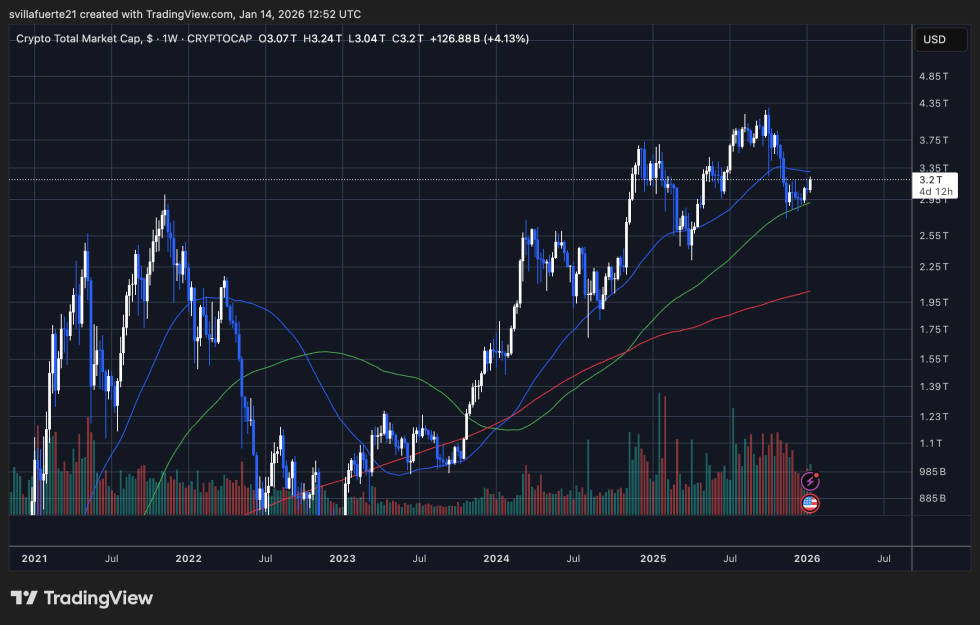
Currently, the total market cap is hovering around the $3.2 trillion level, which aligns with a former key resistance zone that has now served as support on multiple occasions. The weekly structure suggests a cooling phase rather than a breakdown. The price remains above the ascending 200-week moving average, which continues to rise and reinforces the idea that the primary market trend is still constructive.
Short-term moving averages have flattened, reflecting indecision and a slowdown in momentum after the previous impulsive move. Volume declined from record levels, indicating that aggressive distribution pressure has eased, but strong expansion demand has not yet returned. This combination is typical of mid-cycle consolidation rather than terminal weakness.
From a structural perspective, the market is digesting previous gains while maintaining a lower frame compared to previous cycles. Sustained holding above the $3 trillion region keeps the broader bullish structure intact. However, failure to defend this area would expose the market to deeper retracements towards long-term trend support.
Featured image from ChatGPT, chart from TradingView.com
Editorial process as Bitcoinist focuses on providing thoroughly researched, accurate and unbiased content. We follow strict sourcing standards and every page undergoes careful review by our team of top technology experts and seasoned editors. This process ensures the integrity, relevance and value of our content to our readers.


