



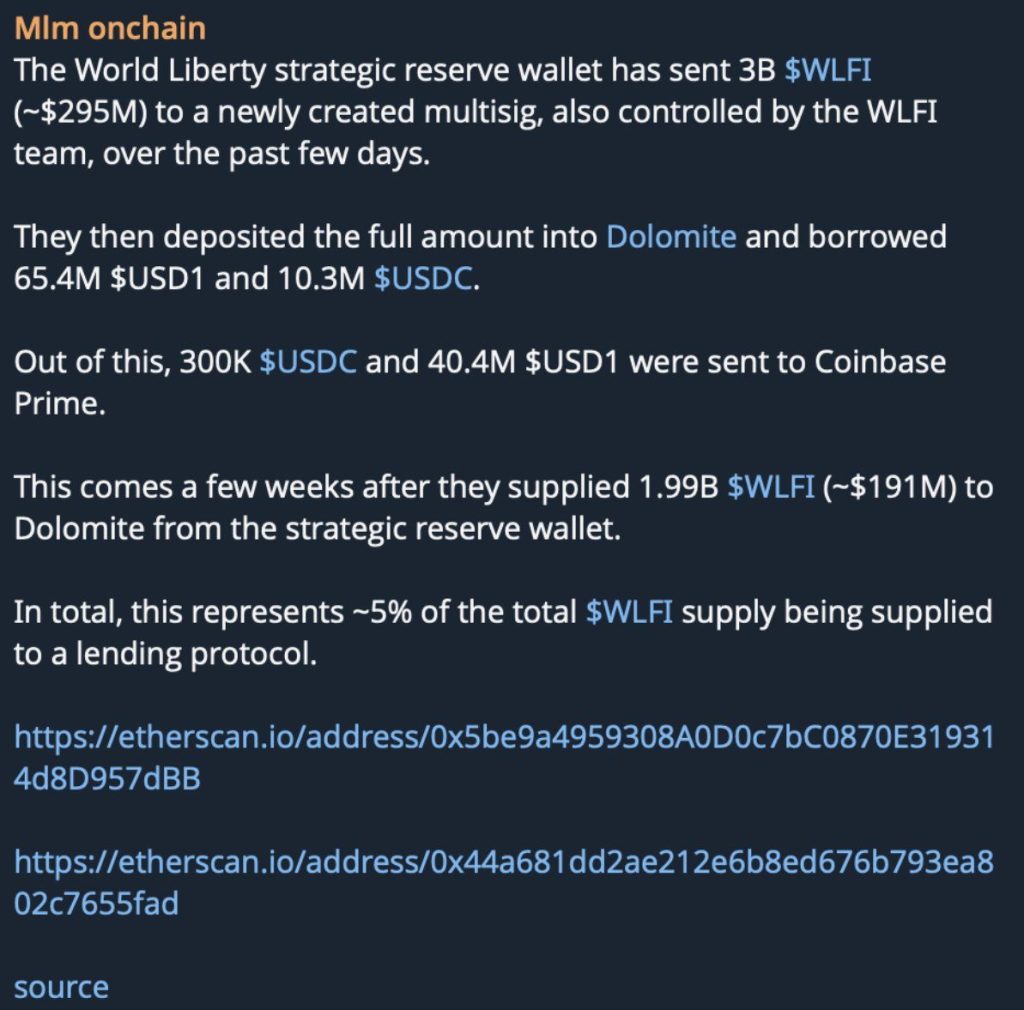
Are Trump’s Crypto Insiders Back? $484 million in Trump WLFI crypto tokens deposited on the Dolomite protocol. Borrowed against for USDC. And a governance token with no real market depth serves as collateral.
If that happens, Dolomite’s lenders won’t get a haircut; they are wiped.
DeFi analyst Ignas reported the trend on X, identifying the leverage structure as a potential systemic threat to Dolomite’s lending pools. The on-chain fingerprint is already public. The question is not whether the risk exists, but rather whether lenders understand what they are hiding.
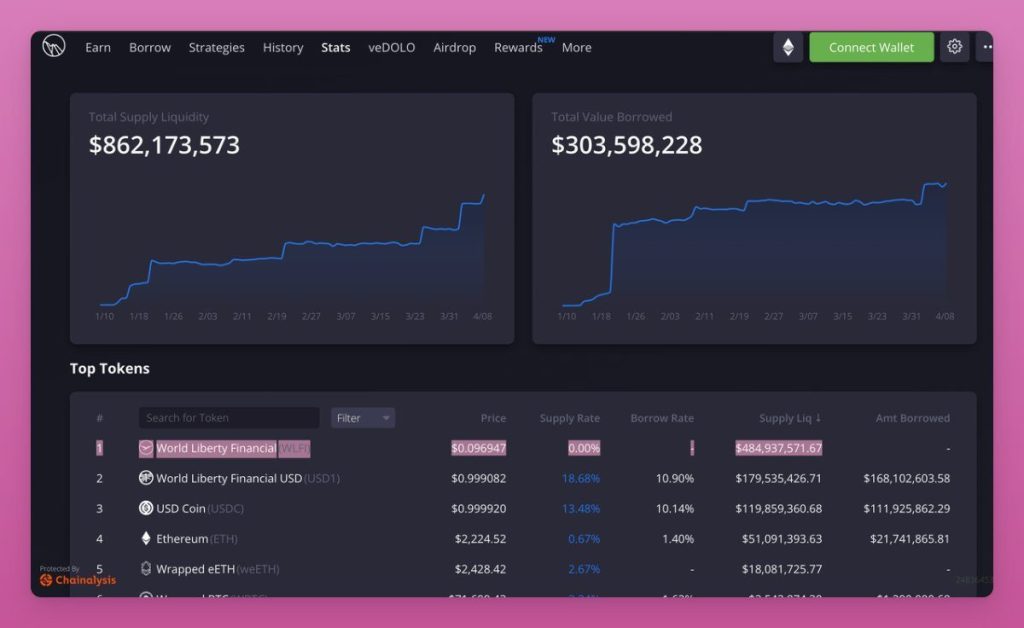
- The deposit: Around $484 million in $WLFI tokens were deposited into the Dolomite protocol as collateral.
- The mechanism: This collateral is used to borrow USDC – mining stable real value against a token with minimal on-chain liquidity.
- The risk of bad debt: If the price of $WLFI falls sharply, the value of the collateral falls below the outstanding USDC debt, leaving Dolomite lenders with unredeemable DeFi bad debts.
- The yield trap: The APY of USDC loans on Dolomite has climbed to 13.5%, which is attractive on the surface, but potentially unrecoverable if a bank run is triggered following confirmation of bad debts.
- The political trigger: Analysts associate the likely window of $WLFI dumping with the token’s diminishing political utility post-cycle – a timeline directly linked to incentives to exit the Trump orbit.
- What to watch: DOLO’s $15 million market capitalization makes it extremely vulnerable to fears of protocol insolvency; any public confirmation of a bad debt could cause the token to explode within hours.
Explore: Best Pre-Launch Token Sales with Asymmetric Upside Potential
How the $484 million Trump WLFI crypto leverage game actually works – and where it breaks down
The structure is direct and that is what makes it dangerous. World Liberty Financial-related entities deposited $484 million worth of WLFI into the Dolomite protocol, using these tokens as collateral to borrow USDC.
On paper, this looks like a standard DeFi leverage position. In practice, it’s a liquidity time bomb.
WLFI is a governance token. It has politically generated demand and almost no organic secondary market depth.
This means that the $484 million figure is a valuation on paper, not $484 million that can actually be liquidated on the open market without dropping the token’s price by 60%, 70% or more in a single session.
The guarantee is not real in any significant liquidation scenario.
When the value of the collateral falls below the outstanding USDC borrowing, and with WLFI’s liquidity profile the threshold is not far away, Dolomite’s liquidation engine cannot recover the debt.
No buyer exists at the price necessary to restore the integrity of the lenders. This is the DeFi bad debt scenario: USDC is gone, the collateral is worthless on a large scale, and the protocol remains insolvent in all but name.
Ignas’ alert on
This rise in rates does not constitute a return opportunity. It’s a distress signal. Similar warning patterns preceded Stabble Protocol’s 62% TVL collapse on Solana, where liquidity pressure built silently ahead of the exit.
The calculations on DOLO exposure are brutal on this scale. A $15 million market cap token absorbing a protocol-wide insolvency event involving nine figures of bad debt does not survive the news cycle intact.
What DOLO Lenders Really Face: Bad Debt Exposure Quantified
DOLO has a market capitalization of approximately $15 million. This number is important because it tells you exactly how much bad news the token can absorb before the math becomes insurmountable.
Dolomite does not appear to have sufficient protocol-level insurance funds to cover a nine-figure bad debt event. There is no safety net that absorbs $484 million in underwater collateral.
IYKYK.
New USDC Incentives @worldlibertyfi are now live on Dolomite.$USDC
→ 14.02% APY
→ 6.52% WLFI
→ 0.59% ODOLO pic.twitter.com/mfgtv5mhu7— Dolomite
(@Dolomite_io) April 7, 2026
 (@Dolomite_io)
 The 13.5% USDC APY that Dolomite is currently promoting to new depositors is the yield trap that Ignas explicitly warned against.
Depositors seeking this rate find themselves in a pool that may not be redeemable at par if the borrowing position unwinds poorly. This is the same dynamic that burned depositors in DeFi platform controversies, where advertised returns masked the structural risk of insolvency.
If a bad debt is confirmed on-chain – whether through a WLFI price collapse or a forced liquidation – DOLO’s reaction will be immediate. A $15 million cap token doesn’t need institutional selling pressure to grow. Retailer panic alone is enough at this size.
Check out: the best crypto presales live right now
After Lending Pool Heist: Are Trump Crypto Insiders Preparing to Crash DOLO Crypto? appeared first on Cryptonews.


